
How to calculate VO₂ and VCO₂ from breathing data
VO₂ describes oxygen used by the body, while VCO₂ describes carbon dioxide produced. This guide explains the measurements, equations and checks needed to calculate both values.
What VO₂ and VCO₂ mean
VO₂ is the volume of oxygen taken up by the body over time. VCO₂ is the volume of carbon dioxide released over the same period. They are usually reported in litres per minute or millilitres per minute.
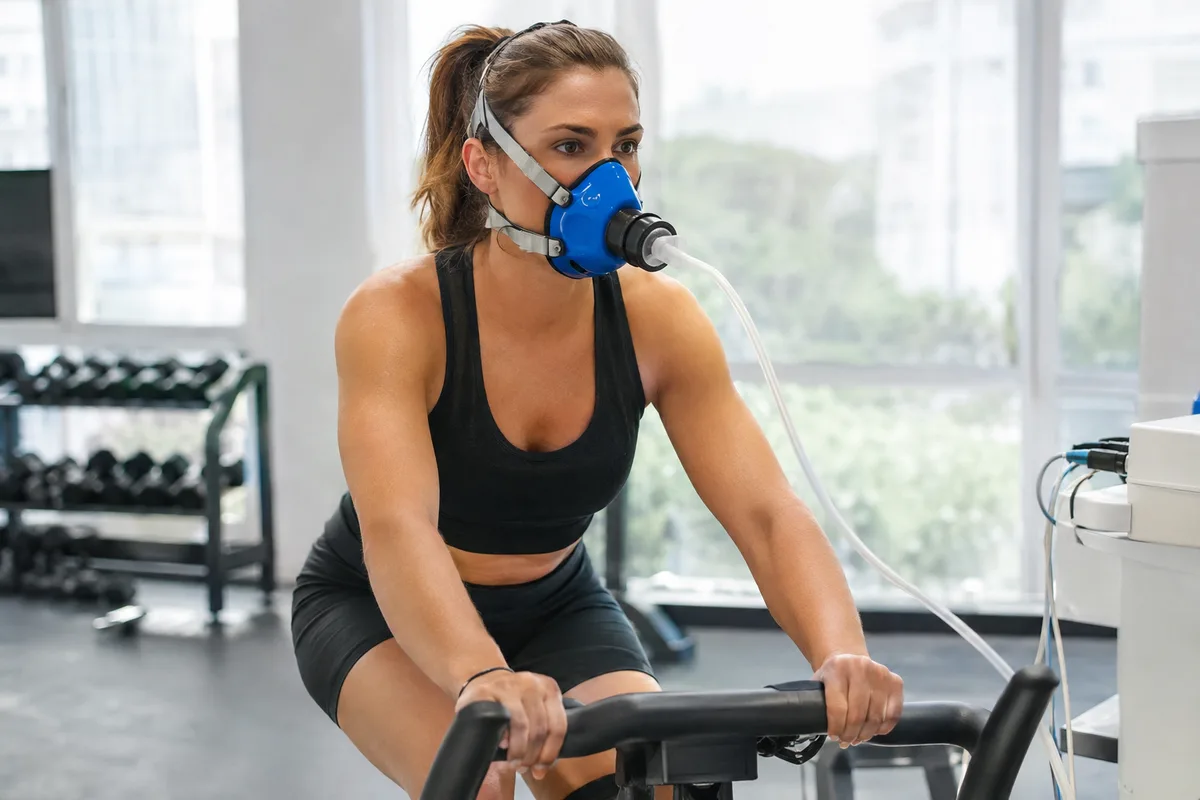
These values cannot be calculated accurately from a food log alone. They are normally obtained by measuring the amount of air breathed and the proportions of oxygen and carbon dioxide in that air. This approach is called indirect calorimetry because energy use is inferred from gas exchange.
- VO₂: oxygen used per minute
- VCO₂: carbon dioxide produced per minute
- VI: volume of inspired air per minute
- VE: volume of expired air per minute
- F: the fraction of a particular gas in the air
Measurements needed for the calculation
The calculation needs inspired and expired airflow, plus the oxygen and carbon dioxide fractions in each. A gas fraction is written as a decimal, so a reading expressed as a percentage must be divided by 100 before it enters an equation. All airflow values must cover the same length of time.
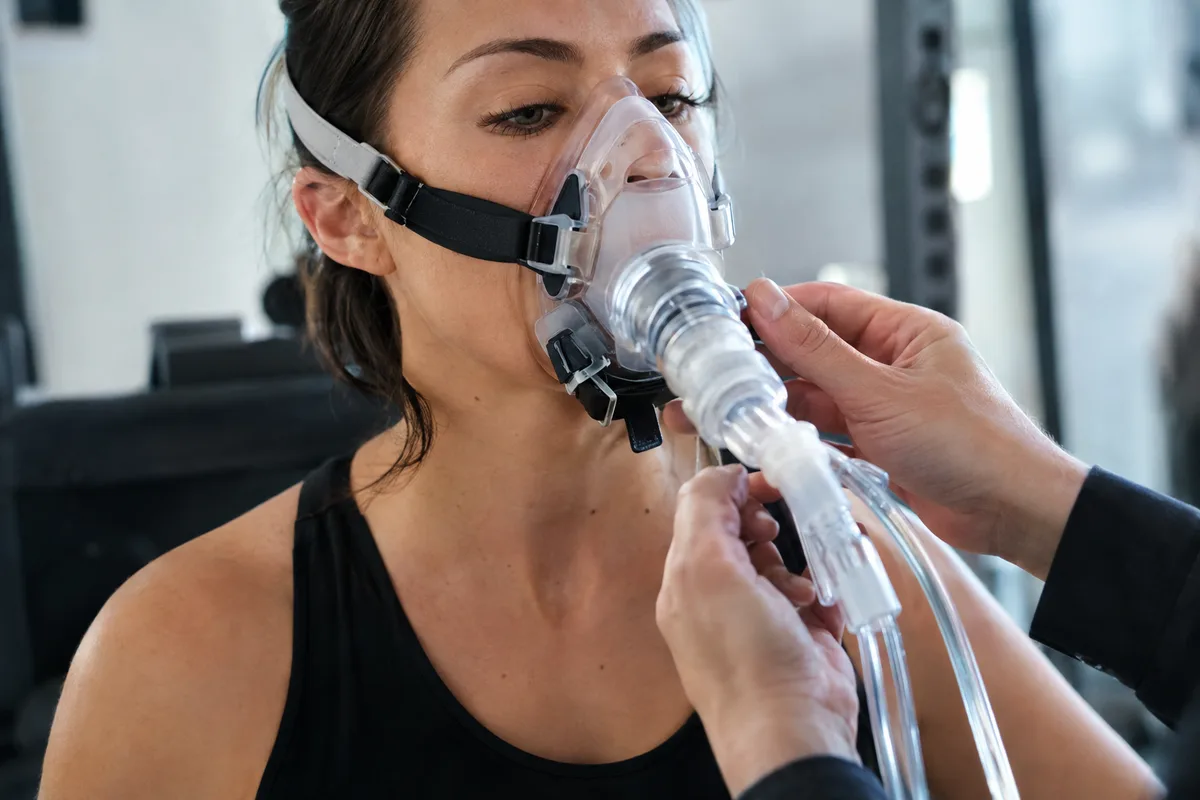
Gas volume changes with temperature, pressure and water vapour. The inspired and expired volumes therefore need to be expressed under the same reference conditions before they are compared. In practice, properly configured measurement systems usually make these corrections as part of their processing.
- VI and VE in litres per minute
- Inspired oxygen fraction, written as FIO₂
- Expired oxygen fraction, written as FEO₂
- Inspired carbon dioxide fraction, written as FICO₂
- Expired carbon dioxide fraction, written as FECO₂
Calculating inspired airflow
Many open-circuit systems measure expired airflow directly but do not measure inspired airflow in the same way. Inspired volume can then be estimated by assuming that nitrogen entering and leaving the body is unchanged. This is known as the Haldane transformation.
First calculate the nitrogen fraction by subtracting the oxygen and carbon dioxide fractions from 1. Inspired volume is then calculated as VI = VE × (1 − FEO₂ − FECO₂) ÷ (1 − FIO₂ − FICO₂). Keep every gas fraction as a decimal and do not round during the intermediate steps.
- Find expired nitrogen fraction: 1 − FEO₂ − FECO₂
- Find inspired nitrogen fraction: 1 − FIO₂ − FICO₂
- Divide the expired fraction by the inspired fraction
- Multiply the result by VE to obtain VI
Calculating VO₂ and VCO₂
Once VI and VE are available under matching conditions, oxygen uptake can be calculated as VO₂ = (VI × FIO₂) − (VE × FEO₂). Carbon dioxide production can be calculated as VCO₂ = (VE × FECO₂) − (VI × FICO₂). If airflow is entered in litres per minute, both answers will also be in litres per minute.
The inspired carbon dioxide term is sometimes very small, but it should not be removed unless the calculation method specifically treats it as negligible. Retaining the measured value keeps the equation consistent. Use unrounded gas fractions throughout and round only the final result to a sensible number of decimal places.
- Calculate VI if it was not measured directly
- Multiply each airflow value by its matching gas fraction
- Subtract expired oxygen from inspired oxygen to find VO₂
- Subtract inspired carbon dioxide from expired carbon dioxide to find VCO₂
- Check that both answers use the same unit and time period
Converting and comparing the results
A value in litres per minute can be converted to millilitres per minute by multiplying it by 1,000. To express VO₂ relative to body mass, multiply litres per minute by 1,000 and divide by body mass in kilograms. The result is written as millilitres per kilogram per minute.
Relative values can help compare measurements taken at different body sizes, but the calculation does not explain every difference between results. Movement intensity, breathing pattern, recent food intake and whether the reading was stable can all affect the number. Compare readings only when the measurement conditions are reasonably similar.
- L/min to ml/min: multiply by 1,000
- Relative VO₂: VO₂ in L/min × 1,000 ÷ body mass in kg
- Record whether the reading was taken at rest or during movement
- Use the same unit whenever you compare sessions
Using VCO₂ alongside food tracking
Dividing VCO₂ by VO₂ gives the respiratory exchange ratio, often shortened to RER. This ratio reflects the mixture of carbohydrate and fat being used at that moment, but it is not a direct reading of the food most recently eaten. Hard effort, changing intensity and an unsettled breathing pattern can make a short reading harder to interpret.
Food tracking records energy and nutrients consumed, whereas VO₂ and VCO₂ describe gas exchange during the measurement period. Protein and carbohydrate provide about 4 kcal per gram, while fat provides about 9 kcal per gram, but those textbook factors cannot be used to reconstruct a precise gas-exchange result. Treat the breathing calculation and the food log as related sources of context rather than interchangeable measurements.
- Calculate RER as VCO₂ ÷ VO₂
- Use values taken over the same time period
- Look for a stable measurement rather than a single unusual breath
- Note recent eating and movement when reviewing the result