
Homemade baguette
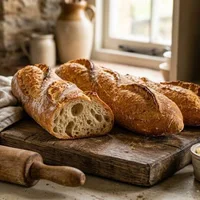
Homemade baguettes have a crisp, golden crust and a soft, airy crumb. Make them with a simple yeast dough for warm bread that is especially good straight from the oven.
Ingredients
- 500 g, plus extra for dustingall-purpose flour
- 7 g (1 packet)dry yeast
- 320 mllukewarm water
- 10 gsalt
- 5 ml (1 tsp)sugar
Instructions
- 1
Activate the yeast
Dissolve the yeast in the lukewarm water and leave it for 5 minutes, until it begins to foam slightly.
- 2
Mix and knead
Combine the flour and salt in a large bowl, then make a well in the middle and pour in the yeast mixture. Knead for about 10 minutes, until the dough is smooth and elastic.
- 3
Let the dough rise
Cover the bowl with a clean tea towel and leave the dough in a warm place for 1 hour, until it has doubled in volume.
- 4
Shape the dough
Lightly dust your work surface with flour. Divide the dough into 3 equal pieces and flatten each one with your hands.
- 5
Roll the baguettes
Use a rolling pin to shape each piece into a rectangle about 20 x 30 cm. Roll each rectangle tightly into a long log and press the seam closed.
- 6
Proof the loaves
Set the baguettes seam-side down on a baking sheet lined with parchment paper. Cover them and leave to proof for another 30 minutes.
- 7
Heat the oven
Preheat the oven to 220°C. Put a baking dish with a splash of water at the bottom of the oven to create steam and help the crust crisp.
- 8
Score and brush
With a sharp knife, cut diagonal slashes across the top of each baguette. Brush them lightly with water and put them in the oven.
- 9
Bake and cool
Bake for 20 to 25 minutes, until golden brown and hollow-sounding when tapped. Cool briefly on a rack and serve warm.
What is a baguette?
A baguette is a long French loaf known for its crisp crust and light interior. This homemade version uses a straightforward yeast dough and relies on shaping and steam to build its characteristic finish.
The loaves are divided into three before shaping, making them a practical size to bake and serve.
Nutrition and macros by portion
The nutrition label shows one serving as written: 620 calories, 17g protein, 123g carbs, 2g fat.
| Portion | Adjustment | kcal | Protein | Carbs | Fat |
|---|---|---|---|---|---|
| Lighter | Smaller bread portion | 434 kcal | 12g | 86g | 1g |
| This serving | As written | 620 kcal | 17g | 123g | 2g |
| Hungry | Larger bread portion | 930 kcal | 26g | 185g | 3g |
Most of the energy and carbohydrates come from the flour, while the flour also supplies most of the protein. The small amount of fat comes mainly from the flour, and the salt contributes most of the sodium. Pair a portion with a protein-rich topping and vegetables or soup for a more rounded plate.
The dough and its ingredients
Flour and water: all-purpose flour gives the dough its structure, while the measured water makes it workable enough to knead and shape.
Yeast and salt: the yeast leavens the dough, and the salt seasons it. The small amount of sugar is included with the yeast water.
Kneading and rising
Knead: work the dough for about 10 minutes until it feels smooth and elastic. This gives it strength to hold its shape as it rises.
First rise: leave it covered in a warm place for 1 hour, checking for the stated cue of doubled volume rather than relying only on the clock.
Rolling and shaping
Rectangles: roll each portion to about 20 x 30 cm so the dough can be formed into an even log.
Seam: roll tightly and press the join closed. Put each loaf seam-side down on the tray to help keep it together during proofing.
Steam, scoring and crust
Steam: the baking dish of water adds moisture to the oven, which helps the crust develop as the baguettes bake.
Slashes: diagonal cuts across the top give the loaves room to expand. Use a sharp knife and make the cuts just before baking.
How to tell they are baked
Look for a golden-brown crust after 20 to 25 minutes, then tap a loaf and listen for a hollow sound. If it does not sound hollow yet, continue baking and check again.
Cool the baguettes briefly on a rack before serving so their crust and interior can settle.
Serving ideas
Serve the baguettes warm with soup, salad or a savoury meal, or slice them to share with butter and cheese.
If serving later, let them cool on the rack first rather than covering them while warm, which can soften the crust.
Recipe notes & tips
- Use lukewarm rather than hot water when mixing the yeast.
- Knead until the dough is smooth and elastic before its first rise.
- Dust the work surface lightly so the dough does not pick up too much extra flour.
- Press the seam firmly closed and place it underneath on the tray.
- Make the diagonal cuts with a sharp knife just before baking.
- Listen for a hollow sound when tapping a loaf to check that it is baked.
Variations
- Wholemeal blend: replace some of the all-purpose flour with wholemeal flour, allowing for a denser crumb.
- Herb dough: knead dried herbs into the dough for a savoury aroma.
- Sesame topping: sprinkle sesame seeds over the lightly brushed loaves before baking.
- Garlic serving: serve warm slices with garlic butter or a garlic-rich dip.
- Cheese pairing: add sliced baguette to a cheese board once the loaves have cooled.
Common mistakes to avoid
- Hot water: it can hinder the yeast; use lukewarm water instead.
- Under-kneading: the dough may lack elasticity; continue until it is smooth and elastic.
- Skipping the full rise: shaping too early can leave the loaves dense; wait until the dough has doubled.
- Loose seams: the logs can open as they proof; pinch each seam closed and place it underneath.
- No steam: the crust may not develop as intended; put the baking dish with a splash of water in the oven.
- Removing them too soon: pale loaves may need longer; bake until golden brown and hollow-sounding.
How to store
Once completely cool, store the baguettes in a paper bag or bread bin and eat within 1 to 2 days for the best texture. Refresh briefly in a hot oven before serving; freezing is also an option for longer storage.
Frequently asked questions
How do I know the dough has risen enough?
After the first rise, it should have doubled in volume. Keep it covered in a warm place and use the volume cue as well as the 1-hour guide.
Can I make the dough ahead?
The method is written for a same-day rise and proof. For best results, follow the stated timings and bake after the second proof.
Why put water in the oven?
The water creates steam, which helps the baguettes form a crisp crust during baking.
Do I have to score the loaves?
Scoring is part of this method and gives the loaves a place to expand as they bake. Use a sharp knife to make diagonal slashes.
How can I tell when a baguette is done?
The crust should be golden brown and the loaf should sound hollow when tapped. The recipe gives a baking time of 20 to 25 minutes.
Can I freeze homemade baguette?
Yes. Cool it completely, wrap it well and freeze it. Thaw before serving, then briefly warm it in the oven to refresh the crust.
Cook it from the original
This recipe comes from cookinglife.eu. Their page has the author’s own photos, notes and tips — the best place to cook it from.
Open the recipe on cookinglife.eu