
Christmas turkey with herb butter and roasted vegetables
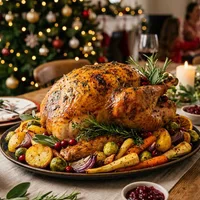
This Dutch-style Christmas turkey is rubbed with lemon, garlic and herbs, then roasted over winter vegetables that soak up the cooking juices. It makes a generous centrepiece for a festive meal, with pan juices turned into a simple gravy.
Ingredients
- 1, about 4–5 kgturkey, at room temperature
- 150 gsoftened butter
- 4 sprigsfresh thyme
- 4 sprigsfresh rosemary
- 6 leavesfresh sage, finely chopped
- 4 clovesgarlic, pressed (for the butter)
- Zest of 1lemon
- 1lemon, halved (for the cavity)
- 1 headgarlic, halved (for the cavity)
- To tastesalt and freshly ground black pepper
- 3carrots, roughly chopped
- 3parsnips, roughly chopped
- 2red onions, quartered
- 3 stalkscelery, cut into pieces
- 300 mlchicken stock
- A splashdry white wine or sherry (for the gravy)
Instructions
- 1
Prepare the turkey
Take the turkey out of the fridge 2 hours before cooking. Pat it dry inside and out with kitchen paper.
- 2
Mix herb butter
Stir the softened butter with finely chopped thyme and rosemary, sage, pressed garlic, lemon zest, salt and pepper until smooth.
- 3
Butter the turkey
Gently ease your hand between the breast skin and meat. Spread half the herb butter beneath the skin, then brush the remaining butter over the outside.
- 4
Fill the cavity
Loosely place the halved lemon, halved garlic head and a few sprigs of thyme and rosemary inside the turkey.
- 5
Prepare the roasting pan
Heat the oven to 180°C. Spread the carrots, parsnips, onion and celery in large pieces across the base of a roasting pan, then pour in the chicken stock.
- 6
Start roasting
Set the turkey breast-side up on the vegetables. Cover the pan with aluminium foil and place it in the oven.
- 7
Roast covered
Roast at 180°C for about 2.5 hours, allowing about 40 minutes per kilogram. Baste the turkey with the pan juices every 45 minutes.
- 8
Brown the skin
After 2.5 hours, remove the foil and raise the oven temperature to 220°C. Roast uncovered for another 30 minutes, until the skin is crisp and golden brown.
- 9
Check doneness
Use a meat thermometer to check the thickest part of the thigh without touching bone. It should reach at least 75°C.
- 10
Rest the turkey
Transfer the turkey to a chopping board, loosely cover it with aluminium foil and leave it to rest for at least 30 minutes.
- 11
Make the gravy
Strain the roasting juices into a saucepan and reduce them briefly. Season with salt and pepper, then add a splash of dry white wine or sherry.
- 12
Carve and serve
Carve the turkey in the kitchen or at the table. Serve it with the roasted vegetables and gravy.
What is Dutch Christmas turkey?
This festive roast pairs a whole turkey with the familiar winter vegetables of carrots, parsnips, onions and celery. The recipe is presented as a Dutch Christmas-style centrepiece, bringing the bird, vegetables and gravy together in one roasting pan.
Herb butter under the skin seasons the breast meat directly, while lemon and garlic scent the cavity. The vegetables sit beneath the turkey, catching its juices as they cook.
Nutrition and macros by portion
The nutrition label shows one serving as written: 760 calories, 78g protein, 29g carbs, 39g fat.
| Portion | Adjustment | kcal | Protein | Carbs | Fat |
|---|---|---|---|---|---|
| Lighter | Less butter, more vegetables | 532 kcal | 55g | 20g | 27g |
| This serving | As written | 760 kcal | 78g | 29g | 39g |
| Hungry | Larger turkey portion | 1140 kcal | 117g | 44g | 59g |
The turkey supplies most of the protein, while the butter contributes much of the fat and saturated fat. The vegetables provide most of the carbohydrates and fibre, with the stock and gravy adding to the sodium. For a balanced plate, serve a moderate portion of turkey with plenty of vegetables and a side such as potatoes.
Why butter under the skin matters
Under the skin: Carefully separate it from the breast without tearing it, then spread half the butter over the meat. This puts the herb mixture in direct contact with the turkey.
On the outside: Brush on the remaining butter for a seasoned, browned surface. Letting the butter soften first makes it easier to mix and spread.
Set up the roasting bed
Vegetables: Cut the carrots, parsnips, onions and celery into large pieces so they form a sturdy base beneath the bird. Add the stock to the pan before placing the turkey on top.
Cavity: Keep the lemon, garlic and herb sprigs loose rather than packing them in. This leaves room for heat to circulate inside the bird.
Manage the long roast
Covered stage: The foil stays on for about 2.5 hours at 180°C, with basting every 45 minutes. The recipe also gives a guide of about 40 minutes per kilogram, so use the thermometer rather than relying on the clock alone.
Uncovered stage: Remove the foil after 2.5 hours and raise the oven to 220°C for another 30 minutes. This final hotter spell is intended to crisp and colour the skin.
Know when it is cooked
Temperature: Check the thickest part of the thigh with a meat thermometer, avoiding the bone. The stated target is at least 75°C.
Resting: Leave the cooked turkey loosely covered for at least 30 minutes before carving. This gives the juices time to settle and makes the bird easier to carve neatly.
Turn the pan juices into gravy
Strain: Pour the roasting juices through a sieve into a saucepan, keeping the cooked vegetables for serving. Reduce the liquid briefly, then season with salt, pepper and a splash of wine or sherry.
Serve: Bring the gravy to the table with the carved turkey and vegetables. Potatoes, sprouts or other Christmas sides can round out the meal.
Recipe notes & tips
- Bring the turkey to room temperature for the stated 2 hours before roasting.
- Pat the cavity dry as well as the outside so the herb butter is not diluted by surface moisture.
- Set the roasting pan on a stable shelf before adding the turkey, as the filled pan will be heavy.
- Baste every 45 minutes during the covered roasting stage, as directed.
- Use a thermometer to check the thigh and keep its probe clear of the bone.
- Rest the turkey for at least 30 minutes before carving so it is easier to handle.
Variations
- Add orange: Use orange zest in place of the lemon zest for a different citrus note.
- Change the herbs: Swap some of the thyme or rosemary for extra sage in the butter.
- Use cider: Replace the splash of wine or sherry in the gravy with a splash of dry cider.
- Add potatoes: Roast potatoes separately and serve them alongside the turkey and vegetables.
- Include Brussels sprouts: Serve roasted or steamed sprouts as an additional festive vegetable.
Common mistakes to avoid
- Tearing the skin: Ease your hand under it slowly and stop if it begins to split.
- Packing the cavity tightly: Keep the lemon, garlic and herbs loose so heat can circulate.
- Skipping the thermometer: Check the thickest part of the thigh and make sure it reaches at least 75°C.
- Removing the foil too soon: Keep the turkey covered for about 2.5 hours before the final uncovered roast.
- Carving straight away: Rest the bird under loose foil for at least 30 minutes first.
How to store
Refrigerate leftover turkey and vegetables in covered containers within 2 hours of serving and use within 3 days. Reheat until piping hot throughout; warm the gravy separately and add a little stock if it has thickened.
Frequently asked questions
How long should I cook a 4–5 kg turkey?
The method allows about 40 minutes per kilogram, with about 2.5 hours covered at 180°C followed by 30 minutes uncovered at 220°C. Treat these as guides and confirm that the thickest part of the thigh reaches at least 75°C.
Can I prepare the herb butter in advance?
Yes. Mix it ahead and keep it covered in the fridge, then soften it enough to spread before using. The turkey itself should still be taken out of the fridge 2 hours before cooking as specified.
Do I need to baste the turkey?
The method calls for basting every 45 minutes while the turkey is covered. Use the pan juices and keep the oven door open only briefly.
Why does the turkey need to rest?
Resting for at least 30 minutes gives the juices time to redistribute and makes carving more manageable. Keep it loosely covered with foil while it rests.
Can I make the gravy without wine or sherry?
Yes. Reduce the strained roasting juices and season them with salt and pepper, leaving out the wine or sherry. Add a little chicken stock if you want more gravy.
Can I roast the vegetables for longer?
They cook beneath the turkey for the full roasting time, so their final softness depends on the size of the pieces. Cut them into large pieces as directed to help them hold their shape.
Cook it from the original
This recipe comes from cookinglife.eu. Their page has the author’s own photos, notes and tips — the best place to cook it from.
Open the recipe on cookinglife.eu