
Buttermilk Donuts
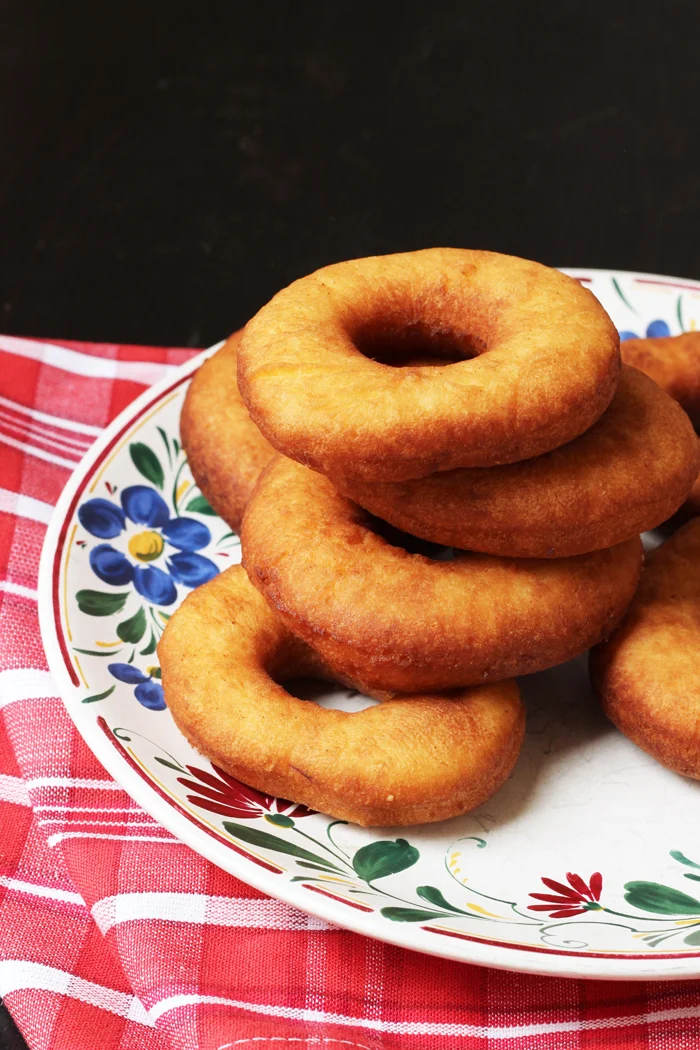
These American buttermilk doughnuts are tender, lightly tangy and fried until golden. They’re a family-style bake that’s ready in about 35 minutes and can be frozen for later.
Ingredients
- 2eggs
- 200 g (1 cup)granulated sugar
- 1 tspvanilla extract
- 60 ml (¼ cup)neutral oil
- 240 ml (1 cup)buttermilk
- 500 g (4 cups)unbleached plain flour
- 4 tspbaking powder
- ¼ tspbicarbonate of soda
- ¾ tspsalt
- to tasteoil for frying, such as peanut or avocado oil
Instructions
- 1
Mix the dough
In a large mixing bowl, combine the eggs, sugar, vanilla, neutral oil, buttermilk, flour, baking powder, bicarbonate of soda and salt. The dough will be quite sticky.
- 2
Cut the doughnuts
Roll the dough out on a floured board, then cut it into rounds with a doughnut cutter.
- 3
Fry until golden
Pour oil into a pot to a depth of at least 5 cm (2 inches) and heat it. Fry the doughnuts, turning them once, until golden brown and cooked through. Drain them on a rack set over paper towels.
- 4
Freeze for later
Once cooled, pack the doughnuts in an airtight container and freeze for up to 6 weeks.
What are buttermilk doughnuts?
These are American-style fried doughnuts made from a leavened dough rather than a yeast-raised one. Buttermilk gives the dough a gentle tang, while baking powder and bicarbonate of soda help it rise as it cooks.
This family-style version keeps the ingredients straightforward and the method quick: mix, roll, cut and fry. The dough is intentionally sticky, so handle it on a floured board.
Nutrition and macros by portion
The nutrition label shows one serving as written: 168 calories, 4g protein, 29g carbs, 4g fat.
| Portion | Adjustment | kcal | Protein | Carbs | Fat |
|---|---|---|---|---|---|
| Lighter | Smaller doughnut portion | 118 kcal | 3g | 20g | 3g |
| This serving | As written | 168 kcal | 4g | 29g | 4g |
| Hungry | Larger doughnut portion | 252 kcal | 6g | 44g | 6g |
The flour and sugar provide most of the carbohydrates, while the eggs and buttermilk contribute protein. The dough and frying oil supply fat; serve a doughnut with fruit or plain yoghurt to add a fresh, protein-containing side.
The ingredients that matter
Buttermilk: Its acidity pairs with the bicarbonate of soda, and its richness helps give the dough a tender crumb.
Raising agents: Baking powder and bicarbonate of soda provide lift without a proving stage. Measure them carefully for an even result.
Frying oil: Choose a neutral oil suited to frying, such as peanut or avocado oil, so its flavour does not dominate the doughnuts.
Handling sticky dough
Floured board: The dough is described as quite sticky, so dust the board before rolling it out. Use enough flour to prevent sticking, while avoiding working extra flour into the dough.
Doughnut cutter: Cut the rounds cleanly and transfer them carefully to the hot oil, keeping their shape as much as possible.
Frying and doneness
Oil depth: The method calls for at least 5 cm (2 inches) of oil in the pot. Take care not to fill the pot too high, as the oil level rises when the doughnuts are added.
Colour and centre: Fry each doughnut, turning it once, until golden brown and cooked through. Drain on a rack over paper towels to catch excess oil.
Timing the batch
The stated total time is 35 minutes, so have the doughnut cutter, draining rack and paper towels ready before you begin frying. Work in batches that leave the doughnuts room in the pot.
The recipe gives no exact frying time or oil temperature; use the stated colour and cooked-through texture as your cues.
Serving ideas
Serve the doughnuts once they have cooled enough to handle, or enjoy them still slightly warm. They work well as a breakfast treat or a simple snack.
For a more balanced plate, pair one with fruit and plain yoghurt. The doughnuts can also be frozen for a future serving.
Recipe notes & tips
- Measure the flour and raising agents carefully for a consistent dough.
- Flour the board before rolling, since the dough is quite sticky.
- Use a pot deep enough to hold at least 5 cm (2 inches) of oil.
- Turn each doughnut once and look for an even golden-brown colour.
- Drain the fried doughnuts on a rack set over paper towels.
- Cool completely before packing doughnuts for the freezer.
Variations
- Add a coating: Toss cooled doughnuts in granulated sugar.
- Add cinnamon: Mix ground cinnamon into a sugar coating.
- Glaze them: Dip cooled doughnuts in a simple icing glaze.
- Change the oil: Use a neutral frying oil you already have, provided it is suitable for frying.
Common mistakes to avoid
- Skipping the flour on the board: The sticky dough may cling; dust the surface before rolling.
- Adding too much extra flour: The dough can become tougher; use only enough to prevent sticking.
- Crowding the pot: Doughnuts may not fry evenly; leave room around them and cook in batches.
- Overfilling the pot: Hot oil can spill when doughnuts are added; keep the oil level safely below the rim.
- Packing them warm: Steam can collect in the container; cool the doughnuts fully before storing.
How to store
After cooling, pack the doughnuts in an airtight container and freeze for up to 6 weeks. The recipe does not specify refrigerator storage or reheating instructions.
Frequently asked questions
Why is the dough so sticky?
The method describes it as quite sticky. Roll it on a floured board and use just enough flour to stop it clinging.
How deep should the frying oil be?
The method calls for at least 5 cm (2 inches) of oil. Use a suitably deep pot and avoid filling it close to the rim.
How can I tell when the doughnuts are done?
Fry them until golden brown and cooked through, turning each one once. The recipe does not give a specific frying time.
Can I freeze these doughnuts?
Yes. Cool them completely, pack them in an airtight container and freeze for up to 6 weeks.
Can I use a different frying oil?
The recipe suggests peanut or avocado oil. Choose a neutral oil suitable for frying.
Cook it from the original
This recipe comes from goodcheapeats.com. Their page has the author’s own photos, notes and tips — the best place to cook it from.
Open the recipe on goodcheapeats.com