
Irish Soda Bread
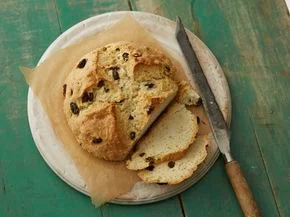
Irish soda bread is a quick, lightly sweetened loaf leavened with bicarbonate of soda and baking powder rather than yeast. It is straightforward to make and is ready to serve warm in under an hour.
Ingredients
- 3 tablespoons (43 g)butter or margarine, softened
- 2 1/2 cups (about 315 g)plain flour
- 2 tablespoons (25 g)sugar
- 1 teaspoon (about 5 g)bicarbonate of soda
- 1 teaspoon (about 4 g)baking powder
- 1/2 teaspoon (about 3 g)salt
- 1/3 cup (about 50 g), if desiredraisins
- 3/4 cup (180 ml)buttermilk
- To taste, if desiredsoftened butter or margarine, for brushing
Instructions
- 1
Heat the oven
Heat the oven to 190°C (375°F) and grease a baking sheet.
- 2
Make the dough
In a large bowl, cut the softened butter into the flour, sugar, bicarbonate of soda, baking powder and salt using a pastry blender or two knives, until the mixture resembles fine crumbs. Stir in the raisins, if using, then add just enough buttermilk for the dough to pull away from the sides of the bowl.
- 3
Shape the loaf
Turn the dough onto a lightly floured surface and knead for 1 to 2 minutes, or until smooth. Shape it into a round loaf about 6 1/2 inches (16.5 cm) in diameter and place it on the baking sheet. With a floured knife, cut an X about 1/2 inch (1.3 cm) deep into the top.
- 4
Bake until golden
Bake for 35 to 45 minutes, or until golden brown. Brush with softened butter or margarine if desired.
What is Irish soda bread?
Irish soda bread is a quick bread that uses bicarbonate of soda for lift instead of yeast. Soda breads became a practical choice where simple ingredients and a short preparation time mattered.
This version adds baking powder as well, with a little sugar and optional raisins for a gently sweet loaf. The cross cut into the top helps the loaf open as it bakes.
Nutrition and macros by portion
The nutrition label shows one serving as written: 110 calories, 3g protein, 19g carbs, 3g fat.
| Portion | Adjustment | kcal | Protein | Carbs | Fat |
|---|---|---|---|---|---|
| Lighter | Skip the brushing butter | 77 kcal | 2g | 13g | 2g |
| This serving | As written | 110 kcal | 3g | 19g | 3g |
| Hungry | Serve a larger slice | 165 kcal | 5g | 29g | 5g |
The flour and sugar provide most of the carbohydrates, while the butter or margarine contributes much of the fat. The flour and buttermilk supply some protein; serve a slice with eggs, cheese or soup for a more balanced plate.
Choosing the ingredients
Flour: Plain flour gives the loaf its structure. Cutting in the softened butter or margarine creates fine crumbs before the buttermilk is added.
Buttermilk: Add it gradually, stopping as soon as the dough comes away from the sides of the bowl. Raisins are optional, so leave them out for a plainer loaf.
Getting the dough right
Mixing: Work the butter into the dry ingredients until no large pieces remain and the mixture looks like fine crumbs. Stir in the buttermilk only until the dough gathers together.
Kneading: A brief knead of 1 to 2 minutes is enough to smooth the dough. Kneading for much longer can make the loaf tougher.
Shaping and scoring
Round loaf: Shape the dough to about 16.5 cm across so it bakes evenly. A lightly floured surface helps prevent sticking without adding too much extra flour.
Cross: Cut an X roughly 1.3 cm deep with a floured knife. This gives the top room to open as the loaf rises in the oven.
Checking for doneness
Colour: The loaf should be golden brown after 35 to 45 minutes. Begin checking towards the earlier end of the baking range, as ovens can vary.
Finish: If you like a softer, richer surface, brush the hot loaf with softened butter or margarine after baking.
Serving the bread
Warm slices work well with butter, jam or a savoury topping such as cheese. The raisins make the loaf especially suited to breakfast or an afternoon snack.
For a more substantial meal, serve it alongside soup or a salad. Let the loaf rest briefly after baking so it is easier to slice.
Recipe notes & tips
- Soften the butter before mixing so it cuts into the flour more easily.
- Measure the flour without packing it into the cup, or weigh the metric amount.
- Add the buttermilk in stages and stop once the dough leaves the bowl's sides.
- Flour the knife before cutting the X to reduce sticking.
- Use the earlier end of the baking time as a first check, then continue until golden.
Variations
- Raisin-free: Leave out the raisins for a less sweet loaf.
- Extra fruit: Add the listed raisins for little pockets of sweetness.
- Margarine option: Use softened margarine in place of butter.
- Savoury pairing: Serve the bread with cheese or alongside soup.
- Buttered finish: Brush the baked loaf with softened butter or margarine for a richer surface.
Common mistakes to avoid
- Too much buttermilk: The dough can become sticky; add it gradually and stop when the dough pulls from the bowl.
- Over-kneading: A long knead can toughen the loaf; stop once it is smooth after 1 to 2 minutes.
- Skipping the score: The loaf may not open as intended; cut the X about 1.3 cm deep.
- Unfloured knife: The blade can drag through the dough; dust it with flour before scoring.
- Underbaking: A pale loaf may need more time; bake until golden brown, checking within the 35-to-45-minute range.
How to store
Once cool, keep the loaf wrapped or in an airtight container at room temperature for up to 2 days. Rewarm slices briefly in the oven or toaster; freeze extra bread for longer storage.
Frequently asked questions
Can I leave out the raisins?
Yes. They are optional, and the loaf will still work without them.
How much buttermilk should I add?
Use up to 180 ml, adding it gradually. Stop when the dough leaves the sides of the bowl.
Why does the loaf need an X on top?
The recipe calls for the cut to help the loaf open as it bakes. Make it about 1.3 cm deep with a floured knife.
How do I know when it is baked?
The loaf should be golden brown after 35 to 45 minutes. If it is not golden at the earlier check, continue baking.
Can I use margarine instead of butter?
Yes. The recipe allows either butter or margarine in the dough and for the optional brushing.
Cook it from the original
This recipe comes from goldmedalflour.com. Their page has the author’s own photos, notes and tips — the best place to cook it from.
Open the recipe on goldmedalflour.com