
Stuffed Leg of Lamb
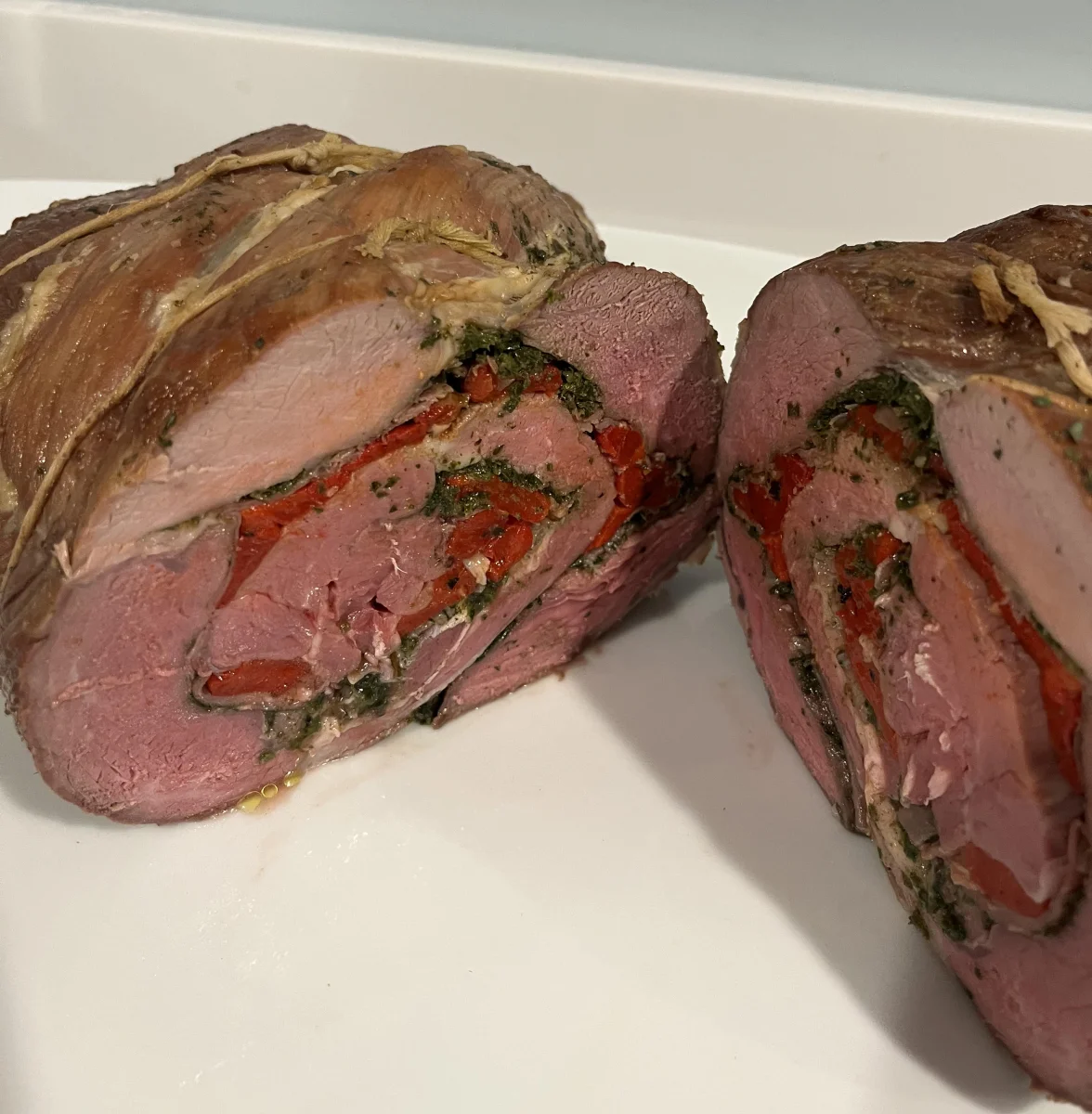
This stuffed leg of lamb is rolled around pesto, prosciutto and roasted red peppers, then roasted and sliced for serving. It makes a centrepiece that can be prepared for a crowd and carved into portions at the table.
Ingredients
- 2.3–2.7 kg (5–6 lb)boneless leg of lamb, trimmed and butterflied
- 225 g (½ lb)prosciutto
- 225 g (8 oz)pesto
- 225 g (8 oz)roasted red peppers
- To tastesalt and pepper
- 240 ml (1 cup)water or broth
- As neededbutcher’s twine
Instructions
- 1
Season the lamb
Season both sides of the butterflied lamb with salt and pepper.
- 2
Spread the pesto
With the inside of the lamb facing up, spread the pesto over the meat.
- 3
Add the prosciutto
Arrange the prosciutto in a layer over the pesto.
- 4
Add the peppers
Place the roasted red peppers over the prosciutto.
- 5
Roll the lamb
Gently roll the lamb into a cylinder, keeping the filling inside.
- 6
Tie crosswise
Tie the cylinder at intervals across its width with butcher’s twine, then snip off the ends.
- 7
Tie lengthwise
Run another piece of twine lengthwise along the cylinder, weaving it in and out of the crosswise ties.
- 8
Heat the oven
Preheat the oven to 220°C (425°F).
- 9
Set up the roasting pan
Place the lamb on a baking rack set in a large roasting pan. Add water or broth to the bottom of the pan to help prevent smoke from the drippings.
- 10
Roast the lamb
Roast for 60–70 minutes, or until the internal temperature reaches 54–57°C (130–135°F).
- 11
Rest the meat
Remove the lamb from the oven and loosely cover it with foil. Leave it to rest for 20 minutes.
- 12
Slice the lamb
Cut across the lamb on a slight diagonal into 1.3 cm (½-inch) slices.
- 13
Serve warm
Serve the lamb warm.
What is stuffed leg of lamb?
A butterflied leg of lamb is opened out, filled, rolled and tied before roasting. The approach is common to many roast preparations, while the filling here draws on Mediterranean flavours from pesto, cured ham and sweet roasted peppers.
The filling gives the meat a savoury, aromatic centre, and rolling it makes the roast easy to carve into attractive slices. Tying it helps the lamb keep its shape as it cooks.
Nutrition and macros by portion
The nutrition label shows one serving as written: 810 calories, 70g protein, 3g carbs, 59g fat.
| Portion | Adjustment | kcal | Protein | Carbs | Fat |
|---|---|---|---|---|---|
| Lighter | Smaller lamb portion | 567 kcal | 49g | 2g | 41g |
| This serving | As written | 810 kcal | 70g | 3g | 59g |
| Hungry | Larger lamb portion | 1215 kcal | 105g | 5g | 89g |
The lamb supplies most of the protein and much of the fat, while pesto and prosciutto add further fat and the prosciutto contributes salt. The peppers add relatively little carbohydrate; serve a slice with vegetables and a modest portion of potatoes or bread to balance the plate.
Why these ingredients work
Pesto: spreading it directly on the lamb gives the filling a herby, rich base. Leave a little space at the edges so it is less likely to squeeze out as you roll.
Prosciutto and peppers: the prosciutto adds a salty layer, while the peppers bring sweetness and colour. Pat very wet peppers dry so the filling is easier to roll.
Rolling and tying the roast
Rolling: keep the cylinder snug but do not force it tightly; an even shape helps it roast more uniformly. Keep the filling tucked inside as you roll.
Tying: crosswise ties hold the roll together, and the lengthwise tie helps secure those loops. Use enough ties to support the cylinder without cutting deeply into the meat.
Roasting and doneness
Rack and pan: the rack lets hot air circulate around the lamb, while the water or broth in the pan helps limit smoke from the drippings. Check that the pan has not dried out during roasting.
Temperature: the recipe calls for 54–57°C (130–135°F) internally after 60–70 minutes. Check the thickest part of the meat with a thermometer, avoiding the filling, and allow for the temperature to rise as it rests.
Resting and carving
Resting: leave the roast loosely covered for the full 20 minutes before slicing. This gives the meat time to settle and makes it easier to cut neat portions.
Carving: slice across the roll on a slight diagonal, aiming for roughly 1.3 cm (½-inch) pieces. Use a sharp knife and remove the twine as you carve.
What to serve alongside
Serve the lamb with potatoes, bread or another starchy side to make a substantial meal. A crisp green salad or simply cooked green vegetables add a fresh contrast to the rich filling.
If serving a sauce, spoon over some of the pan juices, tasting first because the prosciutto and pesto already bring salt.
Recipe notes & tips
- Pat the roasted peppers dry if they are especially moist, to keep the filling from becoming slippery.
- Keep the roll even in thickness so it cooks more consistently.
- Check the temperature in the thickest section of meat rather than in the filling.
- Add enough water or broth to cover the bottom of the roasting pan before it goes into the oven.
- Rest the lamb for 20 minutes before carving to help the roll hold together.
Variations
- Herb pesto: use a different pesto in the same quantity for a change in flavour.
- Pepper mix: combine different colours of roasted peppers while keeping the same total amount.
- Extra herbs: spread chopped fresh herbs over the lamb with the pesto.
- Garlic pesto: use a garlic-forward pesto for a more pronounced savoury note.
Common mistakes to avoid
- Loose rolling: the filling can fall out; roll the lamb snugly and secure it with twine.
- Wet peppers: excess moisture can make rolling difficult; drain and pat them dry first.
- Tight twine: string can cut into the meat; tie firmly enough to hold the shape without digging in.
- Skipping the thermometer: appearance alone can be misleading; check the thickest part of the lamb.
- Slicing too soon: the roll may lose more juices and fall apart; rest it for 20 minutes first.
How to store
Refrigerate leftover lamb in a covered container within 2 hours and use within 3–4 days. Reheat slices gently in a covered dish with a little water or broth until hot throughout.
Frequently asked questions
Can I prepare the lamb ahead?
You can fill, roll and tie it ahead of roasting. Keep it covered in the refrigerator and allow time to take the chill off while the oven heats.
How can I tell when the lamb is done?
Use a meat thermometer in the thickest part of the meat, away from the filling. The recipe gives a target of 54–57°C (130–135°F) and also specifies 60–70 minutes of roasting.
Do I need a baking rack?
The method uses a rack in the roasting pan so hot air can circulate around the lamb. Add water or broth to the pan beneath it to help prevent smoke from the drippings.
Why does the lamb need to rest?
Resting for 20 minutes helps the roast settle before carving. Cover it loosely with foil so it stays warm without trapping too much steam.
Can I use a different filling?
Yes, you can change the pesto or roasted peppers while keeping the roll-and-tie method. Keep the filling layer manageable so the lamb closes around it.
Cook it from the original
This recipe comes from appetitomagazine.com. Their page has the author’s own photos, notes and tips — the best place to cook it from.
Open the recipe on appetitomagazine.com