
Hake en papillote
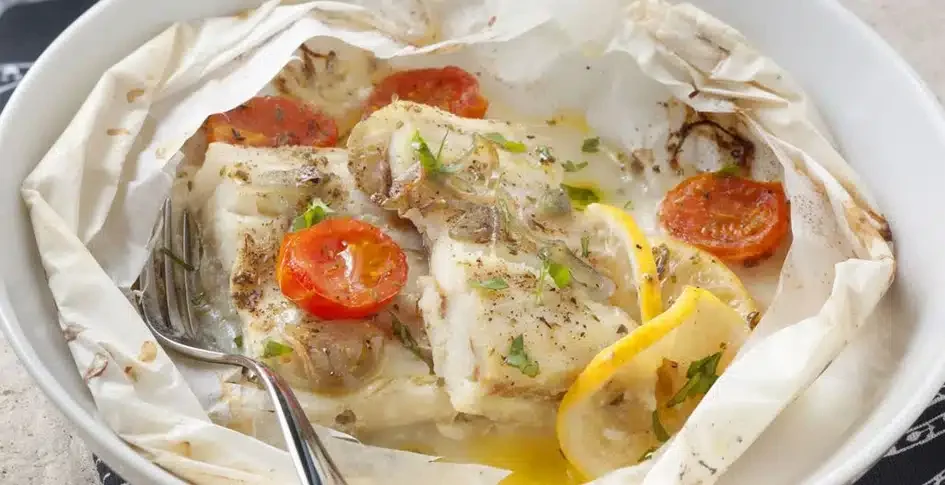
Hake en papillote is fish baked in individual foil parcels with tomatoes, onions, butter and parsley. The parcels are quick to assemble and keep the fish moist as the ingredients cook together.
Ingredients
- 4, about 150 g eachhake steaks
- to tastecurly parsley
- 60 gsalted cultured butter
- 3 mediumsweet onions
- 4ripe tomatoes, or plain canned tomato pulp if unavailable
- to tastefleur de sel
- to tasteblack pepper or Espelette pepper
Instructions
- 1
Heat the oven
Preheat the oven to 200 °C, using the fan setting if available.
- 2
Prepare the parcels
Cut 4 large squares of aluminium foil. Place 2 onion slices and 1 to 2 tomato slices in the centre of each square.
- 3
Season the fish
Season the hake steaks with fleur de sel and black pepper or Espelette pepper. Set one steak on the vegetables in each parcel.
- 4
Add the toppings
Put one onion slice and one tomato slice on each steak, followed by a knob of butter and a little parsley.
- 5
Seal the parcels
Close each parcel carefully, folding the foil over itself to make a triple layer.
- 6
Bake the fish
Place the parcels on the oven rack and bake for 9 minutes. For a conventional oven, cook for 4 minutes, turn the parcels over, then cook for 5 minutes more.
What is hake en papillote?
En papillote is a French method of cooking food in a sealed parcel, traditionally made with paper. This version uses foil and pairs hake with tomatoes, sweet onions, butter and parsley.
The parcel traps the ingredients’ moisture as they cook, so the fish is gently steamed in its own juices. The simple Breton-style seafood combination is quick to prepare and brings the vegetables and fish together in each serving.
Nutrition and macros by portion
The nutrition label shows one serving as written: 320 calories, 0g protein, 0g carbs, 0g fat.
| Portion | Adjustment | kcal | Protein | Carbs | Fat |
|---|---|---|---|---|---|
| Lighter | Use less butter | 224 kcal | 0g | 0g | 0g |
| This serving | As written | 320 kcal | 0g | 0g | 0g |
| Hungry | Add potatoes or rice | 480 kcal | 0g | 0g | 0g |
The hake provides most of the protein, while the tomatoes and onions contribute carbohydrates. Butter is the main source of fat; serve the fish with a generous portion of green vegetables and a measured portion of potatoes or rice for a more rounded plate.
Choosing the ingredients
Hake: Choose four steaks of roughly equal thickness so they cook at a similar rate. Handle them gently when placing them in the parcels, as the flesh can break apart.
Tomatoes and onions: Ripe tomatoes bring plenty of juice, while sweet onions soften alongside the fish. If ripe tomatoes are unavailable, the recipe allows plain canned tomato pulp instead.
Butter and herbs: Salted butter adds richness, and curly parsley gives the parcels a fresh herbal note. Add the butter in small knobs so it melts over the fish.
Building each parcel
Vegetable base: Arrange the onion and tomato slices in the centre of each foil square before adding the fish. This gives the hake a bed to rest on and helps keep it from sticking directly to the foil.
Tight folds: Fold the foil securely, making the specified triple layer. A well-sealed parcel holds in steam and juices during baking.
Seasoning the hake
Salt and pepper: Season the steaks before placing them on the vegetables, using fleur de sel and either black pepper or Espelette pepper. Espelette gives a gentle, fruity warmth; use whichever suits your preference.
Toppings: Add the extra onion and tomato slice, butter and parsley on top of each steak. Distribute them evenly so every parcel gets a similar share.
Getting the timing right
Oven setting: The recipe calls for a preheated oven at 200 °C, with the fan setting if available. Its stated baking time is 9 minutes.
Conventional oven: Without the fan setting, bake the parcels for 4 minutes, turn them over, then bake for another 5 minutes. Keep the parcels sealed while turning them.
Serving the parcels
Open each parcel carefully at the table or just before serving, as hot steam can escape. Spoon the tomato and onion juices over the hake.
Serve with potatoes, rice or crusty bread to make use of the cooking juices. A green salad or lightly cooked green vegetables make a fresh side.
Recipe notes & tips
- Cut the foil squares large enough to leave room around each steak for folding.
- Slice the onions and tomatoes evenly so they sit neatly beneath and on top of the fish.
- Use a little less fleur de sel if your butter is particularly salty.
- Fold the foil edges securely to help keep the juices inside.
- Turn the parcels carefully during conventional-oven cooking to avoid opening the folds.
Variations
- Use tomato pulp: Spoon plain canned tomato pulp into each parcel if ripe tomatoes are unavailable.
- Choose Espelette pepper: Use it instead of black pepper for a mild chilli warmth.
- Add lemon: Place a thin slice of lemon with the tomato for a brighter flavour.
- Try another herb: Replace the curly parsley with a little chopped dill.
- Serve with potatoes: Add boiled or steamed potatoes on the side to soak up the juices.
Common mistakes to avoid
- Loose foil folds: The juices can escape; fold the edges securely into a triple layer.
- Uneven steaks: Pieces of different thicknesses may cook at different rates; choose steaks of similar size.
- Too much salt: Salted butter adds seasoning too, so use fleur de sel sparingly.
- Opening too early: Steam escapes when a parcel is opened; keep it sealed until serving.
- Overturning the parcels: The folds may come apart; turn each parcel gently and keep it closed.
How to store
Refrigerate leftover hake in a covered container and eat within 1–2 days. Reheat gently in a covered ovenproof dish until hot throughout, or warm briefly in the microwave; the fish may become drier if overheated.
Frequently asked questions
Can I use canned tomatoes instead of fresh?
Yes. The ingredient list allows plain canned tomato pulp when ripe tomatoes are unavailable. Use it in place of the tomato slices in the parcels.
Can I use baking paper instead of foil?
Yes, provided it is suitable for oven use and can be folded into a sealed parcel. The method here specifies aluminium foil.
How can I tell when the hake is cooked?
The flesh should look opaque and separate into flakes when gently tested with a fork. Avoid extending the cooking unnecessarily, as hake can dry out.
Can I prepare the parcels ahead?
You can assemble the parcels shortly before cooking and keep them chilled until they go into the oven. Bake them just before serving for the best texture.
What should I serve with hake en papillote?
Potatoes, rice or crusty bread all go well with the tomato and onion juices. Green vegetables or a simple salad add a fresh side.
Cook it from the original
This recipe comes from fruitsdelamer.com. Their page has the author’s own photos, notes and tips — the best place to cook it from.
Open the recipe on fruitsdelamer.com