
Saffron pavlova with berries
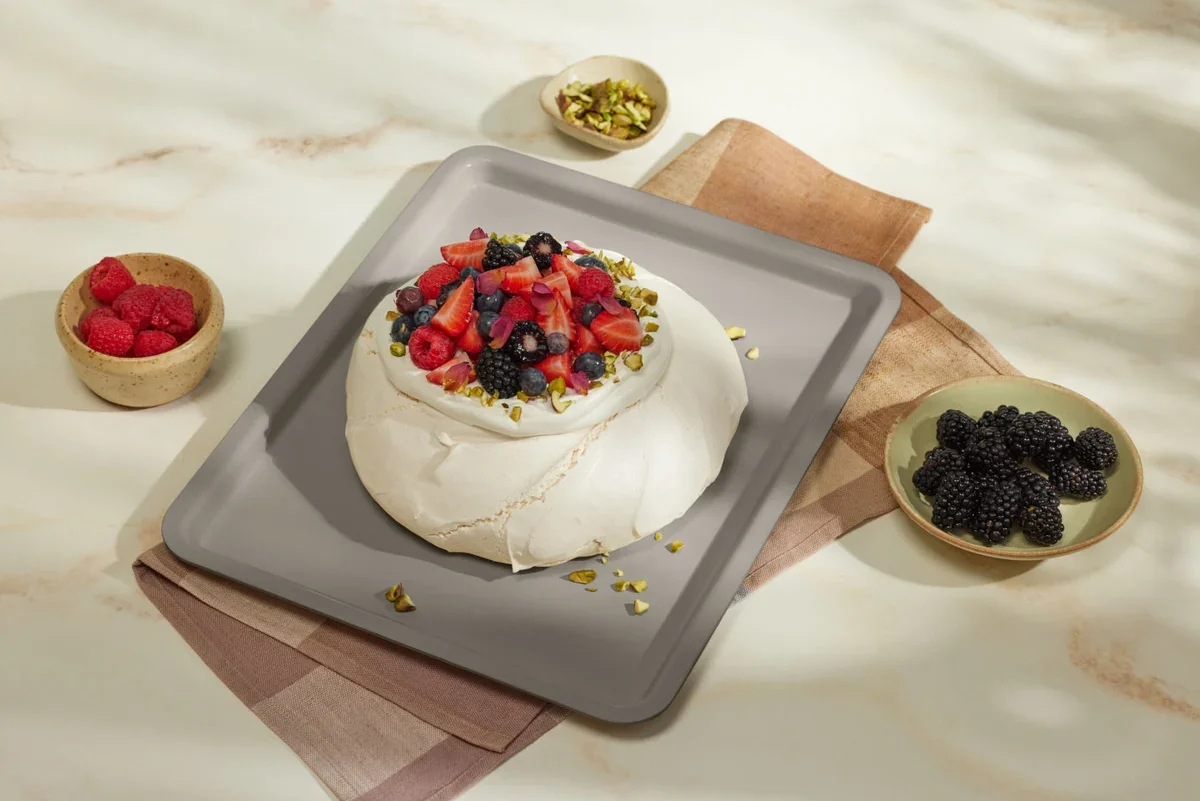
This saffron pavlova has a crisp, delicate shell and a soft centre, topped with whipped cream, macerated berries and pistachios. It is a showy make-ahead dessert, with the oven doing most of the work while the pavlova cools.
Ingredients
- 4 (148 g)large egg whites, at room temperature
- 1.25 ml (¼ teaspoon)kosher salt
- ½ teaspoonsaffron threads
- 5 ml (1 teaspoon)white vinegar
- 190 gsuperfine sugar
- 10 ml (2 teaspoons)cornflour
- 30 g (¼ cup)chopped pistachios, for garnish
- 150 g (1 cup)fresh blackberries
- 150 g (1 cup)fresh strawberries, hulled and quartered
- 5 ml (1 teaspoon)vanilla extract
- 2 tablespoonssuperfine sugar
- 170 g (6 oz)cold double cream
Instructions
- 1
Preheat the oven
Preheat the oven to 163°C on the Bake setting.
- 2
Macerate the berries
Put the blackberries and strawberries in a bowl with the vanilla extract and 2 tablespoons of superfine sugar. Toss gently and leave at room temperature for 1–3 hours, or refrigerate if serving much later.
- 3
Whip the cream
In a clean, dry stand-mixer bowl fitted with a whisk, whip the cold double cream on medium-high for about 2 minutes. Keep it refrigerated until serving.
- 4
Whisk the whites
In a separate clean, dry mixer bowl with the whisk attachment, combine the egg whites, salt, saffron and vinegar. Whisk on medium until soft peaks form, about 1–2 minutes.
- 5
Add the sugar
Lower the mixer to medium-low and add the sugar 1 tablespoon at a time, waiting 15 seconds between additions. Once it is all incorporated, the whites should be at medium peaks. Increase to medium-high and whisk for about 3–4 minutes, just until stiff peaks form; take care not to overwhip.
- 6
Add the cornflour
With the mixer switched off, sift the cornflour over the egg whites. Mix on medium-high for 15 seconds to distribute it evenly.
- 7
Shape the pavlova
Use a large spoon or spatula to place the meringue on the baking tray in a circle about 15 cm across and 13 cm high. With an offset spatula, gently shape it like an upside-down bowl, with a flat top, about 18 cm across and 8 cm high.
- 8
Bake and cool
Place the tray in the bottom of the oven, reduce the temperature to 102°C and bake for 1 hour 45 minutes. Do not open the oven door during baking or cooling. When the time is up, leave the pavlova in the oven for 3 hours, or until the oven is completely cool. The finished pavlova should be pale beige with a delicate crisp crust.
- 9
Top and serve
Carefully move the pavlova to a serving dish. Add the whipped cream and half the pistachios, then spoon over the berries and finish with the remaining pistachios. Serve straight away for the best texture.
- 10
Store the base
The baked, undecorated pavlova keeps for up to 1 day if protected from humidity. Leave it overnight in a cool, dark container or in the oven.
What is a pavlova?
Pavlova is a meringue-based dessert associated with Australia and New Zealand, named after the Russian ballerina Anna Pavlova. Its defining contrast is a crisp outer shell around a soft, marshmallow-like centre.
This version adds saffron to the egg whites for a floral aroma and pale beige colour. Sweet-tart berries, cream and pistachios make a fresh, crunchy topping for the delicate base.
Nutrition and macros by portion
The nutrition label shows one serving as written: 321 calories, 0g protein, 0g carbs, 0g fat.
| Portion | Adjustment | kcal | Protein | Carbs | Fat |
|---|---|---|---|---|---|
| Lighter | Use less cream | 225 kcal | 0g | 0g | 0g |
| This serving | As written | 321 kcal | 0g | 0g | 0g |
| Hungry | Serve a larger slice | 482 kcal | 0g | 0g | 0g |
The meringue’s sugar supplies most of the carbohydrates, while the double cream and pistachios contribute much of the fat. Egg whites add protein, and the berries bring fruit and some fibre. Serve a slice with extra fresh berries for a fruit-forward plate.
The ingredients that matter
Egg whites: Room-temperature whites whip readily, and a thoroughly clean, dry bowl helps them build volume. Keep every trace of yolk or grease out of the mixture.
Superfine sugar: Its fine crystals dissolve more easily into the foam. Add it gradually so the meringue has time to take it up without losing its structure.
Saffron and vinegar: Saffron lends the meringue its distinctive floral note. Vinegar and cornflour are incorporated into the foam as directed, helping shape the pavlova’s soft-centred texture.
Build a stable meringue
Soft peaks are the first cue: the whisk leaves peaks that droop gently. After the sugar has been added, continue only until the whites hold stiff peaks, then stop to avoid overwhipping.
Add the sugar one tablespoon at a time, with a 15-second pause between additions. Sift in the cornflour with the mixer off, then mix briefly to distribute it.
Shape without compressing
Spoon the meringue into a tall circle before shaping it into an upside-down bowl with a flat top. Work gently with the spatula rather than pressing hard, so the foam keeps its volume.
The shallow bowl shape gives the cream and fruit a place to sit once the base is cool. Keep the stated approximate dimensions so the pavlova bakes as intended.
Bake slowly and cool fully
The oven starts at 163°C for preheating, then the temperature drops to 102°C for a long, gentle bake. The finished shell should be delicate and crisp, with an overall light beige colour.
Do not open the oven door during baking or cooling. Let the pavlova cool inside for 3 hours, or until the oven is completely cool; this patient cooling is part of the method, not optional resting time.
Prepare the toppings
Berries: Toss them gently with vanilla and sugar, then leave them for 1–3 hours at room temperature. Refrigerate them if they need to wait longer before serving.
Cream: Whip the cold double cream for about 2 minutes and keep it chilled. The recipe does not specify a peak stage, so stop once it is whipped and holds its shape.
Pistachios: Scatter half over the cream and reserve the rest for the berries. Adding them at the end keeps their crunch more distinct.
Serve at the right moment
Assemble the pavlova just before serving, once the base has cooled completely. The cream and fruit add moisture, so the crisp crust is at its best when the dessert is served promptly.
Serve it as a centrepiece after a meal, or alongside tea or coffee. A small portion is rich and sweet, with plenty of fruit to cut through the cream and meringue.
Recipe notes & tips
- Start with room-temperature egg whites and a clean, dry mixing bowl.
- Add the superfine sugar gradually, allowing 15 seconds between each tablespoon.
- Stop whisking as soon as the whites reach stiff peaks.
- Shape the meringue gently so you do not knock air out of it.
- Keep the oven door closed throughout baking and cooling.
- Wait until just before serving to add the cream, berries and pistachios.
Variations
- Change the berries: Use another mix of fresh berries while keeping the same maceration method.
- Use toasted pistachios: Toast them ahead of time and let them cool before garnishing.
- Adjust the saffron: Use fewer threads for a subtler floral note.
- Add citrus: Serve with a little finely grated lemon zest over the finished topping.
- Make smaller pavlovas: Divide the meringue into individual nests, keeping in mind that their baking time may differ.
Common mistakes to avoid
- Greasy mixing bowl: The egg whites may not whip properly; use a clean, completely dry bowl and whisk.
- Adding sugar too quickly: The foam can lose structure; add it one tablespoon at a time with the stated pauses.
- Overwhipping: The meringue can become difficult to handle; stop when stiff peaks form.
- Opening the oven: A sudden change can disturb the pavlova; keep the door closed through baking and cooling.
- Topping too early: Moisture softens the crust; assemble the pavlova just before serving.
- Storing in humidity: The shell can lose its crispness; keep the undecorated base in a cool, dark, dry place.
How to store
Keep the baked, undecorated pavlova in a cool, dark container or in the oven, away from humidity, for up to 1 day. Refrigerate the whipped cream and macerated berries separately, and assemble just before serving; the decorated pavlova is best eaten straight away.
Frequently asked questions
Can I prepare the pavlova base ahead?
Yes. The undecorated base can be kept for up to 1 day in a cool, dark place, protected from humidity.
Can I macerate the berries in advance?
Yes. Leave them at room temperature for 1–3 hours, or refrigerate them if you are preparing them much earlier.
Why should I leave the oven door closed?
The method calls for the pavlova to bake and cool without the door being opened. Leave it inside for 3 hours or until the oven is completely cool.
How do I know when the meringue is ready?
Whisk the egg whites to soft peaks before adding sugar, then continue until they form stiff peaks. Stop at that point rather than whisking further.
Can I assemble it before guests arrive?
It is better to wait until just before serving. The cream and berries soften the crisp shell as they sit on it.
What if I do not have superfine sugar?
The recipe specifies superfine sugar, which dissolves readily into the meringue. Use it for the closest match to the method.
Cook it from the original
This recipe comes from fromourplace.ca. Their page has the author’s own photos, notes and tips — the best place to cook it from.
Open the recipe on fromourplace.ca