
Cheese Borek Rolls
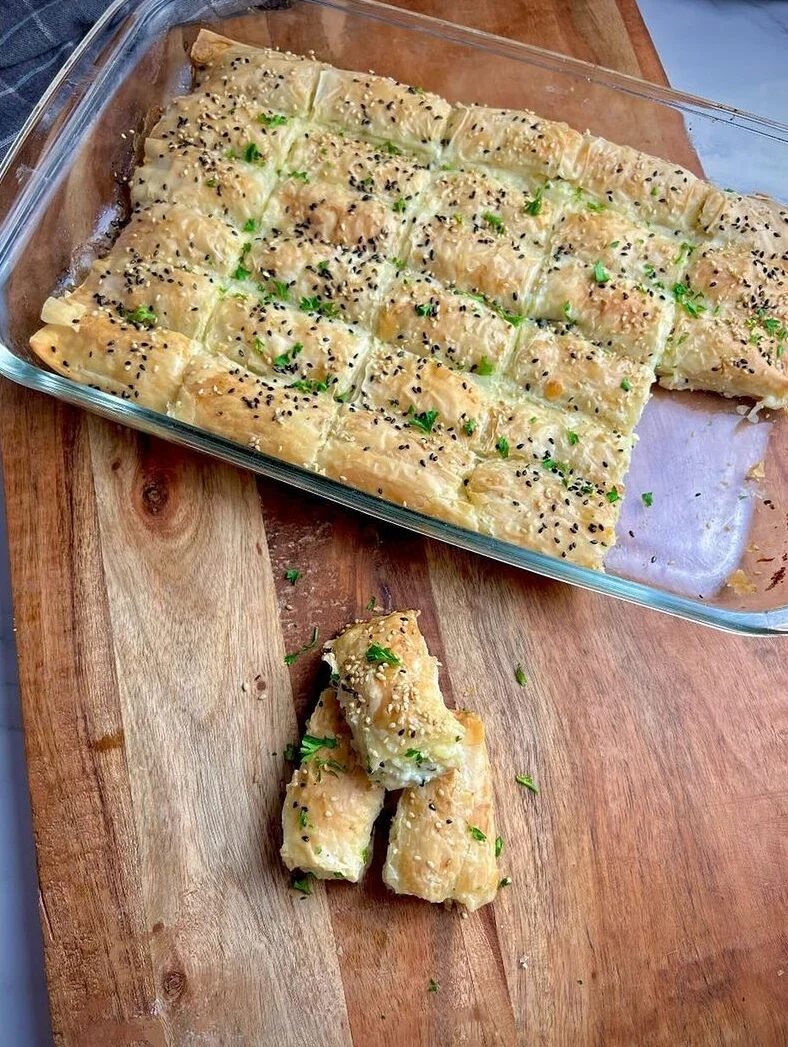
Cheese borek rolls wrap a savoury ricotta and akawi filling in crisp, sesame-topped layers of phyllo. They make a warm snack or a shareable savoury dish, and the cheese filling can be adapted to suit what you have.
Ingredients
- 1 packagephyllo pastry
- for toppingsesame seeds
- 280 gricotta cheese
- 3 cups (approximately 340 g)akawi cheese, or mozzarella
- 1 tspblack seed
- 1/4 cup (approximately 15 g)finely chopped parsley
- quantity not specifiedeggs
- quantity not specifiedmilk
- quantity not specifiedoil
- to tastesalt
- to tasteblack pepper
Instructions
- 1
Mix the filling
Combine the ricotta, akawi cheese, parsley and black seed.
- 2
Make the liquid
Mix the eggs, milk, oil, salt and pepper together.
- 3
Fill and roll
Lay out 2 sheets of phyllo pastry on a flat surface. Brush them generously with the liquid mixture, add some cheese filling and roll up.
- 4
Arrange the rolls
Brush a baking tray with oil and place a filled phyllo roll in it. Repeat with the remaining pastry and filling.
- 5
Coat the tops
Brush the rolls with the remaining liquid mixture; the pastry should become soggy.
- 6
Cut and top
Cut the rolls into small pieces and sprinkle with sesame seeds.
- 7
Bake until golden
Bake at 180°C (350°F) until golden.
- 8
Serve warm
Remove from the oven and enjoy while still warm.
What are cheese borek rolls?
Borek is a broad family of savoury pastries associated with Turkish and neighbouring cuisines, often made with thin sheets of pastry and a cheese or other filling. This version uses phyllo wrapped around a mixture of ricotta, akawi, parsley and black seed.
The layered pastry turns crisp in the oven while the cheese stays soft. Cutting the rolls into small pieces makes them easy to serve warm for a snack or as part of a shared spread.
Nutrition and macros by portion
The nutrition label shows one serving as written: 520 calories, 22g protein, 42g carbs, 29g fat.
| Portion | Adjustment | kcal | Protein | Carbs | Fat |
|---|---|---|---|---|---|
| Lighter | Smaller rolls, more salad | 364 kcal | 15g | 29g | 20g |
| This serving | As written | 520 kcal | 22g | 42g | 29g |
| Hungry | Larger portion | 780 kcal | 33g | 63g | 44g |
The phyllo contributes most of the carbohydrates, while ricotta, akawi or mozzarella, and the oil in the brushing mixture contribute much of the fat. The cheeses also provide most of the protein; serve a modest portion with salad or vegetables to balance the plate.
Choosing the cheese
Akawi: this brined cheese gives the filling its characteristic savoury flavour. If it is very salty, taste the mixture before adding salt.
Mozzarella: the recipe suggests it as an alternative. It melts smoothly, though the filling will have a milder flavour than one made with akawi.
Working with phyllo
Keep the pastry sheets covered while assembling so they do not dry out. Handle the two sheets together as directed, and brush them generously with the egg, milk and oil mixture before adding filling.
The method calls for the pastry to become soggy after the remaining liquid is brushed over the tops. Spread the liquid across the rolls rather than leaving it in one concentrated spot.
Getting the filling right
Cheese mixture: combine the ricotta and akawi evenly with the chopped parsley and black seed so each roll gets a balanced filling.
Amount: add enough filling to make a clear layer, but avoid overfilling; a heavy amount can make the rolls harder to seal and arrange.
How to judge when they are done
The stated doneness cue is a golden colour. Check the rolls as they bake and take them out once the pastry is evenly coloured.
The recipe does not give a baking time, so use the appearance of the pastry rather than a fixed timer. Serve them warm, as directed.
Serving the rolls
Serve the pieces warm, when the pastry is at its crispest and the cheese filling is soft. They work well alongside a fresh salad or other savoury dishes.
For a larger spread, offer a simple yoghurt dip or sliced vegetables on the side; these complement the salty, rich filling without changing the rolls themselves.
Recipe notes & tips
- Keep unused phyllo sheets covered while you assemble the rolls.
- Taste the cheese mixture before adding salt, especially if using akawi.
- Brush the pastry generously as the method directs so the layers are coated.
- Cut the rolls into small pieces before baking, as instructed.
- Watch for an even golden colour because the recipe gives no baking time.
Variations
- Use mozzarella: swap it for akawi for a milder, melty filling.
- Add feta: replace some of the cheese with feta for a sharper, saltier taste.
- Change the herbs: use another chopped soft herb in place of some parsley.
- Adjust the seeds: leave out the black seed if you prefer a simpler cheese flavour.
- Make smaller bites: cut the rolls into smaller pieces before baking for snack-sized portions.
Common mistakes to avoid
- Dry phyllo: keep the sheets covered until you are ready to brush and fill them.
- Over-salting: taste the cheese mixture first, since akawi can already be salty.
- Overfilling: use a manageable layer of cheese so the pastry can roll around it.
- Uneven coating: brush the liquid mixture over the pastry and tops rather than concentrating it in one place.
- Baking by the clock alone: use the golden-colour cue because no baking time is specified.
How to store
Refrigerate cooled leftovers in a covered container and eat within 3 days. Reheat in an oven until hot and crisp; the pastry may soften if reheated in a microwave.
Frequently asked questions
Can I use mozzarella instead of akawi?
Yes. The recipe names mozzarella as an alternative, and it will make a milder, melty filling.
Do I need to add salt?
Taste the cheese mixture first. Akawi may be salty enough already, while mozzarella may need a little seasoning.
How long should the rolls bake?
No baking time is provided. Bake at 180°C (350°F) until the pastry is golden.
Can I prepare the rolls ahead?
You can assemble them ahead and keep them covered in the refrigerator, then bake when ready. Phyllo can dry out, so keep the pastry covered during preparation.
Why are the rolls brushed until soggy?
That is the method's instruction for coating the pastry with the remaining liquid mixture. Brush it over the tops evenly before baking.
Cook it from the original
This recipe comes from fooooods.com. Their page has the author’s own photos, notes and tips — the best place to cook it from.
Open the recipe on fooooods.com