
Focaccia
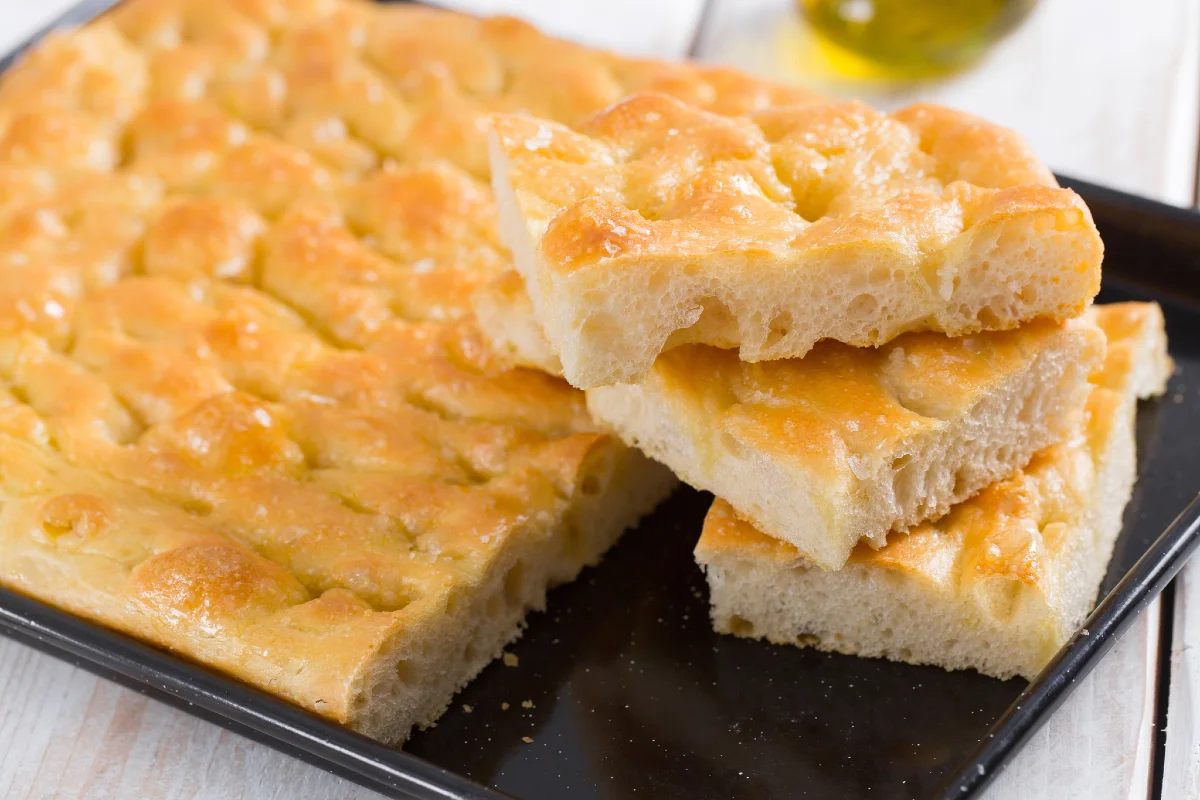
This homemade focaccia is a soft, olive-oil-rich leavened bread with a crisp, dimpled top and a tender crumb. It makes a generous centrepiece for sharing, whether served warm alongside a meal or enjoyed on its own.
Ingredients
- 500 gstrong white flour (strength 350 W)
- 340 gwater, at room temperature
- 7 gfresh baker’s yeast
- 25 gextra-virgin olive oil
- 10 gfine salt
- 60 gextra-virgin olive oil
- to tasteMaldon salt
Instructions
- 1
Mix the dough
Put the flour in a bowl and crumble in the fresh yeast. Add the room-temperature water gradually, mixing as you go so it is absorbed evenly. Once all the water is incorporated and the dough has some body, move it to the work surface.
- 2
Knead in oil
Knead firmly, stretching the dough with the backs of your hands and drawing it back towards you. Turn it 90° before each stretch. When it becomes more even, work in the oil gradually in 3–4 additions, kneading until each addition is absorbed.
- 3
Add the salt
Once the oil is fully incorporated, stretch the dough slightly and scatter all the fine salt over it. Knead thoroughly for several minutes until the salt has dissolved into the dough. Cover with a bowl and leave to rest for 15 minutes.
- 4
Fold and prove
Lift the dough with both hands and slap it down on the work surface, then turn it 180° and repeat; do this at least 2–3 times. Repeat the folds at least once more, leaving the dough covered under a bowl for 15 minutes between rounds. Transfer it to an oiled bowl, seal with cling film and prove at 26–28°C for about 3 hours, until it has tripled in volume.
- 5
Shape the dough
Oil a 25 × 38 cm baking tray. Tip in the dough and gently stretch it towards the edges, pressing with your fingertips to spread it over the tray.
- 6
Prove in tray
If the dough springs back, cover it and leave it for about 5 minutes before gently stretching it again. Cover the tray with cling film or a damp cloth and prove for 1 hour. Pour over the 60 g of oil, then press your fingertips into the dough to make the characteristic dimples.
- 7
Bake the focaccia
Scatter Maldon salt over the surface. Bake in a thoroughly preheated, conventional oven at 200°C for about 30 minutes; the lowest oven shelf can be used. Take the focaccia out and serve while hot.
What is focaccia?
Focaccia is an Italian leavened flatbread, commonly associated with Liguria, where olive oil and a dimpled surface are defining features. It can be served as bread alongside a meal or eaten as a snack.
This version relies on a well-hydrated dough, repeated folds and a generous coating of oil. Those steps help create a soft interior beneath a golden, savoury top.
Nutrition and macros by portion
The nutrition label shows one serving as written: 646 calories, 18g protein, 94g carbs, 22g fat.
| Portion | Adjustment | kcal | Protein | Carbs | Fat |
|---|---|---|---|---|---|
| Lighter | Use less topping oil | 452 kcal | 13g | 66g | 15g |
| This serving | As written | 646 kcal | 18g | 94g | 22g |
| Hungry | Serve a larger piece | 969 kcal | 27g | 141g | 33g |
Most of the carbohydrates come from the flour, while the olive oil supplies most of the fat. The flour also provides the bulk of the protein; Maldon salt and the fine salt contribute sodium. Pair a portion with vegetables and a protein-rich accompaniment for a more balanced plate.
Choosing the flour and oil
Strong flour: the specified 350 W flour is intended to support the wet dough and its long rise. Use a strong white bread flour if you cannot find flour with that exact strength.
Olive oil: some oil is kneaded into the dough, while the larger amount is poured over before dimpling. The two additions contribute to both the crumb and the characteristic rich surface.
Building strength with folds
Rest first: the 15-minute pause after salting gives the dough time to relax and develop strength. Keep it covered so the surface does not dry out.
Fold gently but decisively: lift and slap the dough onto the worktop, then turn it and repeat. Leave 15 minutes between rounds, as directed, so the dough can rest before being handled again.
Reading the rise
First prove: keep the covered dough at 26–28°C for about 3 hours, watching for it to triple in volume. The volume cue matters alongside the stated time.
Second prove: once the dough is spread in the tray, give it 1 hour covered. If it contracts while shaping, let it rest for about 5 minutes before stretching it again rather than forcing it.
Dimples and doneness
Oil and dimples: pour the 60 g of oil over the proved dough, then press your fingertips down to make pockets across the surface. This helps distribute the oil over the top.
Bake: use a thoroughly preheated conventional oven at 200°C for about 30 minutes. The recipe suggests the lowest shelf; look for a well-coloured top and a baked-through centre.
Serving the focaccia
Fresh from the oven: this focaccia is intended to be served hot, when its top is at its crispest and the crumb is still soft.
With a meal: offer it with soup, salads, or a spread of antipasti. Cut it into squares or strips for sharing.
Recipe notes & tips
- Add the water gradually so the flour has time to absorb it evenly.
- Work the oil into the dough in 3–4 additions rather than pouring it all in at once.
- Keep the dough covered during rests and proving to prevent a dry skin forming.
- If the dough resists stretching in the tray, give it the stated 5-minute rest before trying again.
- Preheat the oven thoroughly before baking so the focaccia goes into an already-hot oven.
Variations
- Rosemary: scatter fresh rosemary over the oiled, dimpled surface before baking.
- Cherry tomatoes: press halved tomatoes into the dough before it goes into the oven.
- Olives: add pitted olives to the dimples for a savoury topping.
- Onion: arrange thinly sliced onion over the surface before baking.
- Garlic: brush the baked focaccia with a little garlic-infused oil for extra aroma.
Common mistakes to avoid
- Adding oil too quickly: the dough can struggle to absorb it; work it in over 3–4 additions.
- Skipping the rests: the dough needs time to relax; cover it and allow the full resting intervals.
- Forcing the dough to the tray edges: it may spring back; let it rest for about 5 minutes, then stretch gently.
- Under-proving: the dough may lack volume and softness; look for it to triple during the first prove.
- Using a cool oven: the focaccia may bake unevenly; preheat the oven thoroughly to 200°C.
How to store
Once cool, store the focaccia in an airtight container at room temperature and eat within 2 days. Reheat briefly in a hot oven to refresh the crust; freezing is also suitable for longer storage.
Frequently asked questions
Can I use dried yeast instead of fresh yeast?
Fresh yeast is specified here. If substituting dried yeast, use the conversion on its packaging, as yeast strengths and recommended ratios can vary.
What if my dough does not triple in 3 hours?
The timing is approximate and depends on the dough temperature and room conditions. Continue proving until it has tripled in volume, keeping it covered.
Why does the dough keep shrinking in the tray?
It needs time to relax. Cover it, leave it for about 5 minutes, then stretch it gently again.
Can I prepare the dough ahead?
The recipe describes proving at room temperature and does not give an overnight method. For best results, follow its stated proving sequence.
How do I know the focaccia is done?
Bake for about 30 minutes at 200°C, as directed, until the top is well coloured and the centre is baked through.
Cook it from the original
This recipe comes from giallozafferano.es. Their page has the author’s own photos, notes and tips — the best place to cook it from.
Open the recipe on giallozafferano.es