
Nigiri
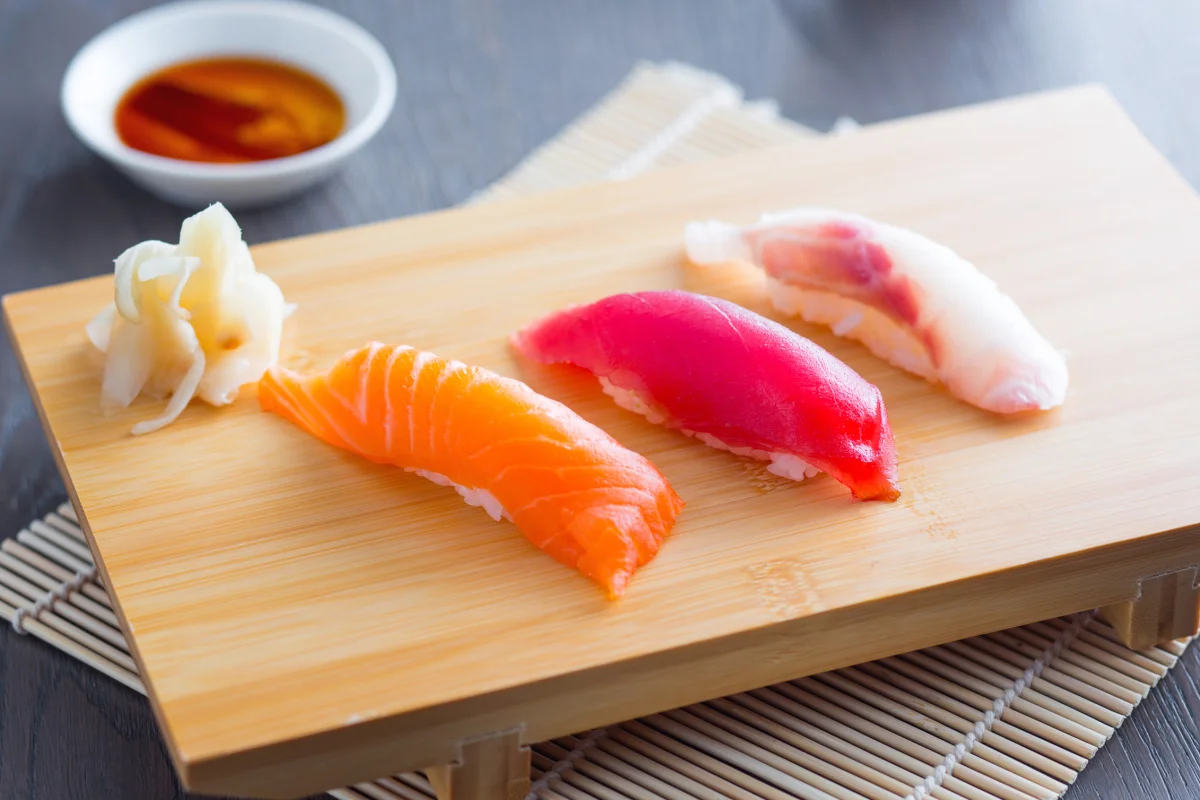
Nigiri pairs compact ovals of seasoned sushi rice with slices of sea bass, salmon and tuna. Careful slicing and gentle shaping help the fish sit neatly on the rice without squashing it.
Ingredients
- 144 gcocido arroz nishiki para sushi
- 40 glubina, congelada rápidamente
- 65 gfilete de salmón, congelado rápidamente, limpio y recortado
- 50 gfiletes de atún, congelados rápidamente, limpios y recortados
- cantidad suficientewasabi
- cantidad suficientejengibre encurtido
Instructions
- 1
Prepara la lubina
Para hacer 12 piezas, empieza con unos 144 g de arroz para sushi ya cocido. Puedes comprar un filete de lubina o sacar uno del pescado entero: tras retirar cabeza, vísceras y escamas, coloca el vientre hacia ti y corta junto a la espina central hasta la cola. Haz un corte a lo largo del lomo sobre la aleta; gira la cola hacia la derecha y repite el corte desde la cola hacia la cabeza hasta la base de la cola. Da la vuelta al pescado, con la carne contra la tabla, y repite para obtener el segundo filete.
- 2
Limpia el filete
Recorta el filete de lubina y quita las espinas con unas pinzas. Sujeta la cola y desliza el cuchillo entre la piel y la carne para retirar la piel. Frota el filete en un cuenco con agua fría, hielo y sal fina disuelta para eliminar buena parte de la grasa.
- 3
Corta el pescado
Sécalo bien con un paño de cocina. Corta la lubina en diagonal y transversalmente para obtener 4 lonchas iguales de unos 12 g cada una. Haz lo mismo con el salmón, cortándolo transversalmente en 4 lonchas de unos 14 g.
- 4
Forma el arroz
Corta transversalmente el atún en 4 lonchas de unos 16 g. Coloca por separado las lonchas de lubina, atún y salmón, a mano para cogerlas con la izquierda. Humedece la mano derecha con un poco de agua acidulada con vinagre de arroz y sécala ligeramente con un paño limpio. Toma como máximo unos 10–15 g de arroz y presiónalo con suavidad en la palma para formar un óvalo.
- 5
Monta el atún
Pon una loncha de atún en la mano izquierda y añade muy poco wasabi en el centro. Coloca encima el arroz y presiona ligeramente. Dale la vuelta y aprieta los lados del pescado con el pulgar y el dedo medio para unirlo bien al arroz. Repite con las demás lonchas de atún.
- 6
Termina y sirve
Repite el montaje con las lonchas de salmón y de lubina. Sirve cada porción con un nigiri de cada tipo de pescado, acompañado de pétalos de jengibre encurtido y salsa de soja.
What is nigiri?
Nigiri is a Japanese style of sushi made by shaping rice into a small oval and topping it with a slice of fish or another ingredient. Its appeal lies in the balance between softly packed rice and a topping that remains the focus.
This version uses sea bass, salmon and tuna, giving each serving three different fish flavours. The small pieces are shaped by hand, so the rice stays tender rather than tightly compressed.
Nutrition and macros by portion
The nutrition label shows one serving as written: 95 calories, 10g protein, 10g carbs, 2g fat.
| Portion | Adjustment | kcal | Protein | Carbs | Fat |
|---|---|---|---|---|---|
| Lighter | Smaller rice ovals | 67 kcal | 7g | 7g | 1g |
| This serving | As written | 95 kcal | 10g | 10g | 2g |
| Hungry | Add extra nigiri | 143 kcal | 14g | 15g | 2g |
The rice supplies most of the carbohydrate, while the three fish contribute protein and some fat, particularly the salmon. For a more substantial plate, serve the nigiri with a simple vegetable side; keep soy sauce to your preferred amount.
Choosing and preparing the fish
Frozen fish: use fish that has been rapidly frozen and is suitable for eating raw. Keep it cold while preparing it, and follow the handling advice on its packaging.
Clean slices: remove pin bones and skin from the sea bass, then cut all three fish across the grain into even pieces. Uniform slices sit more securely on the rice and are easier to portion.
Shaping the rice
Damp hand: lightly moisten your right hand with water acidulated with rice vinegar, then wipe away excess moisture. This helps keep the rice from sticking to your palm.
Gentle pressure: use about 10–15 g of rice for each oval and shape it without crushing the grains. Press just enough for it to hold together when topped.
Getting the topping to hold
A little wasabi: spread a very small amount in the centre of each fish slice before adding the rice. Too much can overpower the fish and make the topping harder to handle.
Final shaping: turn the piece over and press the fish gently around the rice with your thumb and middle finger. The aim is a neat join, not a tightly packed bite.
Serving the three fish
Three-piece portion: serve one sea bass, one salmon and one tuna nigiri together so each fish has its own place on the plate. Keep the slices in separate dishes while assembling to make them easy to pick up.
Accompaniments: offer pickled ginger and soy sauce alongside the nigiri. Serve promptly so the rice stays soft and the fish stays cool.
Timing and preparation
Ready-to-use rice: the stated 40-minute total assumes the sushi rice is already cooked, as the method calls for cooked rice. If cooking it from scratch, allow extra time for cooking and cooling.
Work in sequence: prepare and slice the fish first, then shape and top the rice. This keeps the assembly organised and avoids leaving shaped nigiri waiting longer than necessary.
Recipe notes & tips
- Keep the fish chilled and work with one type at a time.
- Use a sharp knife to make clean, even crosswise slices.
- Keep a clean damp cloth nearby for wiping your hands between pieces.
- Measure roughly 10–15 g of rice per oval to keep the nigiri small.
- Use only a little wasabi so it does not mask the flavour of the fish.
Variations
- Try prawns: use cooked, peeled prawns instead of one of the raw fish toppings.
- Add avocado: place a thin slice over the rice for a non-fish topping.
- Use tamari: offer tamari instead of soy sauce if preferred.
- Change the fish: use another fish suitable for serving raw, prepared and handled according to its packaging.
- Make it vegetarian: top the rice with thin slices of cucumber or lightly cooked aubergine.
Common mistakes to avoid
- Overworking the rice: excessive pressure makes it dense; shape each oval with a light touch.
- Wet hands: too much water makes the rice slippery; dampen your palm and wipe it lightly.
- Uneven slices: inconsistent thickness makes assembly awkward; cut each fish into similar-sized pieces.
- Too much wasabi: a large dab can overwhelm the fish; use only a small amount in the centre.
- Leaving fish out: prolonged time at room temperature is unsuitable for raw fish; keep it chilled until assembly.
How to store
Nigiri is best eaten soon after assembly. Keep any leftovers covered in the fridge and use promptly; avoid leaving them at room temperature, and do not reheat.
Frequently asked questions
How many pieces does this recipe make?
It makes 12 nigiri in total: four each with sea bass, salmon and tuna. The method serves them as three pieces per portion.
Should the sushi rice be warm or cold?
Use cooked rice that has cooled enough to handle and shape. The recipe's listed time and quantities assume the rice is already cooked.
Can I use fish that has not been frozen?
The recipe specifies rapidly frozen fish. For raw preparations, use fish sold as suitable for eating raw and follow the supplier's storage and handling instructions.
Can I prepare the nigiri ahead?
It is better to assemble it just before serving, because the rice can firm up in the fridge and the fish should be kept cold. You can prepare the slices in advance and keep them chilled until needed.
What does the water with rice vinegar do?
It lightly dampens the shaping hand so rice is less likely to stick. Wipe your hand so it is moist rather than wet.
Cook it from the original
This recipe comes from giallozafferano.es. Their page has the author’s own photos, notes and tips — the best place to cook it from.
Open the recipe on giallozafferano.es