
Colombian guava bocadillo
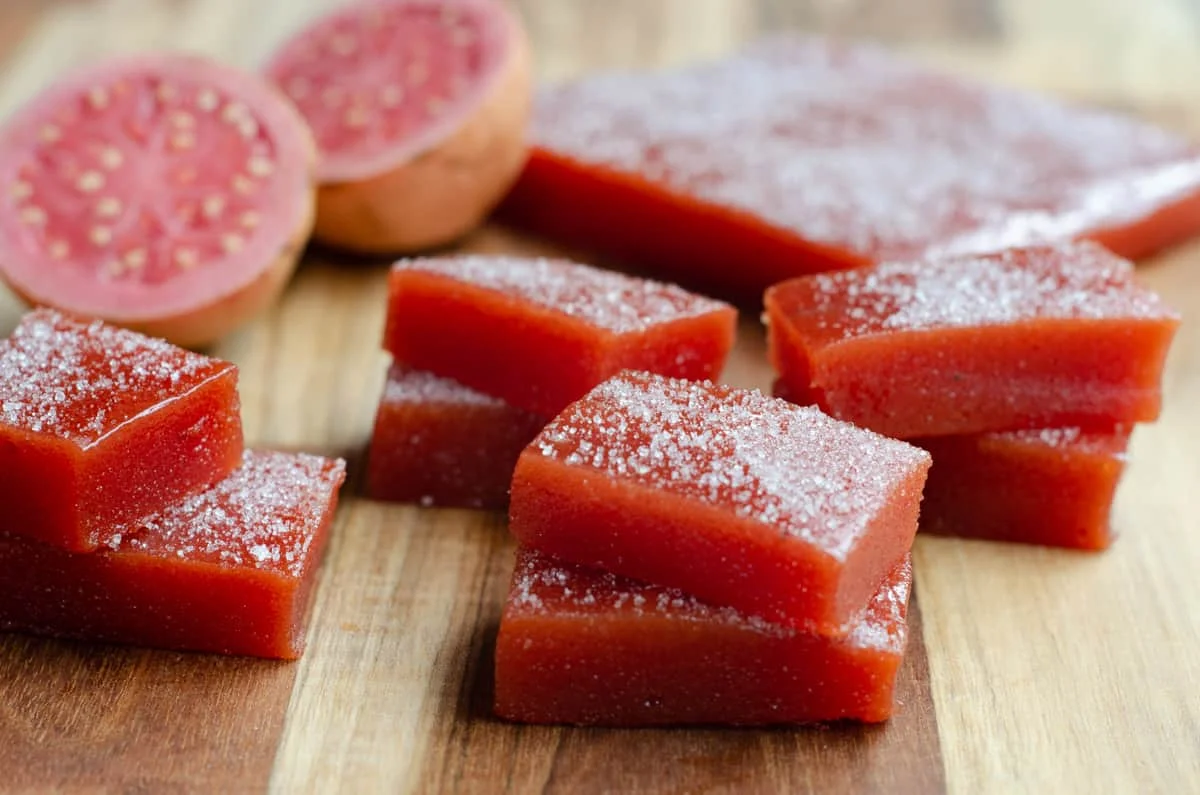
Colombian bocadillo is a firm guava sweet cooked down into a sliceable paste. This version sets in a mould and can be enjoyed on its own or with cheese.
Ingredients
- 600 g (about 4 medium)ripe guavas
- 500 ml (2.5 cups)water
- 450 g (2¼ cups)white sugar
- juice of 1orange
- to tastesugar, for sprinkling
Instructions
- 1
Boil the guavas
Put the whole guavas in a small pan with the water; they will not be completely submerged. Cover and boil for 20 minutes, until the skins split.
- 2
Blend the fruit
Transfer the guavas and their cooking liquid to a blender and blend until smooth.
- 3
Strain the mixture
Set a sieve over a pan and strain out the seeds, pressing the pulp through with a spoon if needed. Discard the seeds.
- 4
Cook the paste
Stir the sugar and orange juice into the guava mixture with a wooden spoon. Bring it to the boil, then simmer gently for 1 hour, stirring every 2–3 minutes so it cooks evenly and does not stick. The colour will change from pink to red-orange after about 30 minutes, then back towards red-pink. It is ready when thick and sticky and you can see the bottom of the pan as you stir.
- 5
Set and slice
Spoon the paste into a silicone baking mould about 30 × 6 cm, such as a loaf tin, and sprinkle sugar over it. Leave to cool to room temperature, cover with cling film and refrigerate for a few hours or overnight to firm up. Cut into blocks and serve as a sweet or with a piece of cheese.
What is Colombian bocadillo?
Bocadillo is a Colombian sweet made by cooking guava into a dense paste and setting it in small, firm blocks. It is often eaten by itself, paired with cheese, or used as a filling for bread and cakes.
This version relies on ripe guavas, a long gentle cook and a final chill. Straining out the seeds gives the finished paste a smoother texture.
Nutrition and macros by portion
The nutrition label shows one serving as written: 96 calories, 0g protein, 24g carbs, 0g fat.
| Portion | Adjustment | kcal | Protein | Carbs | Fat |
|---|---|---|---|---|---|
| Lighter | Use less sugar | 67 kcal | 0g | 16g | 0g |
| This serving | As written | 96 kcal | 0g | 24g | 0g |
| Hungry | Serve with cheese | 144 kcal | 0g | 35g | 0g |
Most of each serving’s energy and carbohydrates come from the added sugar, with guava and orange contributing fruit sugars and some fibre. There is very little fat or protein in the paste; serve it with cheese for a more balanced snack.
Choosing and preparing guavas
Ripe fruit: use ripe guavas for their fragrant, sweet flavour and softer flesh. The recipe boils them whole, which softens the fruit before blending.
Straining: press the blended fruit through a sieve to separate the seeds from the pulp. A spoon helps push the pulp through without letting the seeds into the paste.
Getting the cooking right
Gentle heat: once the mixture boils, keep it at a gentle simmer for the full hour. Stir every 2–3 minutes, scraping along the bottom of the pan to prevent sticking.
Steady stirring: the mixture thickens as water evaporates, so it becomes harder to move towards the end. Use a sturdy wooden spoon and take care around splashes.
How to tell when it is ready
Colour: expect the paste to shift from pink to red-orange and then towards red-pink as it cooks. The colour is a useful guide, but thickness is the better doneness cue.
Texture: when the paste is ready, it should be thick and sticky, with the bottom of the pan briefly visible as you stir. If it still flows back quickly, continue cooking gently and check again.
Setting the paste
Mould: a mould around 30 × 6 cm gives the paste a shape that can be cut into blocks. A silicone mould is easy to turn out; the recipe also suggests a cake tin.
Chilling: cool the filled mould to room temperature before covering and refrigerating. A few hours can firm it up, while chilling overnight gives it longer to set.
Serving ideas
Cheese: serve a block with a piece of cheese for a sweet-and-savoury pairing. The firm paste also works as a filling for bread or cakes.
Portions: cut the chilled paste into small blocks and serve as a sweet. A light sprinkle of sugar adds a finishing touch.
Recipe notes & tips
- Choose a pan with enough room for the mixture to bubble gently as it thickens.
- Stir frequently and scrape the base of the pan to keep the paste from catching.
- Press the pulp through the sieve patiently to separate it from the seeds.
- Use a wooden spoon to check whether the pan bottom shows as you stir.
- Let the paste cool to room temperature before covering and chilling.
Variations
- Cheese pairing: serve each block with a piece of cheese for a sweet-and-savoury bite.
- Cake filling: spread or slice the set paste as a filling for cakes.
- Bread filling: use thin slices of bocadillo inside bread.
- Less garnish: sprinkle on only a little sugar if you prefer a less sweet finish.
Common mistakes to avoid
- Skipping the sieve: seeds can remain in the paste; strain the blended fruit and press the pulp through.
- Cooking too fast: the bottom can catch before the paste thickens; keep the heat gentle.
- Stirring too rarely: the mixture may stick as it reduces; stir every 2–3 minutes.
- Stopping while runny: the paste may not set firmly; cook until it is thick and sticky and the pan bottom shows when stirred.
- Covering while warm: trapped steam can collect on the surface; cool to room temperature before covering.
How to store
Keep the set bocadillo covered in the refrigerator and use it within about a week. Cut off pieces as needed; it is best served chilled or brought briefly to room temperature.
Frequently asked questions
How do I know the guava paste is thick enough?
It should be thick and sticky, and stirring should briefly reveal the bottom of the pan. If it still runs back quickly, simmer it longer.
Can I use a different mould?
Yes. Use a mould that can hold the paste in a layer suitable for cutting into blocks; the recipe suggests one about 30 × 6 cm.
Can I chill it for just a few hours?
Yes. The recipe allows a few hours in the refrigerator, though leaving it overnight gives it longer to firm up.
Do I need to peel the guavas?
No. Boil the guavas whole, then blend them with the cooking liquid and strain out the seeds.
What can I serve with bocadillo?
Serve it by itself or with a piece of cheese. It can also be used as a filling for bread or cakes.
Cook it from the original
This recipe comes from vecinavegetariana.com. Their page has the author’s own photos, notes and tips — the best place to cook it from.
Open the recipe on vecinavegetariana.com