
Creamy Sourdough Basque Cheesecake {Same Day or Overnight }
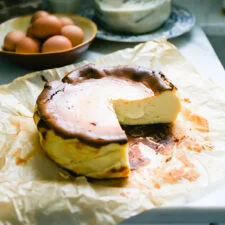
This crustless Basque cheesecake combines cream cheese, eggs, cream, sugar and sourdough starter for a rich, creamy centre and deeply browned top. Bake it the same day or chill the mixed batter overnight before baking.
Ingredients
- 678 g (24 oz)block cream cheese, at room temperature
- 220 g (approximately 1 cup)granulated sugar
- 220 g, cracked weight without shells (about 4–5 large eggs)eggs
- 270 ml (1 cup + 2 tbsp)heavy whipping cream
- 60 gsourdough discard or active sourdough starter
Instructions
- 1
Preheat the oven
Heat the oven to 218°C (425°F). Skip this step if you plan to ferment the batter overnight.
- 2
Line the pan
Lightly coat the bottom of an 8-inch springform pan with cooking spray. Lay one sheet of non-stick parchment across the pan horizontally, then place a second sheet vertically over it to make an X. Press the paper against the base and sides; it does not need to look neat. Scrunching the paper first can help it fit.
- 3
Mix cheese and sugar
Put the softened cream cheese and sugar in a stand mixer bowl. Beat on medium for about 1–2 minutes, until smooth and fluffy, then scrape down the sides with a rubber spatula.
- 4
Add the eggs
With the mixer on low, add the eggs one at a time.
- 5
Blend cream and starter
In a separate bowl, stir the heavy cream and sourdough starter together with a fork until the starter dissolves. This helps it mix into the batter.
- 6
Finish the batter
With the mixer on low, gradually pour the cream mixture into the bowl. Turn off the mixer, then gently stir with a rubber spatula until the batter is cohesive, checking the bottom of the bowl for any cream cheese that has not mixed in.
- 7
Fill and chill
Pour the batter into the lined pan. For the overnight option, cover the pan with an inverted dinner plate and refrigerate it. In the morning, leave the batter at room temperature until it reaches 21–22°C (69–72°F), which can take several hours; check with a digital thermometer.
- 8
Bake the cheesecake
Set the pan on a baking sheet and bake on the centre rack for approximately 43–45 minutes. It is ready when puffed like a soufflé, golden brown on top and very wobbly in the centre; cracks on the surface are expected.
- 9
Cool and chill
Remove the baking sheet from the oven and cool the cheesecake at room temperature for 2 hours. Refrigerate for another 2–3 hours for a creamy, pudding-like texture, or for 6 hours to overnight for a firmer, creamy and fluffy texture. If chilled for longer, let it sit at room temperature for at least 1 hour, or until it reaches 13–16°C (55–60°F), before serving.
What is Basque cheesecake?
Basque cheesecake is a crustless cheesecake associated with the Basque Country in Spain. Its defining contrast is a dark, baked surface and a soft centre, rather than the pale, even top and biscuit base of many other cheesecakes.
This version uses sourdough discard or starter alongside the familiar cream cheese, sugar, eggs and cream. A hot oven browns the top while the short bake leaves the middle creamy.
Nutrition and macros by portion
The nutrition label shows one serving as written: 560 calories, 10g protein, 43g carbs, 42g fat.
| Portion | Adjustment | kcal | Protein | Carbs | Fat |
|---|---|---|---|---|---|
| Lighter | Serve a smaller slice | 392 kcal | 7g | 30g | 29g |
| This serving | As written | 560 kcal | 10g | 43g | 42g |
| Hungry | Serve a larger slice | 840 kcal | 15g | 65g | 63g |
Cream cheese and whipping cream contribute most of the fat, while sugar supplies much of the carbohydrate; eggs and dairy provide protein. Pair a slice with fresh fruit, or serve a smaller slice after a meal with a lighter main course.
Choose the right pan
Pan depth: An 8-inch springform pan is specified. If using a regular pan instead, it must be deep and at least 3 inches high so the batter has room as it puffs.
Parchment: Two sheets laid at right angles line the pan. Scrunching them before arranging them can make them easier to press into the base and sides.
Get a smooth batter
Room-temperature cheese: Softened cream cheese blends more readily with the sugar and is less likely to leave lumps. Scrape the bowl after mixing, then check its bottom again when you fold the finished batter.
Starter: Stirring the starter into the cream separately makes it easier to disperse through the batter. Add that mixture gradually with the mixer on low, then finish gently by hand.
Same-day or overnight
Same-day: Start with room-temperature ingredients, mix the batter, and bake once the oven is heated. The recipe then calls for a two-hour room-temperature cool followed by a few hours in the fridge.
Overnight: Cover the filled pan with an inverted dinner plate and refrigerate the batter. Bring it back to 21–22°C (69–72°F) before baking; the cold batter can take several hours to warm up.
Read the doneness cues
Surface: Look for a puffed cheesecake with a golden-brown top. Cracks are part of the expected finish, not a sign that it has failed.
Centre: The middle should still wobble noticeably when the cheesecake comes out of the oven. It will continue to settle as it cools and chills.
Choose a chill for the texture
Shorter chill: After the initial two-hour room-temperature cooling, refrigerate for 2–3 hours for a softer, pudding-like centre.
Longer chill: Refrigerate for 6 hours to overnight for a firmer, creamy and fluffy texture. Before serving after a long chill, let it warm for at least an hour, until it reaches 13–16°C (55–60°F).
Serving ideas
The cheesecake is rich enough to serve in modest slices, either plain or with fresh berries for a bright contrast. Coffee or unsweetened tea also pairs well with its creamy texture and browned top.
For a fuller dessert plate, serve a slice with fruit rather than adding another rich topping. Keep any accompaniments separate until serving.
Recipe notes & tips
- Weigh the ingredients for the most consistent results.
- Bring the cream cheese to room temperature so it blends smoothly.
- Use parchment in both directions to cover the pan base and sides.
- Mix the starter into the cream before adding it to the batter.
- Check the centre with a gentle shake rather than waiting for it to look firm.
- For overnight fermentation, use a thermometer to confirm the batter reaches 21–22°C (69–72°F) before baking.
Variations
- Use active starter: Replace the discard with the same 60 g of active sourdough starter.
- Serve with berries: Add fresh berries alongside each slice for a fruity contrast.
- Add citrus zest: Fold finely grated lemon zest into the finished batter for a fresh note.
- Change the chill: Refrigerate for 2–3 hours for a softer centre or 6 hours to overnight for a firmer one.
Common mistakes to avoid
- Using a shallow pan: The batter can spill as it rises; choose an 8-inch pan at least 3 inches high.
- Baking cold overnight batter: It may not bake as intended; let it reach 21–22°C (69–72°F) first.
- Leaving cream cheese in the bowl: Scrape the sides and check the bottom before pouring the batter.
- Overbaking until firm: The centre should still wobble when the cheesecake leaves the oven.
- Expecting a crack-free top: Cracks are normal for this style of cheesecake.
- Serving straight from a long chill: Let it sit out for at least an hour, until it reaches 13–16°C (55–60°F).
How to store
Cover and refrigerate leftover cheesecake, where it keeps for up to 4 days. Serve chilled or let a slice sit at room temperature until softened; avoid reheating, which can change its creamy texture.
Frequently asked questions
Can I make the batter the day before?
Yes. Pour it into the lined pan, cover with an inverted dinner plate and refrigerate overnight. In the morning, let it warm to 21–22°C (69–72°F) before baking; this can take several hours.
Can I use active sourdough starter instead of discard?
Yes. The recipe allows either discard or active starter, using 60 g.
Do I need a water bath?
No. This recipe is baked without one.
How do I know when it is baked?
The cheesecake should be puffed, golden brown on top and very wobbly in the centre. Surface cracks are expected.
Why does the centre still wobble when it comes out?
That wobble is the recipe’s doneness cue. The cheesecake continues to settle as it cools and chills.
How long should I chill it before serving?
After cooling at room temperature for 2 hours, chill it for 2–3 hours for a pudding-like texture or 6 hours to overnight for a firmer, creamy and fluffy texture.
Cook it from the original
This recipe comes from theclevercarrot.com. Their page has the author’s own photos, notes and tips — the best place to cook it from.
Open the recipe on theclevercarrot.com