
Piccata Milanese- an Italian classic
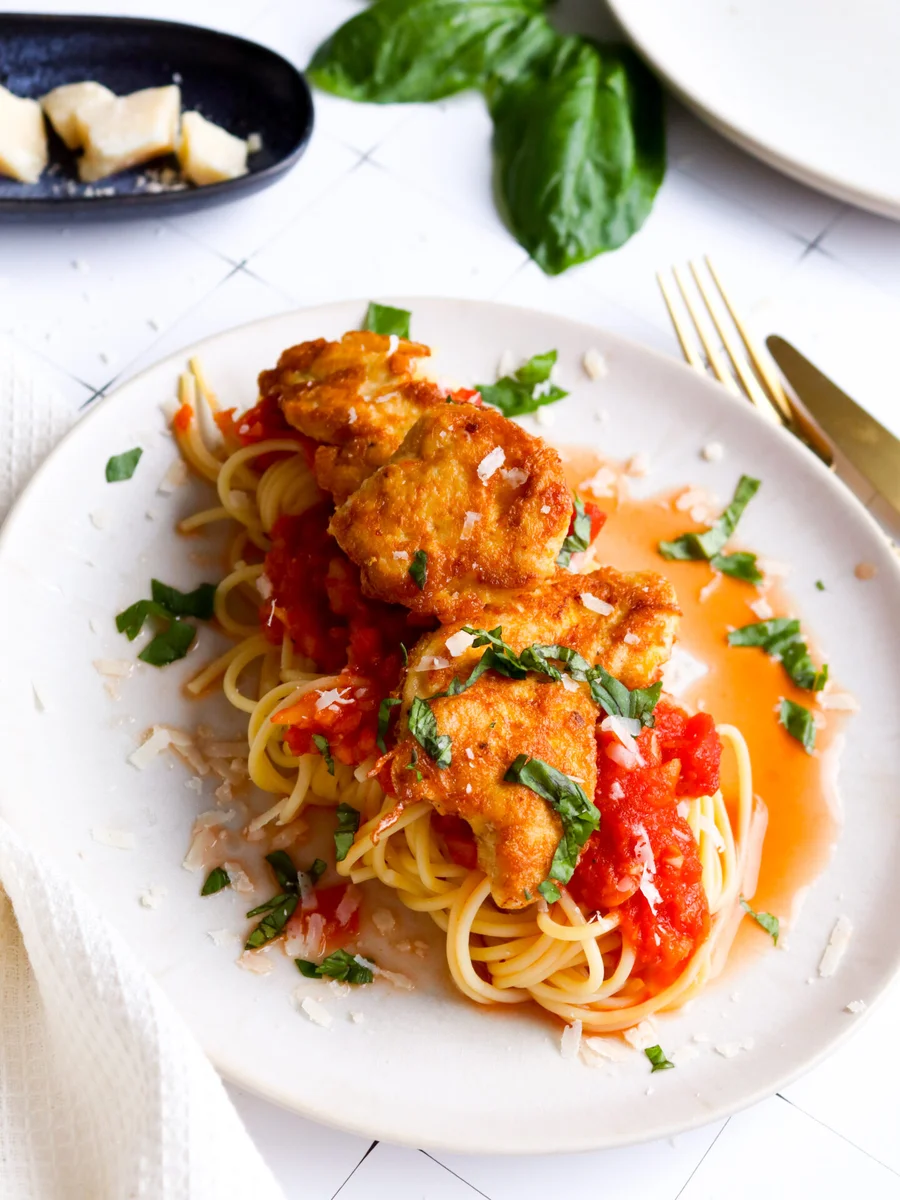
Piccata Milanese pairs Parmesan-coated chicken with spaghetti and a slow-simmered tomato sauce. It makes a generous Italian-inspired meal, with the chicken cooked in batches and kept warm while you finish the rest.
Ingredients
- 2 canschopped tomatoes
- 1/2celeriac or 2 celery stalks
- 1onion
- 2 mediumcarrots
- 1 clovegarlic
- 1 tbsptomato purée
- 2 tbspolive oil
- to tastesalt and pepper
- to tastesugar
- 2 pinchesvegetable stock
- 600 gchicken breast
- 70 gParmesan, grated
- 3eggs
- 1 dashmilk
- 50 gplain flour
- to tastesalt and pepper
- 3 tbspclarified butter
- to tasteolive oil
- 400 gspaghetti
Instructions
- 1
Prepare vegetables
Peel the vegetables and cut them roughly.
- 2
Brown aromatics
Warm a teaspoon of olive oil and brown the onion and garlic.
- 3
Sauté vegetables
Add the chopped celeriac and carrots and sauté until they take on some colour.
- 4
Add tomato purée
Stir in the tomato purée.
- 5
Add tomatoes
Once everything has coloured slightly, add the cans of chopped tomatoes.
- 6
Rinse the cans
Add water to one can and swirl it around, then pour it into the other can to collect the remaining tomato. Add this tomato water to the sauce.
- 7
Season sauce
Season the sauce with salt and pepper to taste.
- 8
Add seasoning
Add one teaspoon of sugar and two pinches of vegetable stock.
- 9
Simmer sauce
If you want a smooth sauce, purée it now, then leave it to simmer over a low heat.
- 10
Cook spaghetti
Meanwhile, cook the spaghetti according to the packet instructions.
- 11
Heat the oven
Preheat the oven to 80°C.
- 12
Prepare chicken
Get the chicken ready for the piccata.
- 13
Season chicken
Slice the chicken into thin pieces and season them generously with salt and pepper.
- 14
Set out bowls
Place two deep plates beside the chicken strips.
- 15
Add flour
Put the flour in the first plate.
- 16
Mix egg coating
In the second plate, beat the eggs with a generous dash of milk and about 20 g, or one third, of the grated Parmesan.
- 17
Reserve Parmesan
Set the remaining Parmesan aside for the spaghetti.
- 18
Heat the fat
Heat the olive oil and clarified butter in a pan.
- 19
Coat the chicken
Once the oil is hot, coat each piece of chicken individually using the two plates.
- 20
Dip and fry
Coat each piece first in flour, then in the egg and cheese mixture, covering both sides. Put it straight into the pan to cook.
- 21
Cook until done
Fry each piece for 1–2 minutes per side, continuing until the chicken is cooked through.
- 22
Keep warm
Line an ovenproof dish with paper towel, add the cooked piccata and keep it in the warm oven until needed.
- 23
Cook remaining chicken
Repeat the coating and cooking process with the remaining chicken.
- 24
Serve the meal
Serve the chicken with spaghetti and tomato sauce, and scatter over the remaining Parmesan.
What is Piccata Milanese?
Piccata Milanese is an Italian-style plate of thin, coated chicken served here with spaghetti and tomato sauce. This version uses an egg-and-Parmesan coating rather than a plain breadcrumb layer.
The recipe’s approach relies on familiar Italian flavours: Parmesan, tomato, olive oil and pasta. The chicken cooks quickly, while the vegetable-rich sauce simmers alongside it.
Nutrition and macros by portion
The nutrition label shows one serving as written: 640 calories, 0g protein, 0g carbs, 0g fat.
| Portion | Adjustment | kcal | Protein | Carbs | Fat |
|---|---|---|---|---|---|
| Lighter | Less spaghetti, more vegetables | 448 kcal | 0g | 0g | 0g |
| This serving | As written | 640 kcal | 0g | 0g | 0g |
| Hungry | Larger pasta portion | 960 kcal | 0g | 0g | 0g |
The spaghetti and flour provide much of the carbohydrate, while olive oil, clarified butter, eggs and Parmesan contribute fat; chicken and Parmesan provide protein. To balance the plate, serve it with green vegetables or salad.
The tomato sauce
Vegetable base: Onion, garlic, celeriac and carrots build the sauce’s savoury foundation. Sauté them until lightly coloured before adding the tomato purée and chopped tomatoes.
Tomato water: Rinsing the cans into one another recovers tomato left behind and adds the water to the sauce. The recipe then seasons it with salt, pepper, sugar and vegetable stock.
Getting the chicken ready
Thin slices: Cut the chicken into thin pieces so it cooks quickly and evenly. Season both sides before coating.
Two-stage coating: Flour goes on first, followed by beaten egg, milk and about 20 g of the Parmesan. Keep the remaining cheese for serving with the spaghetti.
Frying the piccata
Hot pan: Heat the olive oil with clarified butter before adding the coated chicken. Dip each piece just before it goes into the pan so the coating stays in place.
Small batches: Fry the pieces for 1–2 minutes on each side, as directed, and continue until cooked through. Transfer finished chicken to the paper-towel-lined dish and hold it in the 80°C oven.
Timing the meal
Sauce first: Let the sauce simmer on low heat while you prepare the chicken and pasta. If you prefer it smooth, purée it before simmering.
Finish together: Cook the spaghetti according to its packet instructions while the chicken is being prepared. Keep the cooked chicken warm until you are ready to plate everything.
Serving suggestions
Plate the spaghetti with tomato sauce and serve the chicken alongside or on top. Finish with the reserved Parmesan.
For a simple accompaniment, add a green salad or cooked green vegetables. These go alongside the recipe without changing its main components.
Recipe notes & tips
- Slice the chicken evenly so the pieces cook at a similar pace.
- Set out the flour and egg mixture before you start coating the chicken.
- Use the stated 20 g of Parmesan in the egg mixture and save the rest for serving.
- Add the coated chicken to the pan as soon as it is dipped.
- Keep cooked pieces in the low oven while you finish frying the rest.
- Check the spaghetti packet for its cooking time.
Variations
- Use celery: Choose two celery stalks instead of half a celeriac.
- Smooth sauce: Purée the tomato and vegetable sauce before simmering.
- More vegetables: Serve with cooked greens or a crisp salad.
- Extra Parmesan: Grate a little more over the finished plates if you have some available.
- Peppery finish: Add freshly ground black pepper at the table.
Common mistakes to avoid
- Uneven chicken slices: Cut the pieces to a similar thickness so they cook at roughly the same rate.
- Skipping the flour: Coat the chicken in flour before dipping it in the egg mixture.
- Crowded pan: Cook the chicken in batches so the pieces have room to fry.
- Overcooked chicken: Start checking after 1–2 minutes per side and continue until cooked through.
- Watery sauce: Let it simmer on low heat to reduce before serving.
- Using all the Parmesan in the coating: Reserve the remaining cheese for the spaghetti.
How to store
Refrigerate leftover chicken, sauce and spaghetti in separate airtight containers for up to 3 days. Reheat until piping hot; warm the sauce and pasta gently, and reheat the chicken in the oven to help the coating retain some texture.
Frequently asked questions
Can I use celery instead of celeriac?
Yes. The ingredient list gives two celery stalks as an alternative to half a celeriac.
Can I make the sauce smooth?
Yes. The method suggests puréeing the sauce before letting it simmer on a low heat.
How long should I fry the chicken?
The recipe gives 1–2 minutes on each side. Continue until the chicken is cooked through.
Why is the oven set to 80°C?
It is used to keep the cooked piccata warm while you fry the remaining pieces.
Can I prepare the sauce ahead?
You can make the sauce in advance and reheat it gently before serving. Cook the spaghetti and fry the chicken close to mealtime for the best texture.
Cook it from the original
This recipe comes from sabrinastable.com. Their page has the author’s own photos, notes and tips — the best place to cook it from.
Open the recipe on sabrinastable.com