
Mango Brioche Donuts
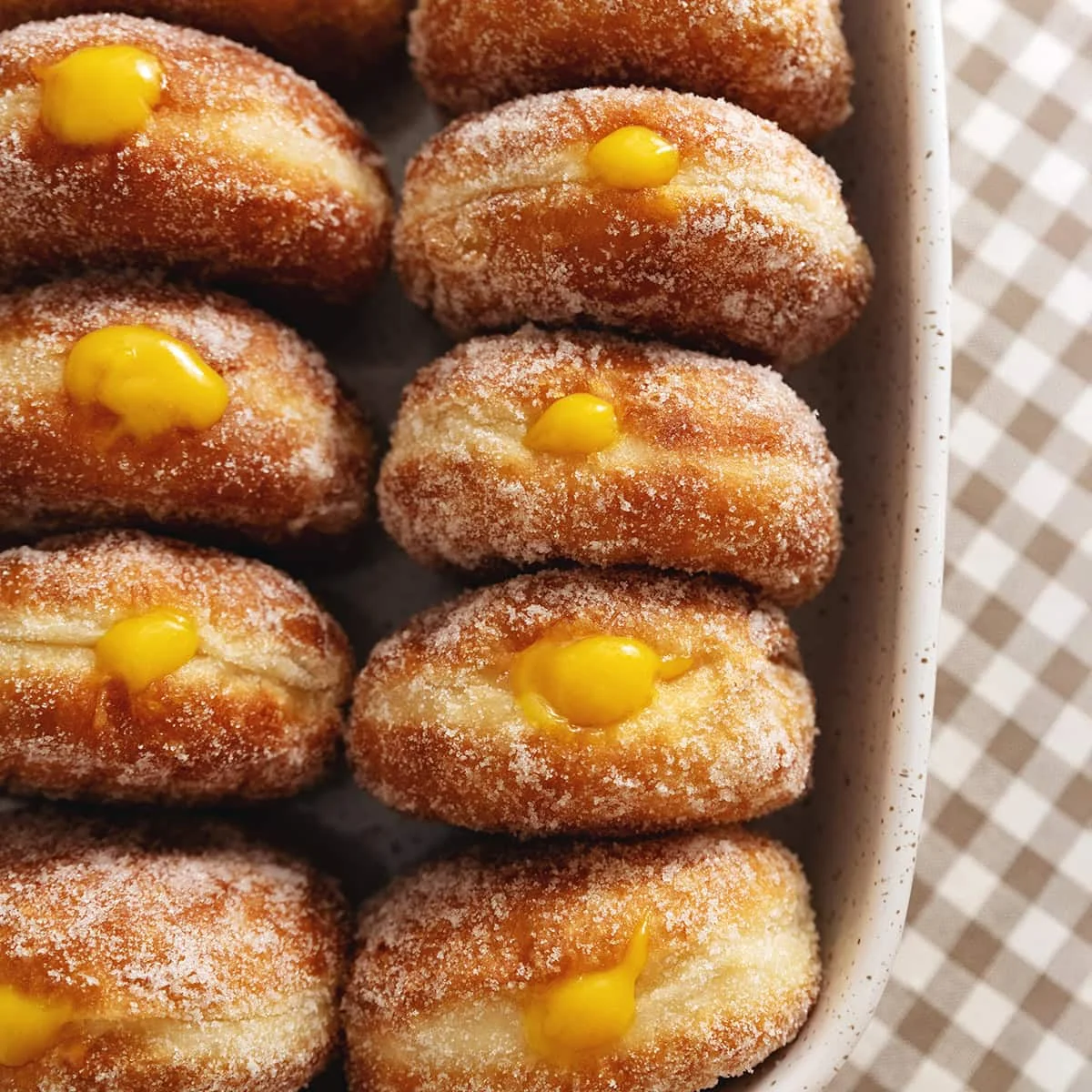
These soft, enriched brioche doughnuts are fried until golden, rolled in sugar and filled with sweet mango curd. They take a little time to rise, but the fruity filling makes them a lovely choice for a special weekend bake.
Ingredients
- 600 gfresh mango chunks
- 150 ggranulated sugar
- 45 gcornflour
- 45 ml (3 tablespoons)water
- 90 gunsalted butter, roughly cubed
- 160 gwarm water
- 2 tablespoonsgranulated sugar
- 1½ teaspoonsinstant yeast or active dried yeast
- 360 gplain flour
- 1 teaspoonsalt
- 2 largeeggs, at room temperature
- 115 gunsalted butter, roughly cubed and softened to room temperature
- 100 ggranulated sugar
Instructions
- 1
Blend the mango
Blend the mango chunks for about 1 minute until smooth. Pour the purée into a small saucepan.
- 2
Thicken the curd
Stir the sugar into the mango purée and warm over a medium-high heat. In a small bowl, mix the cornflour with the water to make a slurry, then stir it into the pan. Cook, stirring often, until thickened; the mixture may sputter as it cooks.
- 3
Add the butter
Turn off the heat and stir in the 90 g butter, one cube at a time, until melted and incorporated. Transfer the curd to a bowl and cool completely at room temperature or in the fridge.
- 4
Activate the yeast
Put the warm water, 2 tablespoons sugar and yeast in the bowl of a stand mixer fitted with a dough hook. Stir and leave for 5 minutes, until slightly foamy.
- 5
Mix the dough
Add the flour, eggs and salt. Mix on low speed for 1 minute, until the dough comes together, then knead at medium speed for 6–8 minutes.
- 6
Knead in butter
With the mixer running, add the softened 115 g butter a few cubes at a time until incorporated. Knead for a further 6–8 minutes, until the dough pulls cleanly away from the sides of the bowl.
- 7
Oil the bowl
Push the dough to one side of the bowl and oil the exposed sides. Move the dough to the other side and oil the remaining sides of the bowl.
- 8
Prove the dough
Cover the bowl and leave the dough at room temperature for 1–2 hours, or in the fridge overnight, until doubled in size.
- 9
Prepare the papers
Cut parchment paper into twelve 10 × 10 cm squares and set them on a baking sheet.
- 10
Deflate the dough
Punch the air out of the dough and turn it onto a lightly floured surface. Press it out to remove any large air bubbles.
- 11
Divide the dough
Roll the dough into a log and cut it in half. Cut each half into 6 equal pieces, then weigh and adjust the pieces so they are about 60–70 g each.
- 12
Shape the doughnuts
With your hand in a claw shape, roll each piece firmly against a lightly floured surface into a tight ball. Put each ball on a parchment square and repeat with the remaining dough.
- 13
Prove the doughnuts
Leave the dough balls at room temperature for 1–2 hours, until risen and puffy. Gently press each one down to flatten it slightly.
- 14
Heat the oil
Heat about 5 cm of oil in a large pot over a medium-high heat until it reaches about 180°C.
- 15
Fry the doughnuts
Lower the doughnuts into the oil using the parchment corners, taking care not to overcrowd the pot. After about 10 seconds, remove the parchment with tongs. Fry each doughnut for 2–3 minutes per side, until golden brown.
- 16
Sugar the doughnuts
Lift the doughnuts from the oil with a slotted spoon and place them on a wire rack. Put the 100 g sugar in a shallow bowl and roll the doughnuts in it while still warm.
- 17
Fill the doughnuts
Insert a knife into the side of each doughnut and twist it to make an opening. Put the cooled mango curd in a piping bag fitted with a round nozzle, insert the nozzle into each opening and pipe in the filling.
What are mango brioche doughnuts?
Brioche is an enriched yeast dough made with butter and eggs, giving it a tender, rich crumb. This American-style filled doughnut pairs that soft dough with a mango curd centre and a coating of sugar.
The method gives the curd time to cool while the dough rises, so both components are ready for filling. Mango brings a bright, fruity contrast to the buttery dough.
Nutrition and macros by portion
The nutrition label shows one serving as written: 347 calories, 5g protein, 49g carbs, 15g fat.
| Portion | Adjustment | kcal | Protein | Carbs | Fat |
|---|---|---|---|---|---|
| Lighter | Smaller doughnut, less sugar | 243 kcal | 4g | 34g | 11g |
| This serving | As written | 347 kcal | 5g | 49g | 15g |
| Hungry | Serve two doughnuts | 521 kcal | 8g | 74g | 23g |
The dough and sugar provide most of the carbohydrates, while the butter and frying oil contribute much of the fat. Eggs and flour supply some protein, and the mango curd adds fruit and sweetness. For a more balanced plate, serve a doughnut with fresh fruit and plain yoghurt.
Making the mango curd
Smooth purée: Blend the mango thoroughly before cooking so the filling has an even texture. Stir regularly as the cornflour thickens it, especially once the mixture begins to sputter.
Butter: Add the cubes after taking the pan off the heat. Let the curd cool completely before piping so it stays thick inside the doughnuts.
Working with enriched dough
Yeast: The warm water should help activate the yeast without being hot. A slightly foamy surface after 5 minutes is the cue to continue.
Butter: Knead the butter in gradually rather than adding it all at once. The dough is ready after the final kneading when it pulls cleanly from the bowl sides.
Shaping and proving
Even pieces: Weighing the portions helps them cook at a similar rate. Roll each into a tight ball so the surface is smooth before the second rise.
Rise cues: The first prove is complete when the dough has doubled; the shaped doughnuts should look puffy after the second prove. The timing can vary, so use these visual cues alongside the stated ranges.
Frying to a golden finish
Oil temperature: Bring the oil to about 180°C before frying. Fry in batches rather than crowding the pot, and turn the doughnuts after 2–3 minutes on the first side.
Sugar coating: Roll each doughnut while it is still warm so the sugar adheres. Use a wire rack after frying to let excess oil drain away.
Filling and serving
Piping: Make a side opening with a knife, then guide the round nozzle into it and squeeze in the cooled curd. Stop when the doughnut feels filled; avoid forcing in more than it can hold.
Serve these freshly filled, with tea or coffee. Their sweetness also pairs well with fresh fruit on the side.
Recipe notes & tips
- Bring the eggs and butter for the dough to room temperature so they mix in more readily.
- Measure the dough portions by weight to help them fry evenly.
- Keep the curd covered while it cools to prevent a skin forming.
- Fry a few doughnuts at a time so the pot is not overcrowded.
- Let the doughnuts drain on a wire rack before rolling them in sugar.
Variations
- Citrus curd: Add finely grated lime zest to the mango purée for a sharper flavour.
- Mixed fruit: Replace some of the mango with ripe passion fruit pulp for a tangier filling.
- Spiced sugar: Mix a little ground cinnamon into the coating sugar before rolling.
- Vanilla curd: Stir vanilla into the mango curd after taking it off the heat.
- Smaller doughnuts: Divide the dough into more, smaller portions and watch the frying time closely.
Common mistakes to avoid
- Hot water: Water that is too hot can hinder the yeast; use warm water for activation.
- Adding butter too quickly: Large additions can be difficult to incorporate; add a few cubes at a time.
- Skipping the second prove: Frying before the dough balls are puffy can leave them dense; allow the full rise.
- Overcrowding the pot: Too many doughnuts make frying harder to manage; work in batches.
- Filling warm doughnuts: Hot dough can soften the curd; wait until the curd is cool before piping.
How to store
Store filled doughnuts in an airtight container in the fridge and eat within 2 days. Bring them towards room temperature before serving; reheating can make the curd runny, so avoid warming them for long.
Frequently asked questions
Can I make the mango curd ahead?
Yes. Cool it completely, cover and refrigerate it until you are ready to fill the doughnuts.
Can the dough prove overnight?
Yes. Cover the dough and leave it in the fridge overnight for the first rise, as directed.
How do I know the doughnuts are ready to fry?
After the second rise, they should look risen and puffy. Gently press them down slightly before frying.
Can I use active dried yeast?
Yes. The recipe allows either instant or active dried yeast; mix it with the warm water and sugar, then leave it for 5 minutes until slightly foamy.
How do I stop the curd spilling out?
Cool it completely before piping, then fill each doughnut through the side opening until it is full without forcing in too much.
Cook it from the original
This recipe comes from teakandthyme.com. Their page has the author’s own photos, notes and tips — the best place to cook it from.
Open the recipe on teakandthyme.com