
Salmon en papillote with vegetables
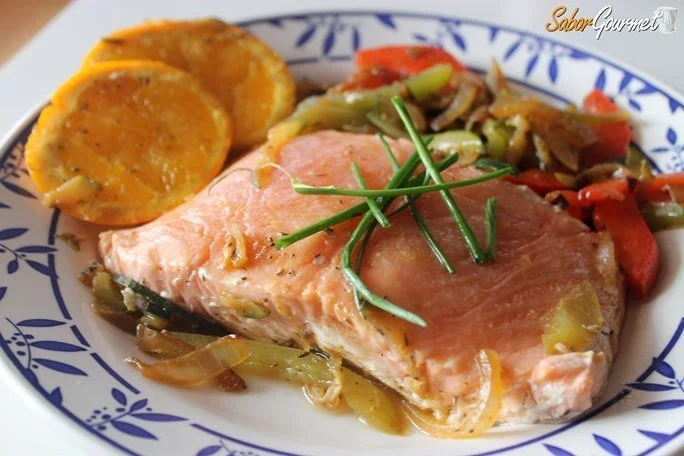
Salmon en papillote is baked in a sealed foil parcel with softened vegetables, orange and herbs. This quick one-person recipe keeps the salmon moist and makes its aromatic cooking juices part of the dish.
Ingredients
- 1salmon fillet
- 1/4onion
- 1/4courgette
- 1/4red pepper
- 1/4green pepper
- 1orange
- to tastewhite wine
- to tasteextra-virgin olive oil
- to tastethyme
- to tastechives
- to tasteblack pepper
- to tastebay leaf
- to tastesalt
Instructions
- 1
Heat the oven
Preheat the oven to 200°C.
- 2
Prepare the vegetables
Clean and cut the vegetables into long, thin strips. Soften the onion first with a little salt, then add the peppers and, last, the courgette. Season with salt, black pepper and a little thyme.
- 3
Reduce the wine
When the vegetables are nearly cooked, add a splash of white wine and let it reduce.
- 4
Build the parcel
Place the salmon in the centre of a piece of aluminium foil; if the fillet is very large, divide it between separate parcels. Top with chopped bay leaf and a slice of orange, then add the vegetables and any remaining cooking juices.
- 5
Seal the foil
Fold the foil over the centre and seal the sides until the parcel is closed tightly, like a pasty or a sweet wrapper.
- 6
Bake the salmon
Pour a little water into the base of an ovenproof dish. Put the sealed parcel in the dish and bake at 200°C for 10 minutes.
- 7
Open and serve
After 10 minutes, unwrap the parcel and plate the salmon and vegetables. Finish with a little fresh chive.
What is salmon en papillote?
En papillote means cooking food inside a sealed parcel, so the ingredients cook in the heat and moisture trapped inside. It is a familiar technique in French cooking, though cooks use it in many cuisines.
Here, salmon shares its parcel with softened peppers, courgette, onion and orange. Cooking the vegetables first gives them a head start, while the foil keeps their juices close to the fish.
Nutrition and macros by portion
The nutrition label shows one serving as written: 350 calories, 0g protein, 0g carbs, 0g fat.
| Portion | Adjustment | kcal | Protein | Carbs | Fat |
|---|---|---|---|---|---|
| Lighter | Use less olive oil | 245 kcal | 0g | 0g | 0g |
| This serving | As written | 350 kcal | 0g | 0g | 0g |
| Hungry | Add a potato side | 525 kcal | 0g | 0g | 0g |
Salmon provides most of the protein and fat, while the vegetables and orange contribute some carbohydrate; the olive oil also adds fat. For a more balanced plate, serve the parcel with a generous portion of salad or other vegetables.
Why prepare the vegetables first?
Cutting everything into strips helps the vegetables sit neatly around the fillet. Soften the onion before adding the peppers, then add the courgette last, as the method directs.
Reduced white wine and the vegetables’ cooking juices bring flavour to the parcel. Add the wine splash when the vegetables are nearly cooked and let it reduce before assembling.
Orange and herbs
Orange: a slice goes on top of the salmon, where it adds a fresh citrus note as the parcel cooks.
Seasoning: thyme, black pepper, bay leaf and salt flavour the fish and vegetables. Fresh chives are added after baking for a bright finish.
How to seal the parcel
Place the salmon in the centre of the foil and arrange the toppings over it. Fold the foil over the middle first, then close the sides so the parcel is tightly sealed.
Use a piece of foil large enough to enclose the fish and vegetables without forcing the folds. Keep the seam facing upwards when you place the parcel in the dish.
Timing and doneness
The oven should be at 200°C before the parcel goes in, and the stated baking time is 10 minutes. The exact result can depend on the thickness of the salmon fillet.
Open the parcel carefully, as hot steam may escape. Check that the centre of the fish is cooked to your liking before serving.
Serving the dish
Serve the salmon with the softened vegetables and spoon over any juices left in the foil. A simple side of potatoes or bread can make the meal more substantial.
A crisp green salad also works well alongside the warm parcel. Add the fresh chives just before bringing it to the table.
Recipe notes & tips
- Slice the vegetables into similar-sized strips so they soften at a similar rate.
- Add the courgette after the onion and peppers, as in the method, to avoid overcooking it.
- Let the white wine reduce before transferring the vegetables to the parcel.
- Seal the foil firmly to help keep the cooking juices inside.
- Open the parcel carefully and keep your hands clear of the escaping steam.
- Add fresh chives after baking so they retain their colour and fresh flavour.
Variations
- Add fennel: include a few thin strips with the other vegetables.
- Use lemon: replace the orange slice with a slice of lemon for a sharper citrus flavour.
- Change the herbs: use a little parsley in place of the chives.
- Add cherry tomatoes: put a few halved tomatoes in the parcel with the softened vegetables.
- Serve with potatoes: add boiled or roasted potatoes on the side for a heartier meal.
Common mistakes to avoid
- Loose foil: the juices can escape, so fold the centre and sides firmly closed.
- Thick vegetable pieces: they may not soften in time, so cut them into thin strips.
- Skipping the reduction: excess wine can make the parcel watery, so let it reduce before assembling.
- Overbaking: the salmon may become dry, so start checking the centre after the stated 10 minutes.
- Opening too quickly: hot steam can burn, so unwrap the parcel cautiously and away from your face.
How to store
Refrigerate leftovers in a covered container and eat within 2 days. Reheat gently until piping hot, or enjoy the salmon cold; avoid reheating it repeatedly.
Frequently asked questions
Can I use baking parchment instead of foil?
Yes, parchment can be used to make a sealed cooking parcel. Fold it securely and place it in the ovenproof dish.
Can I prepare the vegetables ahead?
You can cut the vegetables in advance and keep them covered in the fridge. For the best texture, soften them and assemble the parcel close to cooking time.
How do I know when the salmon is cooked?
Check the thickest part after the 10-minute bake. It should be cooked through to your preference; thicker fillets may need longer.
Can I leave out the white wine?
Yes. The dish will still cook in the parcel, though it will have less of the wine’s flavour. You can use a small splash of water instead.
Can I make more than one serving?
Yes. Make a separate parcel for each fillet and avoid crowding the ovenproof dish. The cooking time may vary with the size and thickness of the salmon.
Cook it from the original
This recipe comes from saborgourmet.com. Their page has the author’s own photos, notes and tips — the best place to cook it from.
Open the recipe on saborgourmet.com