
Quiche Lorraine
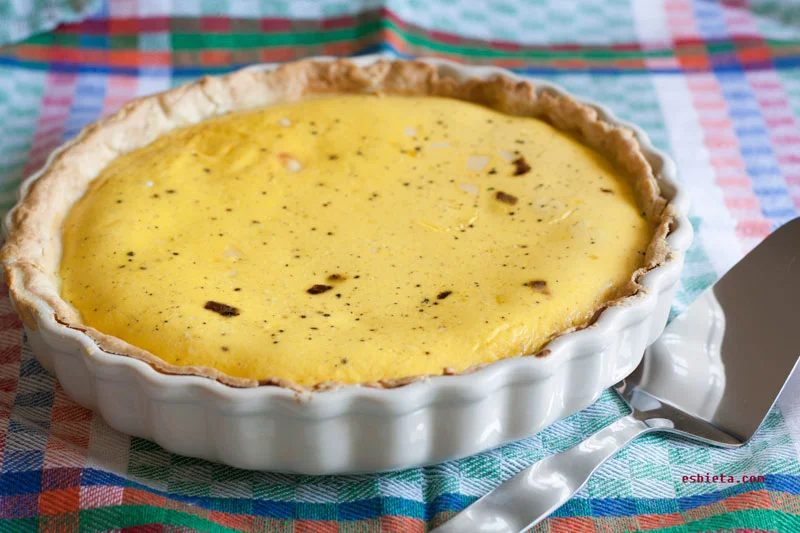
Quiche Lorraine is a savoury French tart with a crisp pastry case and a creamy filling of eggs, cooking cream, bacon and cheese. This version is made from scratch and uses a little mustard and nutmeg to season the filling.
Ingredients
- 150 gplain flour
- 1/2 teaspoonsalt
- 75 gcold butter, straight from the fridge
- 3–4 tablespoonsice-cold water
- 3eggs
- 300 mlcooking cream
- 75 gbacon
- 100 gcheese (emmental in this version)
- to tastesalt
- to tasteblack pepper
- to tastenutmeg
- 1 teaspoonmustard
Instructions
- 1
Mix the flour
Sift the flour into a bowl. Add 1/2 teaspoon of salt and stir it through.
- 2
Cut in butter
Dice the cold butter and add it to the flour. Use a pastry blender, two knives or a coarse grater to work it in until the mixture resembles crumbs, with the butter and flour evenly combined.
- 3
Form the dough
Add 3 tablespoons of ice-cold water and mix with a spoon. If the dough comes together into a ball, do not add the fourth tablespoon; otherwise, add just enough to bring it together. Press it into a ball with your hands without kneading.
- 4
Chill the dough
Wrap the dough in cling film and chill it in the fridge for at least 30 minutes.
- 5
Prepare the filling
While the dough chills, dice the cheese and chop the bacon. Fry the bacon in a dry pan, then drain it on a paper towel.
- 6
Mix the custard
Crack the eggs into a bowl and add the cream and mustard. Season with salt and black pepper, add a pinch of nutmeg, and mix again, taking care not to use too much nutmeg.
- 7
Line the tin
Roll the chilled dough into a circle and use it to line the tin. Roll over the top to trim away excess pastry, then chill the lined tin for another 15 minutes.
- 8
Blind-bake pastry
Preheat the oven for at least 20 minutes to 200°C. Prick the pastry base in several places with a fork, cover it with baking weights such as dried pulses or ceramic baking beads, and bake for 15 minutes.
- 9
Dry the base
Remove the tin from the oven, take off the weights and bake the pastry for a further 10 minutes.
- 10
Fill the pastry
Scatter the diced cheese and fried bacon over the pastry case. Pour in the egg and cream mixture.
- 11
Bake the quiche
Bake on the centre shelf at 200°C for about 20 minutes, until the filling has set but still wobbles slightly when you move the tin.
What is Quiche Lorraine?
Quiche Lorraine is a French savoury tart, traditionally associated with the Lorraine region. Its defining feature is a rich egg-and-cream filling baked in a pastry case, often with bacon.
This version adds emmental and mustard to the bacon filling. A homemade, crumbly pastry and a gently wobbly centre give it a crisp base and creamy texture.
Nutrition and macros by portion
The nutrition label shows one serving as written: 650 calories, 25g protein, 29g carbs, 48g fat.
| Portion | Adjustment | kcal | Protein | Carbs | Fat |
|---|---|---|---|---|---|
| Lighter | Smaller slice, extra salad | 455 kcal | 18g | 20g | 34g |
| This serving | As written | 650 kcal | 25g | 29g | 48g |
| Hungry | Larger slice | 975 kcal | 38g | 44g | 72g |
The flour supplies most of the carbohydrates, while butter, cream and cheese contribute much of the fat; the eggs, bacon and cheese provide protein. Pair a slice with a generous green salad or vegetables for a more balanced plate.
A crumbly pastry case
Cold butter: keeping it chilled helps it stay in small pieces as it is worked into the flour, rather than blending into a smooth paste.
Minimal handling: press the dough together instead of kneading it. Add water gradually, stopping as soon as the dough forms a ball.
Why the pastry is baked twice
Baking weights: these hold the pastry down during the first 15-minute bake so the base does not puff up.
Uncovered base: removing the weights and baking for another 10 minutes helps dry the pastry before the filling goes in.
Building the filling
Bacon: frying it without added fat browns it and lets you drain away excess grease before adding it to the tart.
Emmental: cut the cheese into small dice so it can be spread across the pastry with the bacon. Mustard and a restrained pinch of nutmeg season the egg-and-cream mixture.
When the quiche is done
The filling should look set rather than liquid, but the centre should still tremble a little when you gently move the tin. It will continue to firm as it stands.
Keep to the stated bake time as a guide and check the centre's movement near the end. Baking until the surface is completely firm can make the filling less creamy.
Timing and serving
The pastry needs at least 30 minutes to chill, followed by another 15 minutes once the tin is lined. The recipe also calls for at least 20 minutes of oven preheating and staged baking.
Serve a slice with a green salad or simply dressed vegetables to add freshness alongside the rich pastry and filling.
Recipe notes & tips
- Keep the butter and water cold while making the pastry.
- Start with 3 tablespoons of water and add more only if the dough will not come together.
- Chill the lined pastry case for the full 15 minutes before baking it.
- Use dried pulses or ceramic baking beads as weights, and remove them before the second bake.
- Drain the bacon after frying so excess grease does not collect in the filling.
- Use only a small pinch of nutmeg, as its flavour can quickly dominate.
Variations
- Try another cheese: replace the emmental with a similarly firm cheese that melts well.
- Add herbs: stir chopped fresh herbs into the egg and cream mixture for a different savoury note.
- Use a different mustard: swap in another mustard, keeping the quantity at 1 teaspoon.
- Add vegetables: use well-drained cooked vegetables alongside the bacon so they do not make the filling watery.
Common mistakes to avoid
- Adding all the water at once: begin with 3 tablespoons and add the fourth only if needed to form the dough.
- Kneading the pastry: press it together gently instead, so it stays crumbly.
- Skipping the weights: cover the pricked pastry base with baking weights for its first 15 minutes in the oven.
- Leaving the bacon greasy: drain it on a paper towel after frying.
- Overdoing the nutmeg: add only a pinch, since too much can overwhelm the filling.
- Overbaking the centre: take the quiche out when the filling is set but still wobbles slightly.
How to store
Cool leftovers, cover them and refrigerate for up to 3 days. Reheat portions in the oven until warmed through; the pastry may soften during storage.
Frequently asked questions
Can I make the pastry ahead?
Yes. Wrap the dough and keep it chilled until you are ready to line the tin. Allow enough time for the separate 15-minute chill once the tin is lined.
What can I use instead of ceramic baking beads?
Dried pulses can be used as weights, as noted in the method. They keep the pastry base from lifting during the first bake.
Why does the pastry need a second bake?
The extra 10 minutes without the weights helps dry the base before adding the filling.
How can I tell when the quiche is ready?
The filling should be set, with a slight wobble when you move the tin. The method gives about 20 minutes at 200°C as a guide.
Can I use a different cheese?
Yes. Emmental is the cheese used in this version, but you can choose another cheese that is suitable for baking in a savoury tart.
Can I skip the mustard?
You can leave it out, though it is part of this recipe's filling. Keep the other seasonings to taste.
Cook it from the original
This recipe comes from recetasdesbieta.com. Their page has the author’s own photos, notes and tips — the best place to cook it from.
Open the recipe on recetasdesbieta.com