
Easy French Bread Recipe
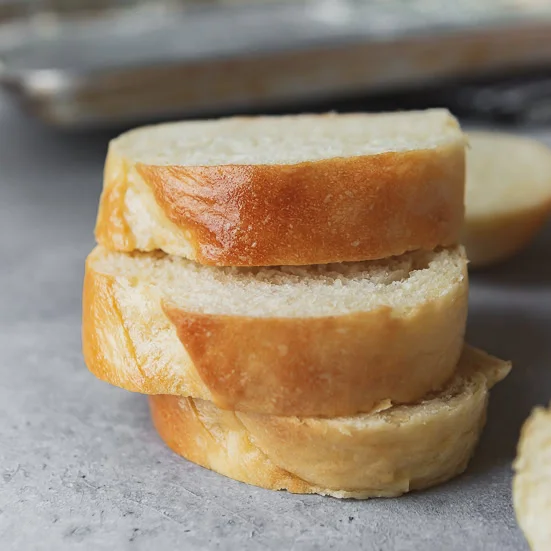
This easy French bread is made with a simple yeast dough, shaped into two long loaves and baked until golden. It is a useful recipe for sandwiches, toast or serving alongside a meal.
Ingredients
- 532 ml (2 1/4 cups)warm water
- 9 g (1 tablespoon)instant yeast
- 25 g (2 tablespoons)sugar
- 625–688 g (5–5 1/2 cups)plain flour
- 15 ml (1 tablespoon)canola oil or vegetable oil
- 12.5 g (2 1/2 teaspoons)fine sea salt
- 1 stickbutter, for brushing
Instructions
- 1
Foam the yeast
Combine the warm water, yeast and sugar in a glass measuring jug. Set aside until the mixture becomes foamy.
- 2
Mix the dry ingredients
Put 3 cups of the flour, the oil and salt in a stand mixer and mix to combine.
- 3
Make the dough
Add the yeast mixture and mix on low with a dough hook. Gradually add more flour in 1/2-cup portions until the dough is slightly sticky but has pulled away from the bowl's sides. The method says to use 5 1/2–6 cups of flour in total. Mix for a further 2–3 minutes.
- 4
Rest and knead
Cover the bowl with a towel or plastic and leave the dough for 10 minutes. Return it to the mixer and mix for 1 minute, then rest for another 10 minutes.
- 5
Repeat the cycles
Repeat the resting and kneading process for 4 more cycles. If short on time, the source suggests skipping those cycles: oil a clean bowl, put in the dough and turn it so it is coated, then cover and leave it to rest for 1 hour.
- 6
Divide the dough
Spread a little oil over the work surface. Turn out the dough and divide it in half.
- 7
Shape the loaves
Press each piece into a thick rectangle about the size of a 23 × 33 cm (9 × 13-inch) pan. Starting at a long edge, roll up the dough and press gently as you go to push out air pockets.
- 8
Proof the loaves
Pinch the edge of each loaf to seal it. Place both loaves seam-side down on a large baking sheet lined with baking paper, cover with a towel and leave to rise for 1 hour.
- 9
Heat and slash
Position a rack in the centre of the oven and heat it to 200°C (400°F). Use a sharp blade to slash the tops of the loaves.
- 10
Bake with steam
Put the bread in the oven, toss 4 ice cubes into the bottom of the oven to create steam, and close the door.
- 11
Finish the crust
Bake for 15–20 minutes, covering the loaves with foil if needed. Remove them from the oven and rub the top of each with butter.
What is French bread?
French bread is a long, shaped yeast loaf with a browned crust and a soft interior. This version uses a straightforward enriched dough and makes two loaves, so it is handy for sharing or setting aside for later.
The recipe’s approach combines brief kneading and resting cycles with a final rise after shaping. Steam at the start of baking helps the crust develop, while the butter brushed on after baking gives the tops a soft finish.
Nutrition and macros by portion
The nutrition label shows one serving as written: 546 calories, 15g protein, 112g carbs, 3g fat.
| Portion | Adjustment | kcal | Protein | Carbs | Fat |
|---|---|---|---|---|---|
| Lighter | Skip the butter finish | 382 kcal | 11g | 78g | 2g |
| This serving | As written | 546 kcal | 15g | 112g | 3g |
| Hungry | Serve a larger slice | 819 kcal | 23g | 168g | 5g |
The flour supplies most of the carbohydrate, while the yeast adds some protein. The oil and butter contribute fat, though the recipe’s listed nutrition per serving reports 3 g of fat. Pair a portion with vegetables and a protein-rich filling or side to make it part of a more balanced plate.
Choosing the flour
Flour amount: the listed quantity is 5–5 1/2 cups, while the method says to use 5 1/2–6 cups in total. Add it gradually and use the dough’s feel and appearance as your guide, rather than tipping it all in at once.
Salt and yeast: fine sea salt distributes readily through the dough, while instant yeast is mixed directly with the warm water and sugar here. Let that mixture stand until foamy before adding it.
Working the dough
Gradual additions: mixing in flour by half-cup increments makes it easier to stop when the dough is slightly sticky and has pulled away from the bowl. A dough that is too stiff may be harder to shape into a soft loaf.
Resting cycles: the repeated short rests and brief mixing give the dough time to relax between kneads. If you need to simplify the process, the recipe offers a covered, one-hour rest in an oiled bowl instead.
Shaping two loaves
Rectangles: press each half into a thick rectangle roughly the size of a 23 × 33 cm pan. Rolling from a long edge creates the loaves’ length.
Seams: press out obvious air pockets as you roll, then pinch the edge closed. Set each loaf seam-side down so the join stays underneath during the rise and baking.
Proofing and doneness
Final rise: cover the shaped loaves and leave them for 1 hour. They should look risen and puffy before they go into the oven.
Baking cues: bake at 200°C for 15–20 minutes, using foil if the tops need protection. Check that the loaves have browned before taking them out; the recipe gives a time range rather than a more specific internal doneness test.
Using steam and butter
Steam: the recipe calls for 4 ice cubes to be tossed into the bottom of the oven as the bread goes in. Close the oven door promptly after adding them.
Finish: rub butter over the tops while the bread is freshly baked. It softens the crust, so leave this step out if you prefer a drier, crisper finish.
Serving the bread
Serve slices with soup, salad or a main dish that benefits from something to mop up a sauce. The loaves also work for sandwiches and toast.
For a simple snack, serve with butter or a savoury spread. If you are serving the bread as part of a meal, add a protein-rich dish and vegetables alongside it.
Recipe notes & tips
- Add the flour gradually so you can stop when the dough is slightly sticky and releases from the bowl.
- Use a towel or plastic to cover the dough during its rests so the surface does not dry out.
- Oil the work surface lightly before dividing the dough to make handling easier.
- Pinch the rolled edge firmly and place each loaf seam-side down on the tray.
- Have the loaves shaped and ready before heating the oven for the steam step.
- Keep an eye on the tops near the end of baking and cover with foil if needed.
Variations
- Herb loaf: knead finely chopped dried herbs into the dough for a savoury note.
- Garlic finish: mix crushed garlic into softened butter before brushing it over the hot loaves.
- Seeded tops: scatter seeds over the loaves just before baking for added crunch.
- Sandwich slices: shape the loaves evenly so they are easier to cut into uniform slices.
- Crisper crust: omit the butter brushed on after baking for a less softened crust.
Common mistakes to avoid
- Adding all the flour at once: the dough can become too firm; add it in half-cup portions and assess as you go.
- Skipping the seal: an open seam can loosen during baking; pinch the rolled edge closed and place it underneath.
- Crowding the tray: leave space between the loaves so they have room to rise and bake.
- Rushing the final rise: the recipe allows 1 hour; cover the loaves and let them become puffy before baking.
- Leaving the oven door open: steam escapes quickly; close it promptly after adding the ice cubes.
- Over-browning the tops: check during the 15–20-minute bake and cover with foil if needed.
How to store
Once completely cool, store the bread in an airtight bag or container at room temperature and use within 2–3 days. Rewarm slices in a toaster or warm the loaf briefly in the oven; freeze extra bread well wrapped for longer storage.
Frequently asked questions
Can I use active dry yeast instead of instant yeast?
The recipe specifies instant yeast. If substituting active dry yeast, follow the yeast packet’s guidance for activation and allow for any difference in rising time.
Why does the flour amount differ between the list and method?
The ingredient list gives 5–5 1/2 cups, while the method says 5 1/2–6 cups total. Add the flour gradually and stop when the dough is slightly sticky but has pulled away from the bowl.
Can I skip the repeated kneading and resting cycles?
Yes. The method offers an alternative: put the dough in a clean oiled bowl, turn it to coat, cover it and leave it for 1 hour.
How do I know when the loaves are ready?
Bake for 15–20 minutes at 200°C, until the loaves are browned. Cover them with foil during baking if their tops are colouring too quickly.
Can I make the dough ahead?
The recipe does not give an overnight or make-ahead method. For the most reliable timing, follow the specified rests and bake after the final 1-hour rise.
What should I serve with French bread?
It goes well with soup, salad or a saucy main, and can also be used for sandwiches or toast.
Cook it from the original
This recipe comes from ohsweetbasil.com. Their page has the author’s own photos, notes and tips — the best place to cook it from.
Open the recipe on ohsweetbasil.com