
Crispy Dosa Recipe
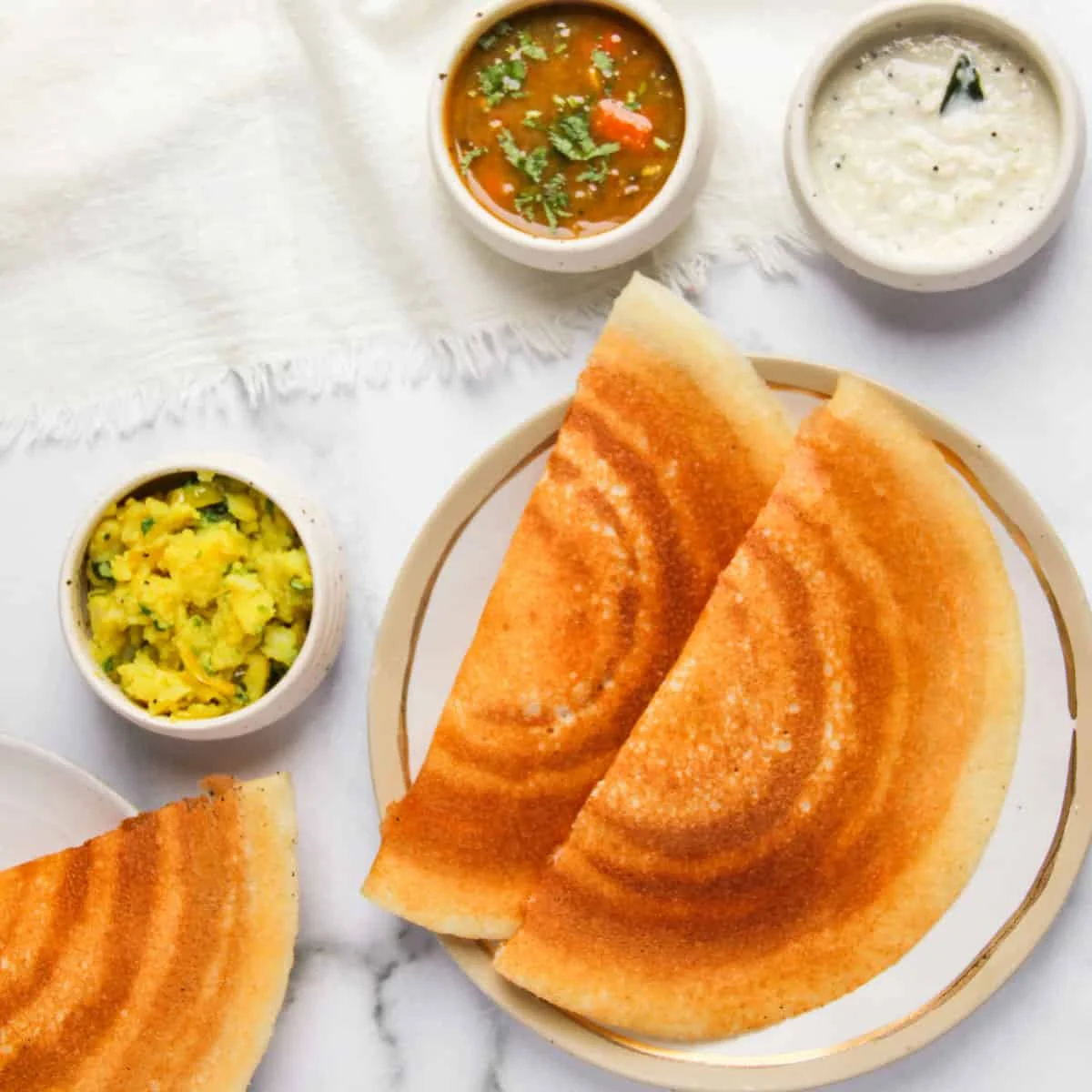
Crispy dosa are thin, golden South Indian savoury pancakes made from fermented rice and lentil batter. This recipe makes a batch to cook and serve fresh, with a choice of thin, crisp dosas or thicker ones.
Ingredients
- 300 gidli rice (or Sona Masoori rice, or half of each)
- 100 gurad dal
- 25 gchana dal
- 1 gfenugreek seeds
- 10 gthick poha
- 5 gsea salt
- 360 mlwater, divided
- 60 mlghee or oil
- ½onion (optional, for applying oil)
Instructions
- 1
Soak the dals
Rinse the urad dal and chana dal two or three times, then drain. Cover with 475 ml water and soak for 6–8 hours or overnight.
- 2
Soak the rice
Rinse the rice two or three times and drain it. Add the fenugreek seeds and poha, then soak in 590 ml water for 6–8 hours or overnight.
- 3
Blend the dals
Drain the lentils and put them in a blender with half the water allocated for grinding. Blend until smooth, then transfer to a large bowl or the Instant Pot insert.
- 4
Blend the rice
Drain the rice mixture and blend it with the remaining water allocated for grinding until slightly coarse. Add it to the bowl with the dal batter.
- 5
Ferment the batter
Add the salt and mix well. Put the insert in the Instant Pot and use the yoghurt setting on normal or ferment for 8 hours. In colder weather, fermentation may take up to 12 hours. The batter is ready when it is light and airy and has almost doubled in volume.
- 6
Adjust consistency
Mix the batter well and add more water if needed to make it easy to pour; about 120 ml is usually added at this stage. The recipe makes about 950 ml of batter.
- 7
Heat the pan
Warm a cast-iron pan or tawa over medium heat. Test it with a few drops of water: they should sizzle and evaporate quickly. To oil the surface, pierce the rounded side of the onion with a fork and rub its flat side over the pan, or use a silicone brush.
- 8
Spread the batter
Lower the heat. Pour about 60 ml of batter into the centre of the pan, then use the back of a ladle to spread it carefully outwards in a clockwise motion. For thicker dosas, use more batter or spread it less thinly; a larger pan may also need more batter.
- 9
Cook the dosa
Drizzle a little oil or ghee over the dosa and around its edges. Cook over medium heat for 4–5 minutes, until the underside turns golden. Run a flat spatula under the edge and towards the centre, then fold and serve.
- 10
Cook the rest
Repeat with the remaining batter. Between dosas, wipe the pan with a couple of damp paper towels to cool it slightly, then rub it with the onion before spreading the next dosa. Once the batter is spread, raise the heat to medium and cook until the underside is golden. If the pan is too hot, the batter may cling to the back of the ladle and be hard to spread thinly.
- 11
Choose thickness
The batter makes 16 thin dosas or 8 thicker ones. Thin dosas are cooked on one side only; if making thicker dosas, flip them and cook the other side for about a minute.
What are dosas?
Dosas are South Indian savoury pancakes made from rice and lentils that are soaked, ground and fermented before cooking. They are often spread thinly on a hot flat pan until crisp and golden.
This version combines idli rice, urad dal and chana dal, with fenugreek and poha in the soak. Fermentation gives the batter its airy quality, while the option to spread it thin or thick lets you choose the texture.
Nutrition and macros by portion
The nutrition label shows one serving as written: 258 calories, 6g protein, 40g carbs, 8g fat.
| Portion | Adjustment | kcal | Protein | Carbs | Fat |
|---|---|---|---|---|---|
| Lighter | Use less ghee or oil | 181 kcal | 4g | 28g | 6g |
| This serving | As written | 258 kcal | 6g | 40g | 8g |
| Hungry | Serve two dosas | 387 kcal | 9g | 60g | 12g |
Rice supplies most of the carbohydrates, while urad dal and chana dal contribute protein. Ghee or oil provides much of the fat; serve a dosa with vegetables and a protein-rich accompaniment for a more balanced plate.
The rice and lentils
Rice choice: Idli rice is specified, but Sona Masoori can be used on its own or mixed half and half with idli rice. Keeping the rice and lentils in separate soaking and blending batches helps each reach its intended texture.
Supporting ingredients: Fenugreek seeds and poha go into the rice soak, while chana dal is blended with the urad dal. Follow the separate soaking instructions so the batter is ready to ferment evenly.
Fermentation matters
Warmth: The recipe uses an Instant Pot yoghurt setting on normal or ferment for 8 hours. In colder conditions, allow up to 12 hours, as the batter may need longer to become light and nearly double in volume.
Readiness: Look for a noticeably airy batter that has risen substantially. The method gives these visual cues rather than relying on a fixed rise alone.
Getting a thin spread
Consistency: Mix the fermented batter, then add water as needed until it pours readily. The recipe notes that about 120 ml is usually added, but the amount can vary with the batter.
Pan temperature: A few drops of water should sizzle and evaporate quickly on a properly heated pan. If the pan is too hot, the batter can stick to the ladle instead of spreading smoothly.
Crispness and doneness
Thin dosas: Spread the batter outwards from the centre and cook on one side until the underside is golden, around 4–5 minutes. Thin dosas do not need flipping.
Thicker dosas: Use more batter or leave it less spread out. The method suggests flipping thicker dosas and cooking the second side for about a minute.
Cooking each dosa
Oil the pan: Rub the surface with the cut side of half an onion held on a fork, or use a silicone brush. The onion is optional, but the pan still needs oil or ghee to help prevent sticking.
Between batches: Wipe the pan with a couple of damp paper towels to bring its temperature down before spreading again. Then let it return to medium heat for cooking.
Serving ideas
Serve the dosas as soon as they are cooked, while their edges are crisp and their centres are warm. They work well alongside a savoury dip or a vegetable-based accompaniment.
For a mixed meal, pair them with a source of protein and vegetables. Keep the dosa folded or serve it flat, depending on whether you have made a thin or thicker version.
Recipe notes & tips
- Soak the rice and lentils separately for the full 6–8 hours or overnight.
- Blend the lentils smooth and leave the rice mixture slightly coarse, as directed.
- Allow up to 12 hours for fermentation in colder conditions.
- Add water gradually after fermentation until the batter pours easily.
- Use the water-drop test to check that the pan is hot before spreading.
- Wipe and cool the pan slightly between dosas to make spreading easier.
Variations
- Use Sona Masoori: Replace the idli rice with Sona Masoori rice, or use half of each.
- Make them thicker: Use more batter or spread it less thinly, then cook the second side briefly.
- Make them thinner: Use about 60 ml batter per dosa and spread it carefully outwards.
- Choose the cooking fat: Use ghee or oil to grease and cook the dosas.
- Skip the onion: Apply oil with a silicone brush instead.
Common mistakes to avoid
- Skipping the soak: Give the rice and lentils 6–8 hours or overnight to soak before blending.
- Blending the rice too smooth: Stop when the rice mixture is slightly coarse.
- Under-fermenting: Wait until the batter is airy and nearly doubled; allow up to 12 hours in colder weather.
- Using batter that is too thick: Add water gradually until it pours readily.
- Spreading on a very hot pan: Lower the heat and cool the pan slightly if the batter sticks to the ladle.
- Flipping thin dosas: Cook thin ones on one side only; flip only the thicker version.
How to store
Refrigerate leftover batter in a covered container and use it within 2–3 days; stir before cooking and adjust with a little water if needed. Cooked dosas are best fresh, but leftovers can be refrigerated for up to 2 days and reheated in a dry frying pan until warm.
Frequently asked questions
How long should dosa batter ferment?
The recipe allows 8 hours on the Instant Pot yoghurt setting, using normal or ferment mode. In colder weather, it may need up to 12 hours; look for batter that is airy and nearly doubled.
Can I use Sona Masoori rice?
Yes. Use it in place of the idli rice, or use half idli rice and half Sona Masoori.
How much water should I add after fermentation?
Add enough to make the batter pourable. The recipe usually uses about 120 ml at this point, but check the consistency as you go.
How do I stop the dosa sticking?
Oil the pan with the onion or a silicone brush and check that it is hot but not too hot. If the batter sticks to the ladle while spreading, cool the pan slightly before continuing.
Do I need to flip a dosa?
No, thin dosas are cooked on one side only. Flip thicker dosas and cook the second side for about a minute.
How many dosas does the batter make?
The recipe makes 16 thin dosas or 8 thicker ones.
Cook it from the original
This recipe comes from ministryofcurry.com. Their page has the author’s own photos, notes and tips — the best place to cook it from.
Open the recipe on ministryofcurry.com