
Chocolate Chip Challah
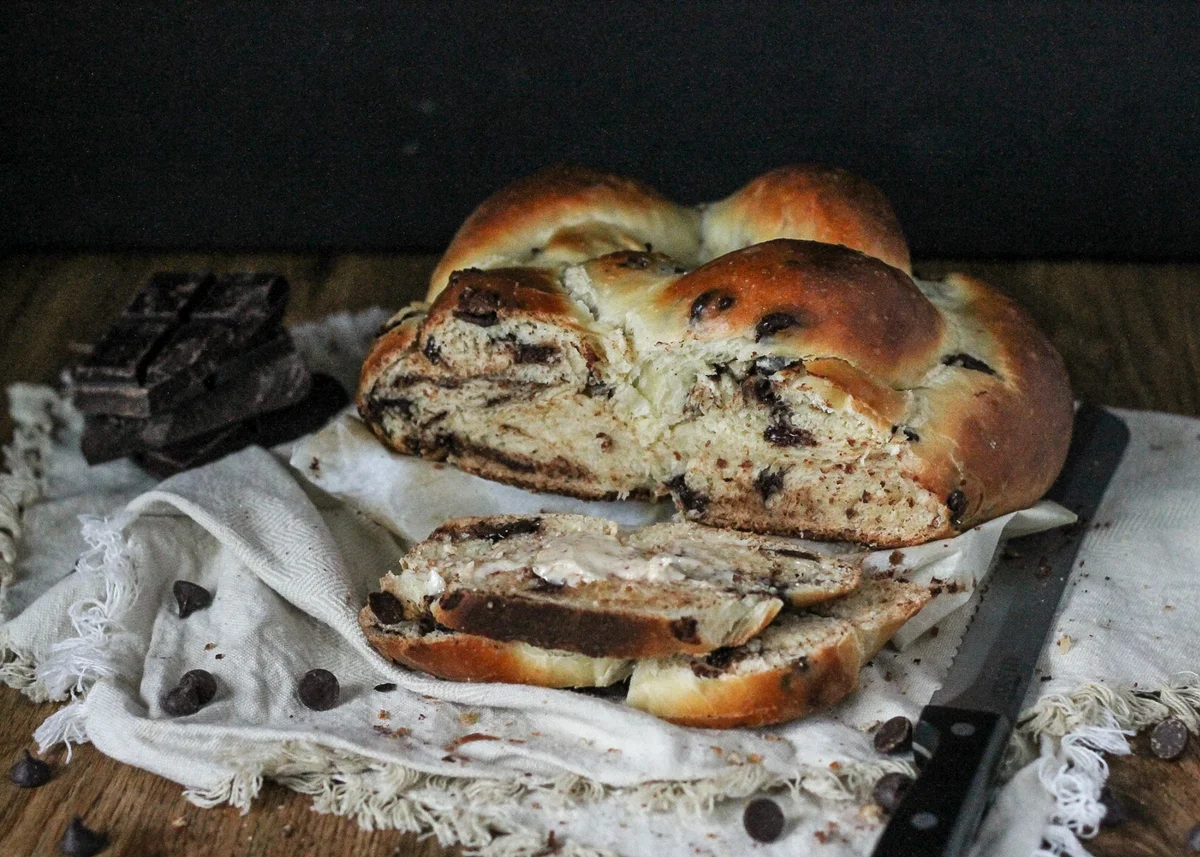
Chocolate chip challah is a soft, enriched braided bread with chocolate folded through its dough. It takes time to rise and bake, but makes a striking loaf for sharing at breakfast, brunch or alongside a cup of tea.
Ingredients
- 120 ml (½ cup), warm, about 43°C (110°F)water
- 57 g (4 tablespoons), meltedunsalted butter
- 2 largeeggs
- 1 largeegg yolk (save the white to glaze the top)
- 375 g (3 cups), plus an extra 63 g (½ cup) if neededplain flour
- 50 g (¼ cup)sugar
- 7 g (2¼ teaspoons)instant yeast
- 7 g (1¼ teaspoons)salt
- 170 g (1 cup)chocolate chips
Instructions
- 1
Mix and knead
In the bowl of a stand mixer fitted with a dough hook, combine 375 g flour, the sugar, yeast and salt. Whisk the warm water, melted butter, eggs and egg yolk together in a measuring jug. With the mixer on low, slowly add the liquid mixture and mix until a rough dough forms. Raise the speed to medium-low and knead for about 8 minutes, until the dough is smooth and elastic. It should pull away from the sides of the bowl while still sticking to the bottom. If it is too sticky, add up to 63 g extra flour a little at a time.
- 2
Let dough rise
Lightly grease a large bowl. Shape the dough into a smooth ball and place it in the bowl, then cover with cling film. Leave it to rise until doubled, about 1–2 hours. Press a finger into the dough to check: if it springs back, give it more time; if the indentation remains, continue to the next step.
- 3
Fill the ropes
Turn the risen dough out onto a floured worktop and cut it in half. Roll one half into a rectangle and scatter chocolate chips over it, then roll it tightly into a rope. Carefully stretch the rope from both ends as far as you can, then cut it in half. Repeat with the remaining dough.
- 4
Weave the challah
Arrange two dough ropes in each direction, perpendicular to one another, like a hash sign. Weave them so that one rope passes over and the other under at the centre. Take the four ends that emerge from underneath the centre and cross each over the rope to its right. Then take the ropes now underneath and cross each over the top rope towards the left. Repeat these alternating crossings if the ropes are long enough, then tuck the ends underneath with the sides of your hands to make a round loaf.
- 5
Glaze and prove
Set the shaped challah on a baking tray lined with baking parchment. Beat the reserved egg white and brush it over the dough. Leave the loaf to rise for another hour.
- 6
Bake until brown
Heat the oven to 190°C (375°F). Bake for 35–40 minutes, until deeply browned. If it darkens too quickly, cover it loosely with aluminium foil for the rest of the baking time. It is done when a thermometer inserted into the centre reads 91°C (195°F). Alternatively, lift it carefully with an oven glove and tap the base: it should sound hollow.
What is chocolate chip challah?
Challah is an enriched Jewish bread, traditionally shaped into a braid and served for Shabbat and other occasions. This version keeps the tender, lightly sweet dough and adds chocolate chips for a treat-like loaf.
The dough is divided and shaped into ropes before being woven into a round loaf. That method distributes the chocolate through the bread while giving it an appealing woven surface.
Nutrition and macros by portion
The nutrition label shows one serving as written: 3100 calories, 70g protein, 425g carbs, 112g fat.
| Portion | Adjustment | kcal | Protein | Carbs | Fat |
|---|---|---|---|---|---|
| Lighter | Smaller slice, less chocolate | 2170 kcal | 49g | 298g | 78g |
| This serving | As written | 3100 kcal | 70g | 425g | 112g |
| Hungry | Larger slice | 4650 kcal | 105g | 638g | 168g |
Most of the carbohydrates come from the flour, sugar and chocolate chips; butter and chocolate contribute much of the fat, while the eggs, flour and chocolate provide protein. This estimate treats the entire loaf as one serving, so share it into portions and pair a slice with fruit or yoghurt for a more balanced plate.
Build an elastic dough
Flour first: start with the stated 375 g and add the wet mixture gradually, so the dough comes together without becoming needlessly firm.
Add flour sparingly: the dough should clear the bowl's sides but remain attached to the bottom. Extra flour is there for a sticky dough, not as an automatic addition.
Give the dough time
First rise: wait for the dough to double, using the 1–2 hour estimate as a guide rather than a strict deadline. A cool kitchen can slow the rise.
Check the centre: a finger indentation that stays put is a useful sign that the dough has risen enough. If it springs back, leave it longer.
Shape without losing the filling
Roll tightly: an even, snug roll helps keep the chocolate chips inside the dough ropes. Stretch each rope gently; pulling too hard can tear it.
Weave evenly: alternate the crossings to form the round shape, and tuck loose ends underneath. The dough does not need to look perfectly uniform to bake well.
Watch the bake
Colour: the loaf should be deeply brown after 35–40 minutes, but check it as it bakes. If it is colouring too quickly, tent it with foil.
Doneness: a centre temperature of 91°C (195°F) is the clearest cue in the method. Without a thermometer, check for a hollow sound when you tap the base.
Serving ideas
Let the loaf cool before slicing so the crumb can settle and the chocolate is less likely to smear. Serve it as it is, or lightly toast slices.
Its sweetness suits a simple breakfast or brunch spread. Fruit or yoghurt on the side can add a fresh contrast.
Recipe notes & tips
- Bring the eggs to room temperature if you can, so they blend more easily into the dough.
- Add any extra flour a little at a time and stop once the dough has the texture described.
- Flour the worktop lightly when rolling the ropes to help prevent sticking.
- Stretch the ropes gently rather than pulling them sharply.
- Use foil if the crust is browning faster than the loaf is baking through.
- Allow the loaf to cool before cutting for neater slices.
Variations
- Dark chocolate: use dark chocolate chips for a less sweet-tasting loaf.
- Cinnamon: add a little ground cinnamon to the dry ingredients for a warm spice note.
- Orange: mix finely grated orange zest into the dough for a citrus accent.
- Smaller loaves: divide the shaped dough into smaller portions and check them earlier, as baking time may change.
- Plain challah: leave out the chocolate chips for a classic lightly sweet loaf.
Common mistakes to avoid
- Adding all the extra flour: too much can make the bread dense; add it gradually only if the dough is overly sticky.
- Rushing the first rise: dough that has not doubled may produce a tighter loaf; use the finger test before shaping.
- Tearing the ropes: stretching too forcefully can split the dough; ease it out in small movements.
- Loose rolling: chips can escape through gaps; roll the dough snugly around the filling.
- Skipping the second rise: bake only after the shaped loaf has had its full hour to rise.
- Judging by colour alone: a dark crust does not confirm the centre is baked; check its temperature or tap the base.
How to store
Once completely cool, keep the challah in an airtight container at room temperature for up to 2 days. Rewarm slices briefly in a low oven or toast them; freeze extra slices in a sealed bag for longer storage.
Frequently asked questions
Can I make this without a stand mixer?
Yes. Mix the dough by hand, then knead until smooth and elastic. It may take longer than the stated 8 minutes of machine kneading.
How do I know when the dough has doubled?
It should look roughly twice its original size. Press a finger into it: if the indentation stays, it is ready to shape.
Why is my dough taking longer than 2 hours to rise?
A cool room can slow yeast activity, as noted in the method. Wait until the dough has doubled rather than relying only on the clock.
Can I use active dry yeast instead of instant yeast?
The recipe specifies instant yeast, so changing yeast type may affect how it is mixed and how quickly the dough rises. Follow the packet's guidance if making that substitution.
Can I tell when the challah is baked without a thermometer?
Yes. Carefully lift the loaf with an oven glove and tap the bottom; it should sound hollow. A thermometer reading of 91°C (195°F) at the centre is the alternative check.
Why is my loaf getting dark before it is done?
Cover it loosely with aluminium foil for the remainder of baking, then continue until the centre is baked through.
Cook it from the original
This recipe comes from bakerita.com. Their page has the author’s own photos, notes and tips — the best place to cook it from.
Open the recipe on bakerita.com