
Dutch Pear Pie
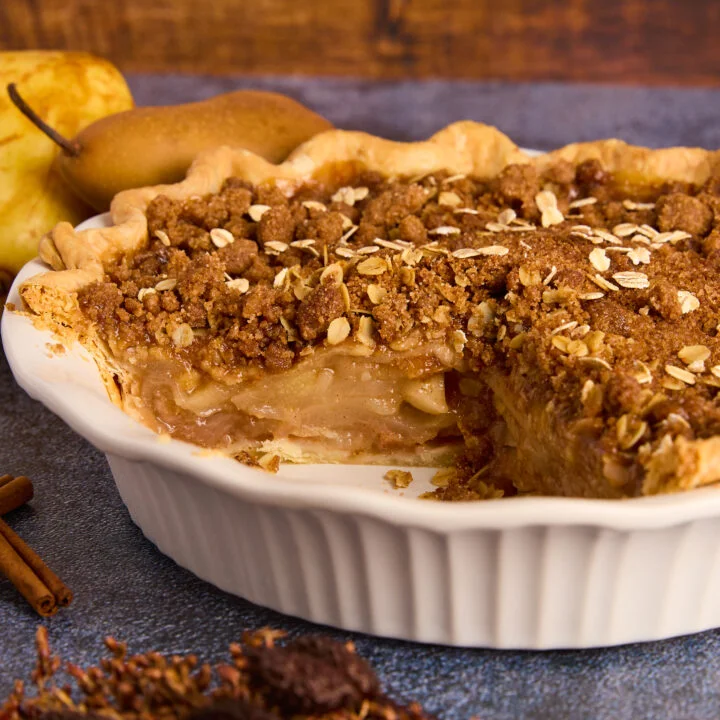
Dutch Pear Pie pairs a buttery pastry crust with spiced fresh pears and a crunchy oat streusel. It is a good choice when you want a fruit pie with a crisp topping and a filling that sets into neat slices after cooling.
Ingredients
- 180 gplain flour
- 1/2 teaspoonkosher salt
- 85 gunsalted butter, cold
- 30 gshortening
- 57–85 gice water
- 100 glight or dark brown sugar
- 100 ggranulated sugar
- 75 gplain flour
- 1 1/2 teaspoonscinnamon
- A pinchsalt
- 50 grolled or quick oats
- 56 gunsalted butter, melted
- 900 gpears, sliced, peeled or unpeeled
- 150 ggranulated sugar
- 30 gcornflour
- 1 teaspooncinnamon
- 1/4 teaspoonground ginger
- 1/4 teaspoonnutmeg
- 1/4 teaspoonkosher salt
- 30 glemon juice
- 28 gbutter, cut into small pieces
Instructions
- 1
Mix the flour
Whisk 180 g plain flour and 1/2 teaspoon salt together in a large mixing bowl.
- 2
Work in fat
Add 85 g cold butter and 30 g shortening, tossing to coat them in flour. Press the fat between your fingertips and thumbs to form small flakes, continuing until the pieces range from pea-sized to walnut-sized.
- 3
Add ice water
Starting with 57 g ice water, add it gradually and fold gently with a spatula. Use more as needed until large clumps form; press the dough together to check that it holds without crumbling.
- 4
Chill the dough
Bring the dough together on the work surface and press it into a flat round disc. Wrap it and refrigerate for at least 30 minutes, preferably 1 hour.
- 5
Roll the pastry
Lightly flour the work surface, dough and rolling pin. Roll the chilled dough until it extends about 4 cm beyond the pie dish on every side.
- 6
Line the dish
Lay the rolling pin across the centre of the pastry and fold the dough over it. Transfer it to the pie plate and gently unroll it.
- 7
Shape the crust
Lift the pastry edges so the dough settles into the dish without stretching. Crimp the edges, trim away excess and refrigerate the crust.
- 8
Heat the oven
Place an oven rack in the bottom third and set a baking tray or baking stone on it. Preheat the oven to 205°C.
- 9
Mix the streusel
In a medium bowl, whisk together 100 g brown sugar, 100 g granulated sugar, 75 g plain flour, 1 1/2 teaspoons cinnamon, a pinch of salt and 50 g oats.
- 10
Add melted butter
Stir in 56 g melted butter, then use your hands to make a crumbly mixture. Set the streusel aside.
- 11
Slice the pears
Slice 900 g pears about 0.6 cm thick, peeling them first if you prefer.
- 12
Season the filling
Toss the sliced pears with 20 g lemon juice in a large bowl. Add 150 g granulated sugar, 30 g cornflour, 1 teaspoon cinnamon, 1/2 teaspoon ginger, 1/4 teaspoon nutmeg and 1/4 teaspoon salt, then toss to coat.
- 13
Fill the crust
Spoon the pear mixture into the prepared crust. Dot the top with 28 g cold butter pieces.
- 14
Add the topping
Cover the pear filling with the oat streusel.
- 15
Bake the pie
Set the pie on a foil-lined baking tray and place it on the preheated surface. Bake at 205°C for 35 minutes, then reduce the oven to 175°C and bake for another 20–35 minutes, until the filling bubbles rapidly at the edges. If the crust browns too much, cover the pie loosely with foil; this may be needed at around 45 minutes.
- 16
Cool before slicing
Transfer the pie to a cooling rack and leave it for at least 3 hours so the filling can thicken before you slice it.
- 17
Store leftovers
Cover the fruit pie and refrigerate it for up to 3 days.
What is Dutch pear pie?
Dutch pear pie takes the fruit filling and crumbly topping associated with Dutch apple pie and gives them a pear-led twist. This version layers spiced pears in a homemade pastry shell beneath an oat streusel.
The pastry benefits from cold fat and a proper rest, while cornflour helps thicken the juices from the fruit. Together, those choices give the pie a crisp base and a filling that can set after baking.
Nutrition and macros by portion
The nutrition label shows one serving as written: 575 calories, 7g protein, 89g carbs, 23g fat.
| Portion | Adjustment | kcal | Protein | Carbs | Fat |
|---|---|---|---|---|---|
| Lighter | Smaller slice, yoghurt | 403 kcal | 5g | 62g | 16g |
| This serving | As written | 575 kcal | 7g | 89g | 23g |
| Hungry | Larger slice | 863 kcal | 11g | 134g | 35g |
The pears, sugars and flour provide most of the carbohydrates, while the butter and shortening contribute much of the fat. The pie contains a little protein from the flour and oats; serve a slice with plain yoghurt or alongside a less-rich meal for balance.
A pastry made with cold fat
Flaky pieces: pressing the cold butter and shortening into the flour leaves small pieces of fat throughout the dough. Keep them visible rather than blending them completely smooth.
Gentle water: add the ice water gradually and stop once the dough holds together when pressed. Too much handling can make the pastry tough.
Rest and shape the crust
Chilling: at least 30 minutes in the fridge gives the dough time to firm up; an hour is preferable. The cold dough is easier to roll and handle.
Fitting: ease the pastry into the dish instead of pulling it to the sides. Stretching can make it shrink as it bakes, so lift and settle the edges before crimping.
Build a crumbly topping
Oats and sugar: the oats add texture to a topping that combines brown sugar, granulated sugar, flour and cinnamon. Rolled or quick oats both work.
Butter: mix the melted butter in by hand until the mixture forms crumbs. Scatter those crumbs over the filling rather than pressing them into a solid layer.
Choose and prepare the pears
Pear mix: Bosc and Bartlett pears are suggested, but a single variety or another combination can be used. The recipe allows the peel to stay on or be removed.
Even slices: cut the pears about 0.6 cm thick so they cook at a similar pace. Tossing them with lemon juice helps limit browning before the remaining filling ingredients are added.
Look for bubbling filling
Hot surface: baking the pie on a preheated tray or stone helps the bottom crust cook through. A foil-lined tray beneath the pie catches any filling that spills over.
Doneness: after the temperature drops from 205°C to 175°C, bake until the filling is bubbling rapidly around the edges. Shield the top with foil if the crust has browned before the filling is ready.
Let it set, then serve
Cooling: leave the pie on a rack for at least 3 hours before cutting. The filling thickens as it cools, making slices easier to serve.
Serving: the sweet, spiced filling and crisp topping work well with plain yoghurt or a scoop of ice cream. A lighter accompaniment keeps the pear and oat textures in focus.
Recipe notes & tips
- Keep the butter and shortening cold while making the pastry.
- Add the ice water a little at a time, stopping as soon as the dough holds together.
- Use a baking tray or stone preheated with the oven to help cook the base.
- Line the tray beneath the pie with foil to catch any bubbling filling.
- Cover the pie loosely with foil if the crust browns before the filling bubbles.
- Wait at least 3 hours before slicing so the filling can set.
Variations
- Mix pear varieties: combine Bosc and Bartlett pears or use one variety.
- Leave the peel on: keep the pear skins for a more textured filling.
- Change the oats: use rolled or quick oats in the streusel.
- Adjust the spice: vary the cinnamon, ginger and nutmeg to suit your taste.
- Serve with yoghurt: add a spoonful of plain yoghurt alongside each slice.
Common mistakes to avoid
- Overworking the pastry: stop mixing once it comes together to avoid a tough crust.
- Adding all the water at once: add it gradually and use only enough for the dough to hold.
- Stretching the crust: ease it into the pie plate so it does not pull back during baking.
- Cutting too soon: cool the pie for at least 3 hours so the filling has time to thicken.
- Ignoring the browning: cover the top loosely with foil if it darkens before the filling bubbles.
How to store
Cover the pie and store it in the refrigerator for up to 3 days. Reheat individual slices gently in the oven if you prefer them warm.
Frequently asked questions
Do I need to peel the pears?
No. The recipe works with peeled or unpeeled pears, so choose the texture you prefer.
Which pears can I use?
Bosc and Bartlett are suggested, either together or on their own. The recipe also allows other pear varieties.
How do I know when the pie is baked?
The filling should be bubbling rapidly around the edges. If the crust gets sufficiently browned first, cover the pie loosely with foil while it finishes baking.
Why does the pie need to cool for so long?
The filling thickens as the pie cools. Leave it on a rack for at least 3 hours before slicing.
Can I make the pastry ahead?
The method calls for chilling the dough for at least 30 minutes, preferably 1 hour. Keep it wrapped in the refrigerator during that rest.
How long will leftovers keep?
Cover the pie and refrigerate it for up to 3 days.
Cook it from the original
This recipe comes from bakerbettie.com. Their page has the author’s own photos, notes and tips — the best place to cook it from.
Open the recipe on bakerbettie.com