
Challah
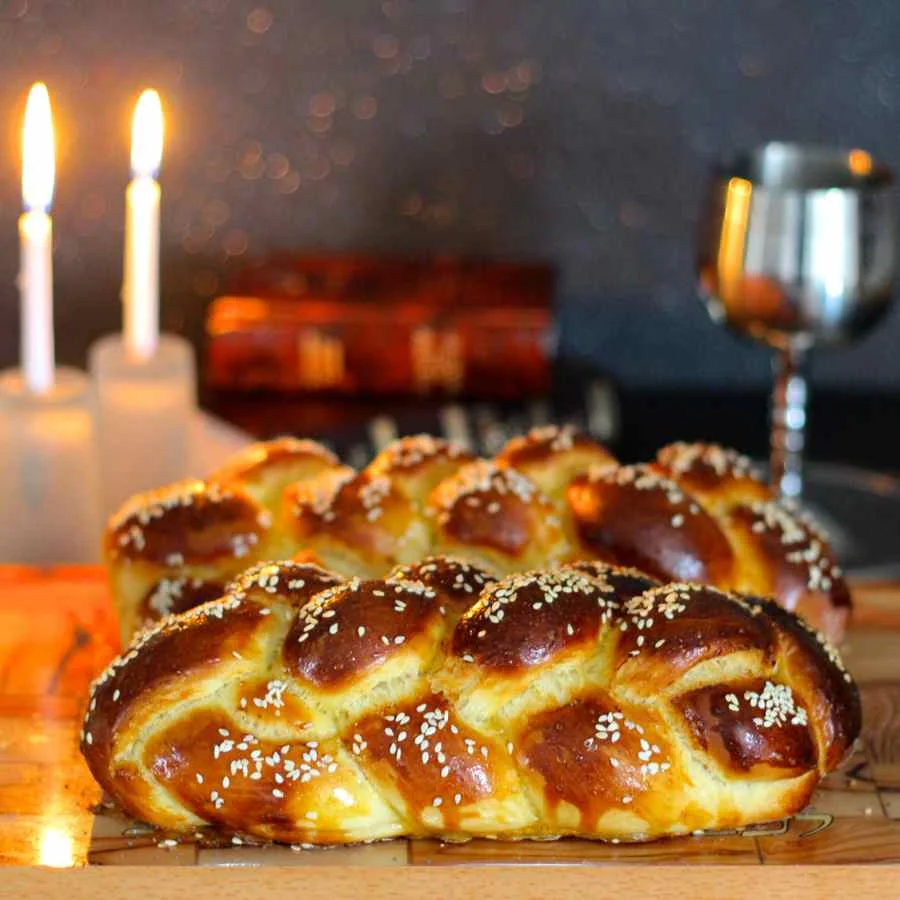
Challah is a soft, enriched bread traditionally braided for Shabbat and Jewish holidays. This version makes a lightly sweet, sesame- or poppy-seed-topped loaf with a glossy egg wash.
Ingredients
- 8 cups (about 960 g)sifted plain flour
- 2½ tablespoons (about 23 g)active dried yeast
- 4 tablespoons (about 50 g), plus 2 tablespoons (about 25 g) for a sweeter tastesugar
- 5 tablespoons (75 ml)sunflower oil
- 1 tablespoon (about 9 g)golden sesame seeds
- 2 teaspoons (about 10 g)salt
- 2 eggs and 1 egg white, beateneggs
- 2 cups (480 ml), more or less depending on the flourwarm water
- 2 teaspoons (10 ml)water
- 2egg yolks
- To tastewhite sesame seeds and/or poppy seeds
Instructions
- 1
Mix the dough
Put all the ingredients except the water and salt in the bowl of a stand mixer. Knead, adding the warm water gradually as you go.
- 2
Knead until soft
Add the salt and knead by hand for 10 minutes or in a stand mixer for 5 minutes. The dough should feel soft and slightly sticky.
- 3
Let it rise
Put the dough in a large airtight container, or cover a container with a clean cloth. Leave it in a warm, draught-free place for 60–90 minutes, until doubled in size.
- 4
Divide the dough
Turn the dough out onto a work surface and divide it into pieces to make the strands.
- 5
Shape the strands
Roll each piece flat with a rolling pin to release some of the air, then shape it into a strand.
- 6
Braid the loaves
Braid the strands to form the loaves. For medium loaves, each strand should weigh about 80 g; for large loaves, about 120 g.
- 7
Arrange on trays
Set each loaf on a baking sheet lined with baking paper, leaving 5–8 cm between them to allow room for proving and baking.
- 8
Prove again
Cover the loaves with a clean cloth and leave them in a dry, draught-free place for about 30 minutes.
- 9
Heat the oven
Preheat the oven to 180°C.
- 10
Brush and seed
Beat the 2 teaspoons of water with the 2 egg yolks in a small bowl. Brush the mixture over each loaf and scatter over sesame seeds and/or poppy seeds.
- 11
Bake until golden
Bake for about 20 minutes, or until the loaves are golden brown.
What is challah?
Challah is a braided Jewish bread traditionally prepared for Shabbat and Jewish holidays. Its enriched dough makes a soft, gently sweet loaf, while braiding gives it its familiar shape.
This version uses oil rather than butter and finishes with an egg-yolk glaze and seeds. Those choices give the crust colour and a little crunch while keeping the centre tender.
Nutrition and macros by portion
The nutrition label shows one serving as written: 1130 calories, 30g protein, 190g carbs, 25g fat.
| Portion | Adjustment | kcal | Protein | Carbs | Fat |
|---|---|---|---|---|---|
| Lighter | Smaller slice, fewer seeds | 791 kcal | 21g | 133g | 18g |
| This serving | As written | 1130 kcal | 30g | 190g | 25g |
| Hungry | Larger slice | 1695 kcal | 45g | 285g | 38g |
Most of the carbohydrates come from the flour, with additional sugar from the dough; the sunflower oil, eggs and seeds contribute much of the fat, while the eggs and flour provide protein. Balance a slice with vegetables and a protein-rich accompaniment, such as eggs.
The ingredients that shape the dough
Flour: Sifting helps distribute it evenly through the dough. Flour can absorb different amounts of water, so the recipe allows for adjusting the quantity as you knead.
Oil and eggs: These enrich the dough and contribute to its soft texture. The beaten eggs and white go into the dough; the yolks are reserved for the glaze.
Getting the dough right
Water: Add it gradually while kneading rather than pouring it in all at once. Stop when the dough is soft and slightly sticky, as the recipe describes.
Salt: Add it after the initial mixing, then knead for the full 10 minutes by hand or 5 minutes in a stand mixer. The dough should become workable enough to divide and shape.
Making the braid
Strands: Flattening each piece with a rolling pin releases some of the dough’s air before you form the strands. Keep the strand sizes similar so the loaf bakes evenly.
Braid: The recipe specifies about 80 g per strand for medium loaves or 120 g for large ones. Leave 5–8 cm between shaped loaves on the tray.
Two rises, two cues
First rise: Give the dough 60–90 minutes in a warm, draught-free place and look for it to double in size; the stated time is a guide.
Second rise: After shaping, cover the loaves and leave them for about 30 minutes. They should have room to expand before going into the oven.
Glaze and bake
Egg wash: Beat the yolks with the measured water and brush the mixture over the loaves before adding seeds. A light, even coating helps the surface colour in the oven.
Doneness: Bake at 180°C for about 20 minutes, watching for a golden-brown crust. If making loaves of different sizes, check each one as it bakes.
How to serve challah
Serve the bread alongside a meal, or slice it for breakfast with fruit or a savoury spread. Its mild sweetness also suits soups and salads.
For a simple plate, pair a slice with eggs or another protein and some vegetables. The bread is substantial, so the portion can be adjusted to suit the rest of the meal.
Recipe notes & tips
- Add the warm water a little at a time because the flour may not need every drop.
- Keep the rising dough covered so its surface does not dry out.
- Weigh the strands if you want the loaves to bake at a similar rate.
- Leave the stated 5–8 cm between loaves so they can expand without touching.
- Brush the egg wash gently to avoid flattening the proved dough.
- Start checking the loaves at around 20 minutes and use their golden colour as the cue.
Variations
- Sweeter dough: Add the optional 2 tablespoons of sugar for a sweeter loaf.
- Sesame topping: Use white sesame seeds over the egg wash for a simple seeded finish.
- Poppy topping: Scatter poppy seeds over the glazed loaves instead of sesame.
- Mixed topping: Combine sesame and poppy seeds for a varied crust.
- Medium loaves: Shape the strands at about 80 g each for medium-sized breads.
Common mistakes to avoid
- Adding water all at once: The dough may become too wet; add it gradually as you knead.
- Skipping the salt: Add it after the initial mixing, as directed, before continuing to knead.
- Rushing the first rise: Wait until the dough has doubled, allowing up to 90 minutes.
- Crowding the tray: Leave 5–8 cm between loaves so they have room to expand.
- Overworking the proved dough: Handle it gently when brushing on the egg wash.
- Baking by time alone: Use the golden-brown colour as well as the roughly 20-minute baking time.
How to store
Once completely cool, store the challah in an airtight container or sealed bag at room temperature and eat within 2–3 days. Warm slices briefly in the oven or toast them; freeze extra bread well wrapped for longer storage.
Frequently asked questions
How much water should I add?
The recipe gives 480 ml as a guide, but flour absorbs water differently. Add it slowly during kneading and stop when the dough is soft and slightly sticky.
How long should the first rise take?
Allow 60–90 minutes in a warm, draught-free place. The dough is ready when it has doubled in size.
Can I knead the dough by hand?
Yes. Knead it by hand for 10 minutes after adding the salt; in a stand mixer, the stated time is 5 minutes.
How much dough should each strand weigh?
Use about 80 g per strand for medium loaves or 120 g per strand for large loaves.
Can I use only one kind of seed?
Yes. The topping can be sesame, poppy seeds, or a mixture of both.
How do I know when the loaves are baked?
The recipe allows about 20 minutes at 180°C. Look for a golden-brown surface, checking each loaf if they are different sizes.
Cook it from the original
This recipe comes from 196flavors.com. Their page has the author’s own photos, notes and tips — the best place to cook it from.
Open the recipe on 196flavors.com