
Baguette
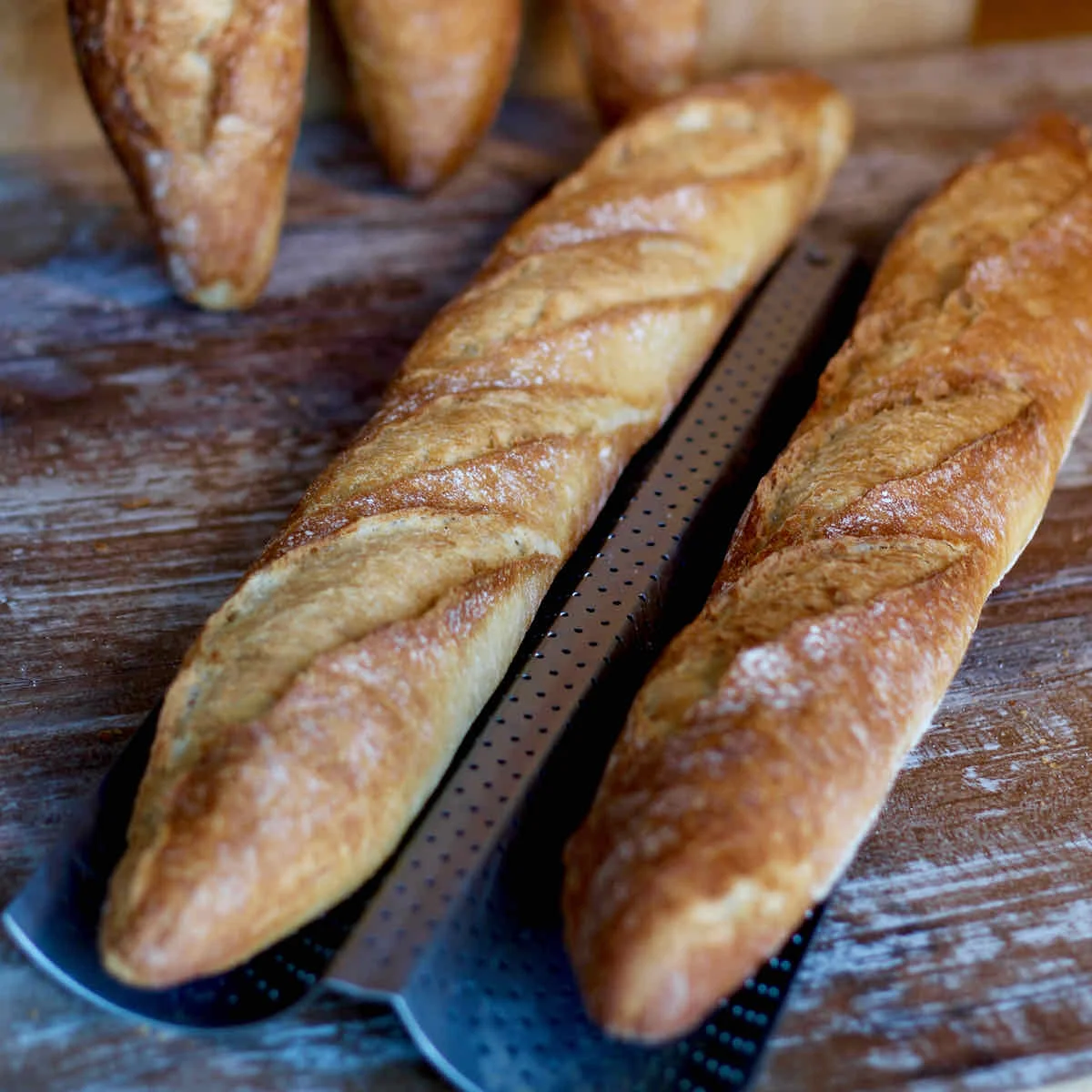
Baguette is a long French loaf with a crisp, crackling crust and a chewy centre. This version makes three loaves, using a stand mixer and a pan of water in the oven to help create its characteristic crust.
Ingredients
- 480 g (4 cups)high-gluten bread flour
- 9 g (1 tablespoon)active dry yeast
- 18 g (1 tablespoon)salt
- 360 ml (1 1/2 cups)warm water
- 1perforated baguette loaf pan
- 1razor blade
- 1spray bottle
Instructions
- 1
Mix flour and yeast
Fit a dough hook to a stand mixer. Add the flour and yeast to the bowl and mix for 1 minute, until the yeast is incorporated.
- 2
Add the water
Knead at low speed while slowly pouring in the water.
- 3
Knead with salt
After 2 minutes, add the salt and knead for a further 8 minutes.
- 4
Divide the dough
Remove the dough from the bowl and divide it into 3 equal portions.
- 5
Shape the loaves
Roll each portion between both hands to make a long stick.
- 6
Dust with flour
Dust each shaped loaf with a little flour.
- 7
Prepare the pan
Spray a little oil into the baguette pan to grease it, then place the uncooked loaves in the pan.
- 8
Leave to rise
Cover the loaves with a damp cloth and leave them to rise for 1 hour.
- 9
Slash and spray
With a sharp razor blade or paring knife, make four diagonal cuts across the top of each baguette. Spray the loaves with water.
- 10
Add oven steam
Put water in a skillet or small baking dish on the oven's bottom rack. The steam helps the baguettes rise fully before a crust forms.
- 11
Preheat the oven
Preheat the oven to 220°C (430°F).
- 12
Bake until crisp
Bake for about 25–30 minutes, until the baguettes are golden brown and crisp.
What is a baguette?
A baguette is a long, narrow French loaf known for its crisp crust and airy, chewy crumb. Its familiar shape makes it easy to slice for meals or sandwiches.
This version uses high-gluten bread flour for a strong dough, and steam in the oven to help the loaves expand before their crust sets.
Nutrition and macros by portion
The nutrition label shows one serving as written: 582 calories, 17g protein, 121g carbs, 2g fat.
| Portion | Adjustment | kcal | Protein | Carbs | Fat |
|---|---|---|---|---|---|
| Lighter | Smaller bread portion | 407 kcal | 12g | 85g | 1g |
| This serving | As written | 582 kcal | 17g | 121g | 2g |
| Hungry | Larger bread portion | 873 kcal | 26g | 182g | 3g |
Most of the energy and carbohydrates come from the bread flour, which also supplies most of the protein; the dough contains very little fat. Salt contributes most of the sodium, so balance a portion with vegetables and a less salty accompaniment.
Choosing the flour
High-gluten flour: its stronger gluten-forming potential helps the dough stretch and hold its shape as it rises. Measure it carefully so the dough does not become unnecessarily stiff.
Yeast and salt: the yeast leavens the dough, while the salt seasons it. Add the salt after the first 2 minutes of kneading, as the method directs.
Shaping three loaves
Equal portions: dividing the dough evenly helps the baguettes bake at a similar rate. Roll each piece into a stick with both hands, keeping the ends and middle reasonably even.
Light dusting: a little flour on the shaped dough helps keep it manageable. The recipe also calls for oiling the perforated pan so the loaves are easier to remove.
Scoring and steam
Diagonal cuts: use a sharp blade or paring knife to make four slashes along the top of each loaf. Keep the cuts deliberate so the surface opens as the bread expands.
Oven steam: the water-filled skillet or baking dish on the bottom rack creates a steamy environment during baking. Take care when handling the hot oven and vessel.
Rise and bake cues
First rise: cover the shaped loaves with a damp cloth and leave them for 1 hour. The recipe gives a set time but does not specify how much they should expand.
Finished bread: bake for about 25–30 minutes at 220°C (430°F), looking for a golden-brown colour and a crisp crust.
Serving baguette
Serve the baguettes warm or at room temperature, sliced alongside soup, salad or a main meal. They are also handy for sandwiches or for serving with cheese.
For a crisp crust, avoid covering the bread while it is still warm; trapped steam can soften the outside.
Recipe notes & tips
- Use warm rather than hot water when mixing the dough.
- Add the water gradually so it incorporates evenly as the mixer kneads.
- Keep the damp cloth over the dough during its 1-hour rise.
- Make the diagonal cuts with a sharp blade for clean slashes.
- Put the water vessel on the bottom rack before baking, as directed.
- Check the baguettes near the end of the 25–30-minute baking time for a golden, crisp finish.
Variations
- Wholemeal blend: replace some of the bread flour with wholemeal flour, allowing for a denser loaf.
- Seeded crust: sprinkle seeds over the damp loaf tops before baking.
- Herb dough: mix dried herbs into the flour before adding the water.
- Garlic serving: serve slices with garlic-infused oil for dipping.
- Sandwich loaf: split a cooled baguette and fill it with your preferred sandwich ingredients.
Common mistakes to avoid
- Adding salt too soon: follow the method and add it after the first 2 minutes of kneading.
- Uneven portions: divide the dough into three equal pieces so the loaves bake more evenly.
- Blunt scoring tool: use a sharp razor blade or paring knife to make clean diagonal cuts.
- Skipping the steam: put water in a skillet or small baking dish on the bottom rack as directed.
- Baking by time alone: check for a golden-brown colour and crisp crust around the 25–30-minute mark.
How to store
Once completely cool, store the baguettes in a paper bag or bread bin and eat within 1–2 days for the best texture. Refresh slices briefly in a warm oven; the crust may soften as the bread is stored.
Frequently asked questions
Can I make the dough without a stand mixer?
The method is written for a stand mixer with a dough hook. You can knead by hand, but the recipe does not specify a hand-kneading time.
How long does the dough rise?
Cover the shaped baguettes with a damp cloth and leave them to rise for 1 hour.
Why is there water in the oven?
The water makes steam, which helps the baguettes rise fully before a crust forms.
How do I know the baguettes are baked?
Bake for about 25–30 minutes at 220°C (430°F), until golden brown and crisp.
Can I bake these without a perforated baguette pan?
The recipe specifies a perforated baguette pan, which supports the loaves as they bake. It does not provide an alternative pan or method.
Cook it from the original
This recipe comes from 196flavors.com. Their page has the author’s own photos, notes and tips — the best place to cook it from.
Open the recipe on 196flavors.com