
Inverted Puff Pastry
Nutrition per Serving
320
Calories
3g
Protein
22g
Carbs
25g
Fat
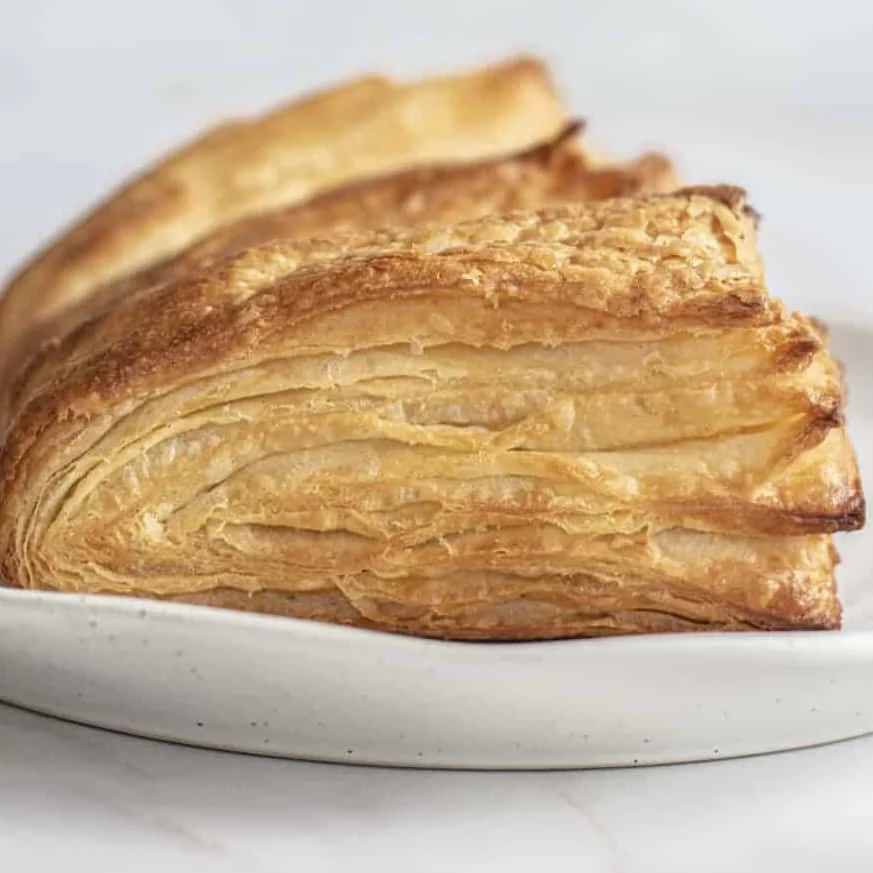
Inverted puff pastry is made by laminating the butter around the dough.It's extra light and flaky.
📝 Ingredients
- 450 g all-purpose flour
- 190 ml water
- 100 g unsalted butter (room temperature)
- 1/2 Tbsp granulated sugar
- 1/2 Tbsp white vinegar or lemon juice
- 1 1/2 tsp salt
- 500 g unsalted butter (room temperature)
- 120 g all-purpose flour
👨🍳 Instructions
- 1--- The dough ---
- 2In a large bowl mix together the flour, water, vinegar, butter, sugar, and salt into a rough dough. Tip the dough out onto a floured bench and knead it for around 5 minutes until smooth.
- 3Shape the dough into a 7x7inch (18x18cm) square. Wrap it up in parchment paper, cling wrap or place it in an airtight container and refrigerate it for 2 hours.
- 4--- The butter packet ---
- 5Mix together the room temperature butter and flour for the butter packet until well incorporated. Spread the butter in between two sheets of parchment paper and roll it out into a 7x7inch (18x18cm) square.
- 6Chill this butter for around 20 minutes until cool but still pliable. If chilling for longer than this, remove the butter 10 minutes before the dough to ensure it's not too hard.
- 7The butter and the dough need to be similar consistencies. If the butter is too hard it will crack and shatter, and if it is too soft it will melt.
- 8--- Laminating ---
- 9Remove the butter packet from the fridge and place it on a well-floured bench. Roll the butter out into a 14x8inch (36x20cm) rectangle. Use as much flour as you need to stop the butter from sticking to the rolling pin or the bench. Lift the butter up regularly as you roll it to ensure it isn't sticking to the bench.
- 10Place the dough at the bottom of the butter rectangle and fold the top of the butter over so it encases the dough. Now that the dough is tucked in, it's time to do the first set of folds.
- 11Roll the butter+dough out into a rectangle that's about 18x9 inches (45x22 cm). Focus on lengthening it, not widening it. Use dustings of flour as you need to, to ensure it rolls smoothly without sticking.
- 12--- Fold 1 & 2 ---
- 13Once it's in a rectangle, dust off any excess flour. Fold the top third of the rectangle down to the middle. Bring the bottom third over top. That was fold 1.
- 14Turn the dough 90 degrees and roll it back out into an 18x9 inches (45x22 cm) rectangle and repeat the fold. That was fold 2.
- 15Wrap the dough up tightly and chill in the fridge for a minimum of 1 hour.
- 16--- Fold 3 & 4 ---
- 17Remove the dough from the fridge and place it vertically on a floured bench. Roll it into an 18x9 inches (45x22 cm) rectangle and fold. That was fold 3.
- 18Turn the dough 90 degrees and roll it back out into a rectangle and repeat the fold. That was fold 4.
- 19As the folds go on the dough will become smoother. For extra even layers, you can cut off the uneven edges of the dough rectangle. Wrap the dough up tightly and chill in the fridge for a minimum of 1 hour.
- 20--- Fold 5 &6 ---
- 21Repeat the folding step twice more to complete fold 5 and fold 6.
- 22After the 6th fold, the dough can be wrapped up and refrigerated for a minimum of 2 hours before using it. It can also be frozen for when you need it.
- 23--- Portioning puff pastry ---
- 24This recipe makes around 1.3kg puff pastry (depending on how much was cut off during lamination) which can be cut into 3 pieces of roughly 430g (15oz) each.
- 25Each 430g piece not being used right away can be wrapped up tightly and frozen for up to three months.
- 26Thaw in the refrigerator before rolling. When rolling it out, place it upright, with the smooth side facing up. If you accidentally roll it out with the cut side facing up, you'll ruin the lamination. Don't knead, or squash the pastry or you'll ruin the layers.
- 27--- Cooking puff pastry ---
- 28The pastry portions should be rolled out quite thin when using it, into a sheet of around 1/8inch (3-4mm) thickness. The cooking time and oven temperature for the pastry will depend on the recipe it is used in.
About the Chef & Original Recipe
This recipe was published by Elien on bakingwithbutter.com. Visit the original source for step-by-step photos, chef notes and additional details.
Source: bakingwithbutter.com