
Homemade Everything Bagels
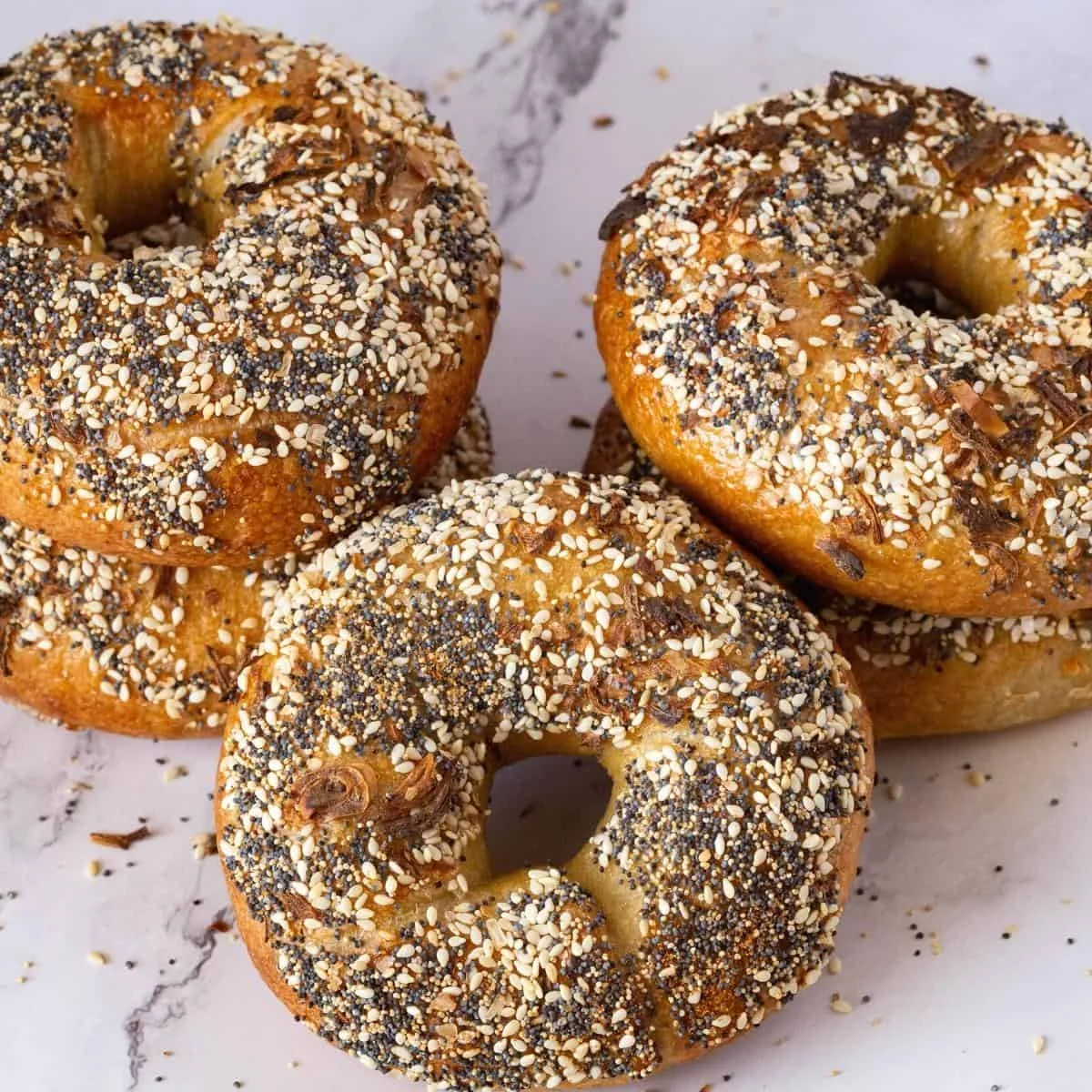
These American-style everything bagels have a chewy centre, a crisp, golden crust and a yeasty flavour. Make a batch for a leisurely baking project, then enjoy them fresh or toasted from the freezer.
Ingredients
- 500 g (at 43°C / 110°F)warm water
- 14 ginstant dry yeast
- 30 golive oil
- 30 gbarley malt syrup or honey
- 733 gbread flour
- 183 gplain flour
- 13 gsalt
- 1,500 mlwater
- 30 gbicarbonate of soda
- 30 gsugar
- 15 gsalt
- 15 gsugar
- 1egg white, beaten
- 30 ml (2 tbsp)sesame seeds
- 30 ml (2 tbsp)poppy seeds
- 15 ml (1 tbsp)garlic granules
- 15 ml (1 tbsp)dried minced onion granules, not flakes
- 15 ml (1 tbsp)coarse sea salt
Instructions
- 1
Mix the seasoning
Combine the sesame seeds, poppy seeds, garlic granules, dried minced onion and coarse sea salt in a bowl or dry jar. Mix well and set aside.
- 2
Combine the dough
Using a stand mixer fitted with a dough hook on medium-high speed, mix the warm water, yeast, olive oil and barley malt syrup or honey. Add the bread flour, plain flour and 13 g salt.
- 3
Knead the dough
Start the mixer at medium speed. Once the flour is incorporated, knead on medium-low for 8–10 minutes, or knead by hand on a well-floured surface for 10–12 minutes.
- 4
Let it rise
When the dough is smooth, soft and elastic, shape it into a ball. Put it seam-side down in an oiled bowl, cover with a clean tea towel or cling film, and leave somewhere warm for 60–90 minutes, until doubled in volume. Alternatively, leave it to rise slowly in the fridge overnight.
- 5
Divide the dough
Turn the doubled dough onto a well-floured surface. Punch it down to release air bubbles, divide it into two portions, then divide each portion into six equal pieces. This makes 12 bagels of about 125 g each.
- 6
Shape into balls
Roll each piece into a tight ball, tucking the seams underneath. Leave the balls to rest for 15 minutes.
- 7
Shape the bagels
Choose one of the three shaping methods. For the first, poke a hole through the centre of each ball with your fingers and stretch it until the hole is 4–5 cm (1½–2 inches) wide. For the second, flatten a ball, roll it into a 25–28 cm (10–11-inch) rope, flatten one end like a fan, twist the rope, tuck the other end into the flattened end and pinch the seam firmly. For the third, flatten and roll a ball into a 25–28 cm rope, twist it and join the ends; put your hand through the hole and roll the dough back and forth on an unfloured surface until the join is nearly seamless.
- 8
Arrange on trays
Line two large baking sheets with baking paper and spray it with non-stick spray or dust it with flour. Arrange the bagels on the trays with room for them to rise.
- 9
Proof the bagels
Leave the bagels at room temperature for 60–90 minutes, or until nearly doubled. For an overnight proof, refrigerate them and bring them to room temperature for 45–60 minutes before poaching.
- 10
Heat the oven
Preheat the oven to 200°C (390°F / Gas Mark 6).
- 11
Prepare the water
Bring the 1,500 ml water to the boil in a large pan. Add the 15 g salt, 15 g sugar and bicarbonate of soda.
- 12
Poach the bagels
When the water is boiling, carefully add a few bagels at a time. Boil each one for 30 seconds on each side, then lift it onto a wire rack set over a baking tray to drain.
- 13
Brush with egg
Return the bagels to a baking-paper-lined sheet, or wipe excess moisture from the tray. Brush the tops and sides with beaten egg white or olive oil.
- 14
Add the topping
For a thicker coating, turn the bagels upside down into the everything seasoning. For a lighter coating, sprinkle the seasoning over the tops.
- 15
Bake until golden
Bake for 20–25 minutes, until the tops are golden brown. When they come out of the oven, move them to a baking tray to help prevent sticking.
- 16
Cool on a rack
Leave the bagels on the baking tray for 3–5 minutes, then transfer them to a wire rack to cool further. They are best on the day they are baked; leftovers are good toasted and can be frozen.
What are everything bagels?
Bagels are ring-shaped yeasted breads associated with Jewish baking traditions in Central and Eastern Europe, and now especially popular in American deli and bakery culture. Their characteristic chewy crumb comes from a firm dough and a short boil before baking.
This version tops the bagels with a savoury mixture of sesame, poppy, garlic, onion and coarse salt. The blend gives each bite a mix of crunch and strong, toasty flavours.
Nutrition and macros by portion
The nutrition label shows one serving as written: 255 calories, 7g protein, 43g carbs, 6g fat.
| Portion | Adjustment | kcal | Protein | Carbs | Fat |
|---|---|---|---|---|---|
| Lighter | Use a thinner topping | 179 kcal | 5g | 30g | 4g |
| This serving | As written | 255 kcal | 7g | 43g | 6g |
| Hungry | Serve with a filling | 383 kcal | 11g | 65g | 9g |
The flour supplies most of the carbohydrates, while the flour and yeast contribute some protein. Olive oil and the egg white wash account for some of the fat, with the seeds adding a little more; pair a bagel with eggs or another protein-rich filling and some vegetables for a more rounded plate.
Why use two flours?
Bread flour: its higher gluten-forming potential helps give the bagels a resilient, chewy texture.
Plain flour: combined with the bread flour, it makes up the dough while keeping the recipe’s flour blend consistent.
Barley malt syrup: it adds a characteristic malty note to the dough; honey is offered as an alternative. The method also mentions malt syrup in the boiling liquid, but no separate quantity is specified in the ingredient list.
Kneading and proofing
Kneading: work the dough until it feels smooth, soft and elastic, following the mixer or hand-kneading times. A well-developed dough is easier to shape and holds its form.
First rise: allow 60–90 minutes in a warm place, watching for the dough to double rather than relying on the clock alone. A slow rise in the fridge is another option.
Second proof: leave shaped bagels until nearly doubled. If they have been refrigerated overnight, give them 45–60 minutes at room temperature before boiling.
Choose a shaping method
Finger hole: the quickest approach is to poke a hole in each dough ball and stretch it to 4–5 cm wide. The opening will shrink somewhat as the bagels proof and bake.
Rope and tuck: flatten a ball, roll it into a rope, then secure the ends by tucking one into a flattened, fan-shaped end. Pinch the join firmly.
Rope and roll: join the twisted rope ends, then roll the ring on an unfloured surface to seal them. Whichever method you use, aim for a secure join so the bagels keep their shape.
The water bath matters
Poaching: add only a few bagels to the boiling water at a time so they have room to move. Give each one 30 seconds on both sides, then drain it on a wire rack.
Finish: brush with beaten egg white before adding the seasoning. Dipping the top into the mix gives a heavier coating; sprinkling it on gives a lighter one.
Look for a golden finish
Bake at 200°C for 20–25 minutes, checking for a golden-brown top rather than relying on colour alone at the earliest end of the range. The egg white helps the seasoning adhere and gives the surface a glossy finish.
After baking, leave the bagels on the tray for 3–5 minutes before moving them to a wire rack. This short rest makes them easier to handle while they continue cooling.
Serving and timing
The recipe takes about 175 minutes in total, with proofing accounting for much of the waiting time. Making the seasoning while the dough is being prepared keeps that small task out of the way later.
Serve the bagels plain, toasted, or with a spread of your choice. They also go well alongside eggs, soup or a salad for a more substantial meal.
Recipe notes & tips
- Measure the warm water at 43°C so it is close to the temperature specified in the recipe.
- Use dried minced onion granules, not onion flakes, for the seasoning blend.
- Keep the work surface unfloured when rolling the joined rope ends so they seal more readily.
- Drain the poached bagels on a wire rack before returning them to the baking sheet.
- For a lighter topping, sprinkle on the seasoning rather than dipping the bagels into it.
- Freeze bagels you will not eat soon, then toast them after thawing.
Variations
- Honey dough: use the listed honey alternative in place of barley malt syrup.
- Oil finish: brush the bagels with olive oil instead of beaten egg white.
- Light seasoning: sprinkle on the topping for a thinner coating.
- Heavy seasoning: dip the tops into the seasoning for a more generous crust.
- Overnight proof: refrigerate the shaped bagels, then bring them to room temperature for 45–60 minutes before poaching.
Common mistakes to avoid
- Under-kneading: the dough may lack elasticity; continue until it is smooth and elastic, observing the stated kneading time.
- Rushing the first rise: wait until the dough has doubled in volume before dividing it.
- Loose joins: bagels can open at the seam; pinch the ends firmly and roll them together where the shaping method calls for it.
- Crowding the pan: too many bagels at once makes poaching awkward; work in small batches.
- Skipping the drain: excess water can make the finish wet; let each bagel drain on the rack after boiling.
- Over-proofing by the clock: use the near-doubled size as the cue for the second proof, rather than leaving the bagels indefinitely.
How to store
The bagels are best on the day they are baked. Store leftovers in an airtight container and toast them to refresh, or freeze them for longer storage; thaw before toasting.
Frequently asked questions
Can I prepare the dough the night before?
Yes. The recipe allows the dough to rise slowly in the fridge overnight. You can also refrigerate the shaped bagels overnight and leave them at room temperature for 45–60 minutes before poaching.
How wide should the hole be?
For the finger-poke method, stretch the opening to about 4–5 cm (1½–2 inches). It may tighten as the bagels rise and bake.
Can I use honey instead of barley malt syrup?
Yes, the recipe lists honey as an alternative to the barley malt syrup in the dough.
Can I use the seasoning from the dough recipe for the water bath?
No. The seasoning is for coating the bagels. The listed water-bath ingredients are water, bicarbonate of soda, sugar and salt; the method also mentions malt syrup but does not give a separate amount for it.
How do I get more seasoning to stick?
Brush the bagels with beaten egg white, then dip the tops into the seasoning for a thicker coating. Sprinkling it over the top gives a lighter layer.
Can I freeze homemade bagels?
Yes. The recipe notes that they freeze well. Thaw them before toasting.
Cook it from the original
This recipe comes from veenaazmanov.com. Their page has the author’s own photos, notes and tips — the best place to cook it from.
Open the recipe on veenaazmanov.com