
Roscón de Reyes with citrus: fresh aroma, soft and fluffy crumb (approx. 1 kg finished weight)
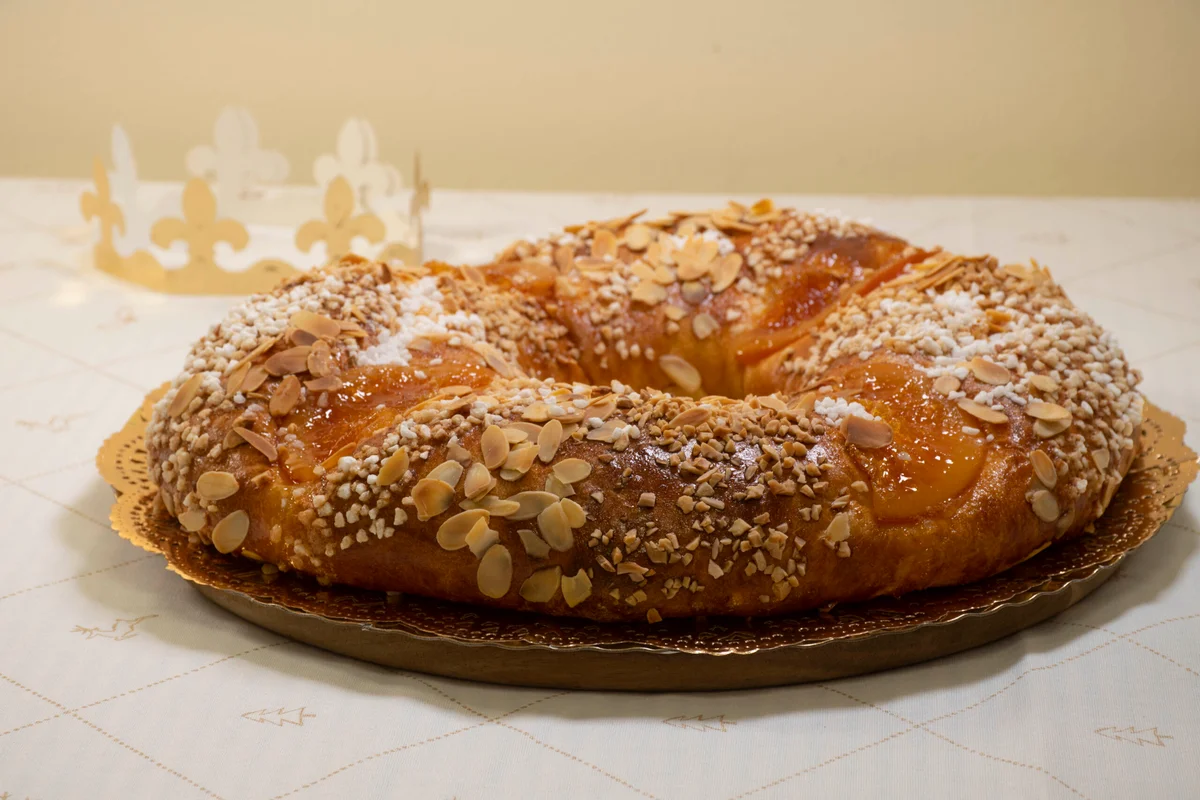
This Spanish Roscón de Reyes is a soft, ring-shaped enriched bread scented with citrus, orange blossom water and rum. Its long fermentation builds flavour and a light crumb, while the topping can be kept simple with almonds and sugar instead of candied fruit.
Ingredients
- 150 g, plus 4 g fresh baker’s yeast or 2 g dried baker’s yeastactive sourdough starter, refreshed over the previous three days and three times the day before at 50% hydration
- 80 gstrong bread flour, for the preferment
- 60 gmilk, for the preferment
- 8 g fresh baker’s yeast or 3 g dried baker’s yeastbaker’s yeast, for the preferment
- all of itpreferment or sourdough starter
- 350 gvery strong bread flour or strong bread flour
- 1egg
- 2egg yolks
- 70 gsugar
- 1 tbspinvert sugar or honey
- 8 g fresh baker’s yeast or 3 g dried baker’s yeastbaker’s yeast
- 30 mlorange blossom water or milk
- 70 mlmilk
- 30 mlrum or milk
- 80 gbutter
- 1 tbspcitrus paste
- 1egg, for brushing
- to tastecandied oranges
- to tasteflaked and chopped almonds, damp sugar or pearl sugar
Instructions
- 1
Mix the dough
Put the flour, milk, invert sugar or honey, sugar, citrus paste, orange blossom water, rum, sourdough with its 4 g of yeast or the preferment, egg, yolks and the listed yeast in the mixer bowl. Mix on low speed for 2 minutes, then on high speed for 4 minutes.
- 2
Add the butter
Rest the dough for 5 minutes. Run the mixer on high speed and add the butter in pieces, in two batches; wait until the first batch is fully incorporated before adding the next. Knead for 5 minutes.
- 3
First fermentation
Turn the dough onto an oiled work surface, fold it a few times, shape it into a ball and return it to the mixer bowl. Cover and leave somewhere warm, such as an oven at 25°C, until doubled in size; this took 3 hours in the original recipe.
- 4
Shape the ring
Take out the dough and shape it into a taut ball. Make a hole in the centre, then widen it by rolling the dough like a wheel. Place it on a baking tray lined with baking paper.
- 5
Proof again
Brush the dough with beaten egg and leave it to rise in a warm place for 40–50 minutes, depending on the room temperature.
- 6
Decorate and bake
Brush the risen dough with beaten egg again and decorate with orange, almonds, sugar or your chosen toppings. Bake in an oven preheated to 180°C, with top and bottom heat, for about 30 minutes. Watch the colour and cover with foil partway through if it is browning too much.
- 7
Check the centre
For a precise doneness check, insert a probe thermometer into the centre of the dough; it should read 92–96°C.
- 8
Cool gradually
Switch off the oven, open the door and leave the roscón inside for about 10 minutes. Transfer it to a wire rack afterwards.
- 9
Serve cooled
Once the roscón has cooled, serve it.
What is Roscón de Reyes?
Roscón de Reyes is a Spanish ring-shaped sweet bread traditionally associated with Three Kings’ Day. Its enriched dough is shaped with a hole in the middle and often decorated with fruit, nuts and sugar.
This version keeps the topping flexible and brings citrus into the dough itself. A preferment or active sourdough, together with careful proofing, helps give the loaf its tender, airy crumb.
Nutrition and macros by portion
The nutrition label shows one serving as written: 345 calories, 9g protein, 49g carbs, 12g fat.
| Portion | Adjustment | kcal | Protein | Carbs | Fat |
|---|---|---|---|---|---|
| Lighter | Use less sugar topping | 241 kcal | 6g | 34g | 8g |
| This serving | As written | 345 kcal | 9g | 49g | 12g |
| Hungry | Serve a larger slice | 518 kcal | 13g | 74g | 18g |
The flour and sugar provide most of the carbohydrates, while butter and egg yolks contribute much of the fat; the eggs and flour also supply some protein. A practical way to balance a slice is to serve it with fruit or plain yoghurt rather than adding another rich topping.
Choose a fermentation route
Sourdough: use the 150 g active starter, with the listed 4 g fresh or 2 g dried yeast. The starter needs advance refreshing as specified in the ingredient list.
Preferment: mix 80 g flour, 60 g milk and 8 g fresh or 3 g dried yeast, then leave for at least 6 hours or overnight in the fridge. Depending on the kitchen temperature, it may be left out instead; use all of it in place of the starter.
Build the dough gradually
Initial mix: the dough contains flour, milk, eggs, sugar, citrus paste, orange blossom water and rum, as well as the chosen starter or preferment. The method uses both the yeast included with the sourdough option and the separately listed yeast, so follow the ingredient option you have chosen.
Butter: add it only after the first mixing and short rest. Incorporating it in two batches gives the dough time to take it in before the next addition.
Watch the proof, not just the clock
First rise: keep the covered dough somewhere warm and wait until it has doubled. The recipe gives about 3 hours at 25°C as its own example, but dough activity and room temperature affect the timing.
Second rise: after shaping, allow 40–50 minutes in a warm place. The ring should look expanded before it goes into the oven.
Shape an even ring
Tension: shape the dough into a taut ball before making the centre hole. Roll it gently to widen the ring, aiming for an even thickness so it bakes consistently.
Tray: move the shaped dough onto baking paper before the final proof. This avoids having to lift and distort the delicate ring later.
Judge colour and doneness
Colour: brush with egg before the second proof and again before baking, as the method specifies. If the top becomes too dark partway through the 30-minute bake, cover it with foil.
Centre: a probe reading of 92–96°C is the recipe’s suggested doneness cue. After baking, leave the roscón in the switched-off oven with the door open for about 10 minutes, then cool it on a rack.
Serve it simply
Toppings: candied orange, flaked or chopped almonds, damp sugar and pearl sugar are suggested options. The recipe gives no fixed amounts, so decorate to taste.
On the table: serve the fully cooled ring on its own or alongside coffee or tea. If making it part of a larger meal, pair a slice with fruit or plain yoghurt.
Recipe notes & tips
- Use the sourdough or preferment route as an alternative, rather than treating the preferment as an extra addition.
- Keep the butter soft enough to incorporate, but add it in two batches as directed.
- Use an oiled work surface when folding and shaping the dough.
- Let the first rise continue until the dough has doubled, even if this takes longer than the example timing.
- Keep an eye on the top during baking and cover it with foil if it browns too quickly.
- Cool the baked ring on a wire rack before slicing so the crumb can settle.
Variations
- Orange blossom: replace the 30 ml of orange blossom water with milk for a milder aroma.
- No rum: use milk instead of the 30 ml of rum, as the recipe allows.
- Almond topping: scatter flaked or chopped almonds over the egg-brushed dough before baking.
- Sugar topping: use damp sugar or pearl sugar in place of the almonds.
- Candied orange: decorate with candied orange pieces for a more traditional-looking finish.
Common mistakes to avoid
- Adding butter too soon: wait until the initial mixing and 5-minute rest are complete.
- Adding butter all at once: divide it into two batches and let each one incorporate.
- Stopping the first rise early: wait for the dough to double rather than relying only on the clock.
- Rushing the second proof: allow the shaped ring its 40–50 minutes in a warm place.
- Over-browning the top: cover it with foil if it is already very golden halfway through baking.
- Cutting while hot: let the roscón cool on a rack before serving.
How to store
Once completely cool, keep the roscón in an airtight container at room temperature and eat within 2 days for the best texture. Warm slices briefly in a low oven or microwave; the crumb will gradually become less soft as it sits.
Frequently asked questions
Can I make this without sourdough starter?
Yes. Make the preferment with 80 g flour, 60 g milk and 8 g fresh or 3 g dried yeast. Leave it for at least 6 hours or overnight, then use all of it in place of the starter.
How long does the preferment need?
It needs at least 6 hours or overnight in the fridge. The recipe notes that it may be left out instead depending on the kitchen temperature.
How do I know when the first rise is finished?
The dough should have doubled in size. The recipe’s example is about 3 hours in a warm place at 25°C, but the dough’s growth is the cue to follow.
Can I leave out the rum?
Yes. The recipe suggests replacing the 30 ml of rum with milk.
What temperature should the centre reach?
Use a probe thermometer to check for 92–96°C at the centre of the dough.
Can I skip candied fruit?
Yes. This citrus version works with almonds, damp sugar or pearl sugar as the decoration instead.
Cook it from the original
This recipe comes from lacocinadefrabisa.lavozdegalicia.es. Their page has the author’s own photos, notes and tips — the best place to cook it from.
Open the recipe on lacocinadefrabisa.lavozdegalicia.es