
Braised Pork Chops, Shanghai-Style
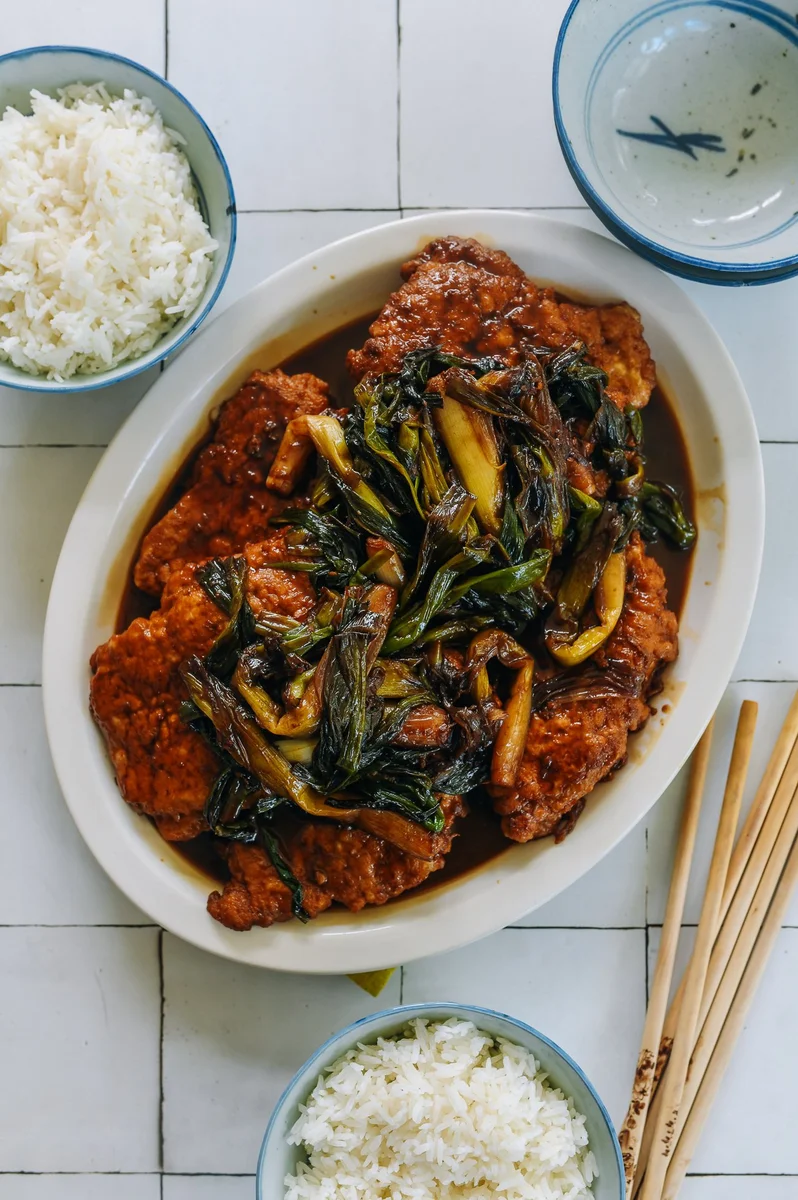
These Shanghai-style braised pork chops are coated, briefly fried and simmered with a generous bed of sweet, softened scallions. The method builds flavour quickly while keeping the pork tender and leaving a glossy sauce for rice.
Ingredients
- 907 g (2 pounds; 6 pieces)boneless centre-cut pork chops
- 30 ml (2 tablespoons)Shaoxing wine
- 2.5 ml (½ teaspoon)salt
- 15 ml (1 tablespoon)light soy sauce
- 45–60 ml (3–4 tablespoons)water
- 2 mediumeggs
- about 40 g (⅓ cup)cornflour
- 2–3 bunchesspring onions
- 80 ml (⅓ cup)neutral oil, such as vegetable, rapeseed or avocado oil
- 15 g (or 1 tablespoon granulated sugar)rock sugar
- 300–360 ml (1¼–1½ cups)water
- 30 ml (2 tablespoons)light soy sauce
- 22.5 ml (1½ tablespoons)dark soy sauce
Instructions
- 1
Prepare the chops
Cut two small slits through the fat around the outer edge of each chop to help stop it curling. Pound both sides with the back of a knife or a meat tenderiser until the chops are ¼–½ inch thick (about 0.75 cm).
- 2
Season the pork
Toss the chops by hand with the Shaoxing wine, salt, 1 tablespoon light soy sauce and 3–4 tablespoons water, until they have absorbed the liquid.
- 3
Coat and marinate
Add the eggs and mix until absorbed and the chops are evenly coated. Stir in the cornflour until well combined, then leave to marinate for 15 minutes.
- 4
Prepare the scallions
Wash the scallions and pat them thoroughly dry to reduce splattering. Cut them in half crosswise; halve thick stems lengthwise as well.
- 5
Fry the chops
Heat a wok over medium-high heat until it starts to smoke, then add ⅓ cup oil to coat the base. Test it with a chopstick: small bubbles should stream around it. Fry the chops in two batches for 30 seconds to 1 minute per side, until light golden and the coating has set. Avoid over-frying, then transfer to a plate.
- 6
Brown the scallions
Leave some oil in the wok, adding a couple of tablespoons if needed. Over medium heat, cook the scallions for a few minutes, until wilted and lightly browned at the edges.
- 7
Simmer the chops
Set the pork chops on the scallions. Add the rock sugar, 1¼–1½ cups water, 2 tablespoons light soy sauce and the dark soy sauce. Cover and simmer over medium heat for about 3 minutes.
- 8
Turn and simmer
Remove the lid, turn the chops and submerge them in the sauce. Cover and simmer for another 2–3 minutes.
- 9
Move the pork
Uncover, turn the heat to high and stir everything well. Quickly transfer the pork chops to a serving platter.
- 10
Reduce the sauce
Cook the sauce for 1–2 minutes, stirring occasionally, until glossy and thick enough to coat a wok spatula. Leave enough sauce to serve with rice.
- 11
Finish and serve
Arrange the scallions over the pork chops and pour the sauce over the top. Serve.
What are Shanghai-style braised pork chops?
葱烤排骨 (cōng kǎo páigǔ) is a Shanghainese home-style dish of pork chops cooked with scallions and a savoury-sweet soy sauce. The scallions are more than a garnish: they soften in the wok and become part of the dish’s aromatic base.
This version first coats and briefly fries the chops, then simmers them with plenty of scallions. That two-stage cooking gives the pork a set outer coating while allowing it to take on the sauce.
Nutrition and macros by portion
The nutrition label shows one serving as written: 419 calories, 36g protein, 11g carbs, 24g fat.
| Portion | Adjustment | kcal | Protein | Carbs | Fat |
|---|---|---|---|---|---|
| Lighter | Use less oil | 293 kcal | 25g | 8g | 17g |
| This serving | As written | 419 kcal | 36g | 11g | 24g |
| Hungry | Add extra rice | 629 kcal | 54g | 17g | 36g |
The pork provides most of the protein, while the cornflour, sugar and any rice served alongside contribute carbohydrates. The oil and pork account for much of the fat; pair a chop with a generous serving of vegetables and a measured portion of rice to balance the plate.
Why pound and slit the chops?
Even thickness: pounding the chops helps them cook in the short simmering time. Work steadily so the meat flattens without tearing.
Flat edges: small cuts through the outer fat help the chops stay flatter as they cook. This makes it easier for them to brown and sit against the scallions.
Build the coating in stages
Seasoning first: the pork is tossed with Shaoxing wine, salt, soy and water before the egg goes in. Mix until the liquid is absorbed so the seasoning is distributed across the chops.
Egg and cornflour: the egg coats the meat before the cornflour is added. Leave the coated chops for 15 minutes, as directed, then fry them just until the coating sets.
Fry without toughening the pork
Hot oil: wait until the wok is smoking and check for small bubbles around a chopstick before adding the meat. Fry in two batches so the chops have room in the wok.
Light colour: the coating should be light golden, not deeply browned. Keep to 30 seconds to 1 minute per side, then transfer the chops out of the wok.
Let the scallions soften
Dry scallions: pat them thoroughly dry after washing to limit oil splatter. If their stems are especially thick, split them lengthwise so they cook more evenly.
Wilted edges: cook them until softened with a little browning before layering the chops on top. They will continue to cook as the pork simmers.
Watch the simmer and sauce
Covered cooking: simmer the chops over medium heat for about 3 minutes, then turn and submerge them before cooking for another 2–3 minutes. The recipe allows 300–360 ml water, with less suited to a lower-powered stove and more to a very hot one.
Glossy finish: after the pork is moved to a platter, reduce the sauce over high heat for 1–2 minutes. Stop when it coats the spatula, keeping enough to spoon over the chops and rice.
What to serve with the chops
Steamed rice is a natural match for the sweet-savoury sauce. Spoon some sauce over the rice, and add a simple green vegetable alongside for a more rounded plate.
Serve the pork soon after the sauce thickens, with the scallions spread over the top. Keep some sauce in the wok rather than reducing it until dry.
Recipe notes & tips
- Pat the scallions thoroughly dry before they go into the hot wok.
- Pound the chops evenly so they cook at a similar rate.
- Fry the pork in two batches and take it out as soon as the coating sets.
- Use the chopstick bubble test to check that the oil is ready.
- Keep some of the finished sauce for spooning over rice.
- Use the lower end of the water range if your stove runs less hot.
Variations
- Use granulated sugar: substitute 1 tablespoon for the 15 g rock sugar.
- Adjust the water: use the lower amount for a cooler stove and the higher amount for a very hot one.
- Choose another neutral oil: vegetable, rapeseed or avocado oil are all options given in the recipe.
- Serve with greens: add a simply cooked green vegetable alongside the pork and rice.
Common mistakes to avoid
- Skipping the slits: the chops may curl at the edges; cut two small slits through the outer fat.
- Uneven thickness: some parts may cook faster than others; pound the chops to an even thickness.
- Wet scallions: water can splatter in hot oil; pat them thoroughly dry after washing.
- Crowding the wok: the coating may not set evenly; fry the chops in two batches.
- Over-frying: the pork can become tough; remove it when the coating is light golden and set.
- Reducing too far: there may be too little sauce for the rice; stop once it coats the spatula.
How to store
Refrigerate leftover pork and sauce in a covered container and use within 3 days. Reheat gently in a covered pan with a splash of water until piping hot, to help keep the pork moist.
Frequently asked questions
Can I use bone-in pork chops?
The recipe specifies boneless centre-cut chops, which are easier to pound and cook quickly. Bone-in chops may need different cooking times, so check that they are cooked through before serving.
Can I use ordinary sugar instead of rock sugar?
Yes. The recipe gives 1 tablespoon of granulated sugar as a substitute for 15 g rock sugar.
Why do the chops need to be pounded?
Pounding makes them thinner and more even, helping them cook in the brief frying and simmering stages.
How do I know when the oil is hot enough?
Put a chopstick into the oil; a stream of small bubbles around it signals that the oil is ready.
How much water should I add for the braise?
Use 300–360 ml. Choose less if your stove has lower heat output and more if it is very hot, as the recipe advises.
Can I make the pork ahead?
For the best texture, serve it after the sauce has thickened. You can refrigerate leftovers and reheat them gently with a splash of water.
Cook it from the original
This recipe comes from thewoksoflife.com. Their page has the author’s own photos, notes and tips — the best place to cook it from.
Open the recipe on thewoksoflife.com