
Blood Orange Pavlovas
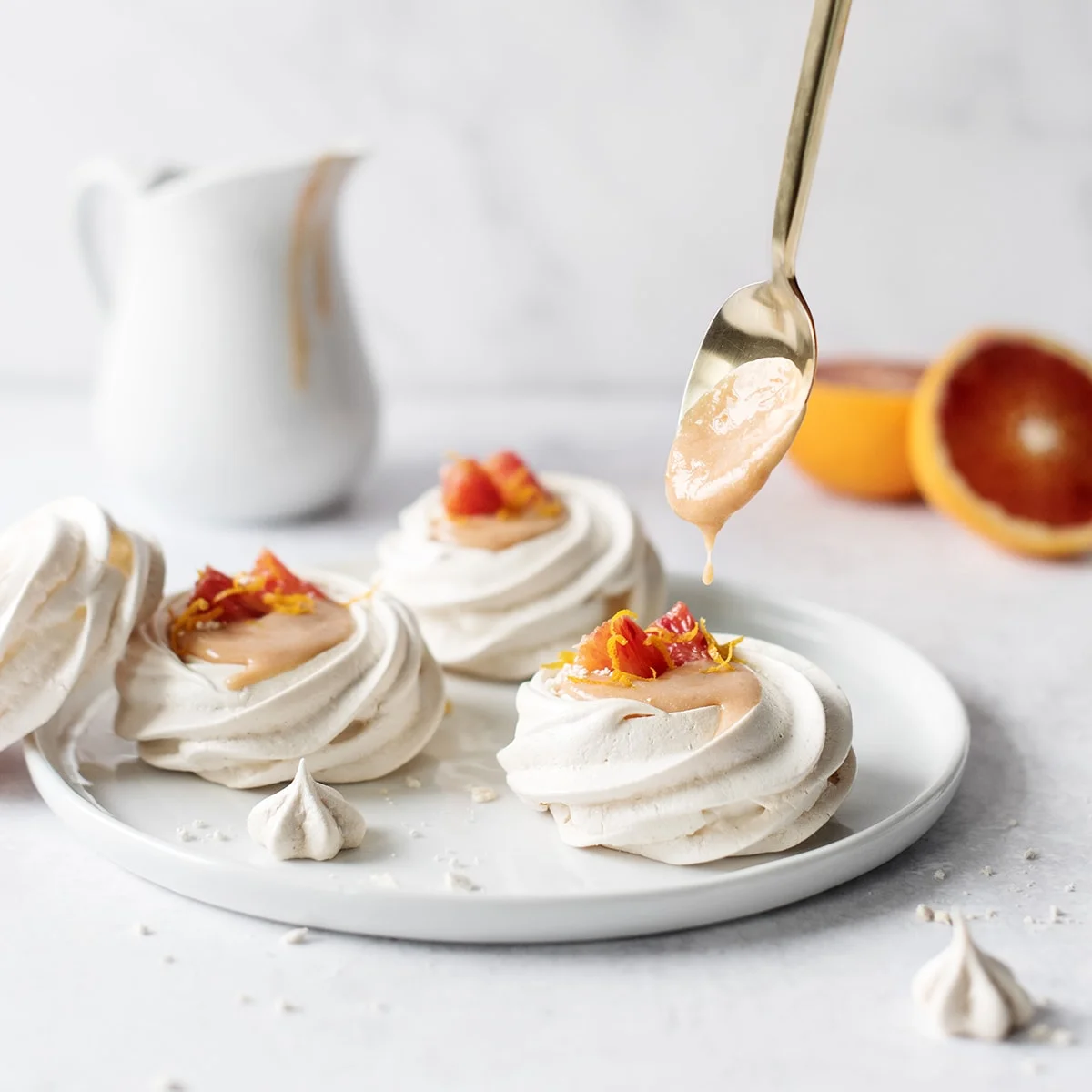
These Australian-style pavlovas pair crisp meringue shells with soft, marshmallowy centres and tangy blood orange curd. They make an elegant dessert that can be prepared ahead and filled just before serving.
Ingredients
- 4 largeegg whites
- 1/4 teaspoonsalt
- 250 ggranulated sugar
- 2 teaspoonscornflour
- 1 teaspoonvanilla extract
- 1 teaspoonwhite vinegar
- 3 largeegg yolks
- 60 ggranulated sugar
- 80 gfreshly squeezed blood orange juice
- Zest of 1blood orange
- 80 gunsalted butter, softened and cubed
Instructions
- 1
Preheat the oven
Heat the oven to 175°C.
- 2
Whisk the whites
Using an electric or stand mixer, whisk the egg whites with the salt until the beaters leave trails in the mixture.
- 3
Add the sugar
Add the sugar slowly, one tablespoon at a time, beating for at least 10–15 seconds after each addition and waiting until it dissolves before adding more.
- 4
Check the meringue
Stop beating when the meringue forms stiff peaks. Rub a little between your thumb and index finger; it should feel smooth, not gritty.
- 5
Fold in flavourings
Sprinkle the cornflour, vanilla and vinegar over the meringue, then fold them in with a rubber spatula until combined.
- 6
Prepare a piping bag
Transfer the meringue to a piping bag fitted with a closed star tip.
- 7
Pipe the shells
Line a baking sheet with baking parchment. Pipe a filled-in circle for each base, then pipe a ring around its outer edge to form a wall and leave a hollow centre for the filling.
- 8
Bake the pavlovas
Put the baking sheet in the oven and immediately reduce the temperature to 150°C. Bake the pavlovas for 30 minutes.
- 9
Cool in the oven
Turn off the oven and leave the pavlovas inside for another 30 minutes, until they lift cleanly from the parchment.
- 10
Cool the shells
Set the pavlovas aside to cool completely. Fill them with blood orange curd just before serving.
- 11
Start the curd
Put the egg yolks, sugar, blood orange zest and blood orange juice in a small saucepan.
- 12
Thicken the curd
Cook over medium-high heat, stirring constantly, for about 3–4 minutes, until thick enough to coat the back of a spoon or reach a jelly-like consistency. Stir vigorously to keep the eggs from scrambling.
- 13
Stir in butter
Take the pan off the heat. Stir in the butter one cube at a time, allowing each cube to melt before adding the next. The curd should hold a spatula line for about 1–2 seconds before the sides come together.
- 14
Cover and cool
Transfer the curd to a small bowl and press cling film directly onto its surface to prevent a skin forming.
- 15
Fill and serve
Let the curd cool completely, then spoon it into the pavlovas. Top with slices of fresh blood orange and a little blood orange zest.
What are blood orange pavlovas?
Pavlova is a meringue-based dessert associated with Australia and New Zealand, named after the Russian ballerina Anna Pavlova. Its shell is crisp outside and soft inside, with a hollow centre for toppings.
Here, individual shells hold tart blood orange curd. The citrus filling balances the sweet meringue, while piping a raised rim helps keep the curd in place.
Nutrition and macros by portion
The nutrition label shows one serving as written: 173 calories, 2g protein, 27g carbs, 7g fat.
| Portion | Adjustment | kcal | Protein | Carbs | Fat |
|---|---|---|---|---|---|
| Lighter | Smaller pavlova shell | 121 kcal | 1g | 19g | 5g |
| This serving | As written | 173 kcal | 2g | 27g | 7g |
| Hungry | Larger pavlova portion | 260 kcal | 3g | 41g | 11g |
The meringue’s sugar supplies most of the carbohydrates, while the butter contributes much of the fat. Egg whites and yolks provide the protein, with the yolks and butter also adding fat. Balance the dessert with fresh fruit alongside it.
Building a stable meringue
Clean equipment: Use a clean bowl and beaters so the whites can whip properly. Add the sugar gradually, giving each addition time to dissolve.
Final check: Stiff peaks should hold their shape, and the meringue should feel smooth when rubbed between your fingers. Folding in the cornflour, vanilla and vinegar gently helps keep the whipped mixture airy.
Shaping the shells
Base and rim: Pipe a solid circle for each base, then add a ring around the edge. This creates a well for the curd without leaving a gap in the bottom.
Even portions: Keep the shells similar in size so they bake at a similar rate. A piping bag with a closed star tip gives them ridged edges, but the recipe relies on forming the raised rim rather than a particular decorative pattern.
Baking and cooling
Temperature change: The oven starts at 175°C and is lowered to 150°C as soon as the tray goes in. This two-stage approach follows the recipe’s method for baking the shells.
Gradual cooling: Leave the pavlovas in the switched-off oven for 30 minutes, then cool them completely outside it. They are ready to lift when they peel cleanly from the parchment.
Getting the curd right
Constant stirring: Stir the yolks, sugar, juice and zest throughout cooking, especially as the mixture thickens. Take care not to let the eggs scramble.
Butter in stages: Add the butter one cube at a time off the heat, melting each piece before adding another. The finished curd should briefly hold a line drawn through it with a spatula.
Serving and timing
Fill close to serving time so the curd does not soften the crisp shell while it sits. Both the meringues and the curd need to be completely cool before assembly.
Serve the pavlovas on their own or alongside fresh fruit. Blood orange slices and a little zest, as in the recipe, echo the flavour of the curd.
Recipe notes & tips
- Add the sugar slowly so it has time to dissolve into the egg whites.
- Check that the meringue feels smooth rather than gritty before folding in the other ingredients.
- Pipe a continuous base beneath each rim to help the curd stay in the shell.
- Stir the curd continuously while it cooks to prevent the yolks from scrambling.
- Press cling film directly onto the curd to stop a skin forming as it cools.
- Wait until both components are cool before filling the pavlovas.
Variations
- Extra citrus: Add a little more blood orange zest to the curd for a stronger citrus aroma.
- Mixed citrus: Replace some of the blood orange juice with another citrus juice while keeping the total amount at 80 g.
- Simple finish: Leave off the orange slices and serve the filled shells with just a little zest.
- Smooth topping: Spoon the curd into the shells instead of piping it for a casual finish.
- Larger nest: Pipe fewer, wider shells if you prefer pavlovas with more filling space.
Common mistakes to avoid
- Adding sugar too quickly: The meringue can stay gritty; add it one tablespoon at a time and beat after each addition.
- Under-whisking: Soft peaks will not hold the shell shape; continue until the meringue forms stiff peaks.
- Scrambling the curd: High heat or pauses in stirring can cook the yolks unevenly; stir constantly and watch for thickening.
- Adding butter all at once: The curd may not incorporate smoothly; stir in one cube at a time.
- Filling warm shells: Heat and moisture can affect the texture; cool the pavlovas and curd completely first.
- Filling too early: The shells can soften as they stand; spoon in the curd just before serving.
How to store
Keep unfilled, cooled pavlova shells in an airtight container at room temperature and refrigerate the curd in a covered container. For the best texture, fill just before serving; filled pavlovas soften as they stand and are not suited to reheating.
Frequently asked questions
Can I make the pavlova shells ahead?
Yes. Cool them completely and store them unfilled in an airtight container at room temperature. Add the curd shortly before serving.
How can I tell when the meringue is ready?
It should form stiff peaks and feel smooth, not gritty, when rubbed between your fingers.
How do I stop the curd from scrambling?
Stir constantly as it cooks and keep a close eye on it as it thickens. Remove it from the heat once it coats the back of a spoon or reaches a jelly-like consistency.
Can I use bottled blood orange juice?
Freshly squeezed juice is specified in this recipe and gives the curd its citrus flavour. If using bottled juice, choose one that is pure juice and keep the amount at 80 g.
Why should I fill the pavlovas just before serving?
The curd's moisture softens the meringue over time. Filling close to serving helps preserve the contrast between the shell and its soft centre.
Cook it from the original
This recipe comes from teakandthyme.com. Their page has the author’s own photos, notes and tips — the best place to cook it from.
Open the recipe on teakandthyme.com