
Stroopwafel doughnuts
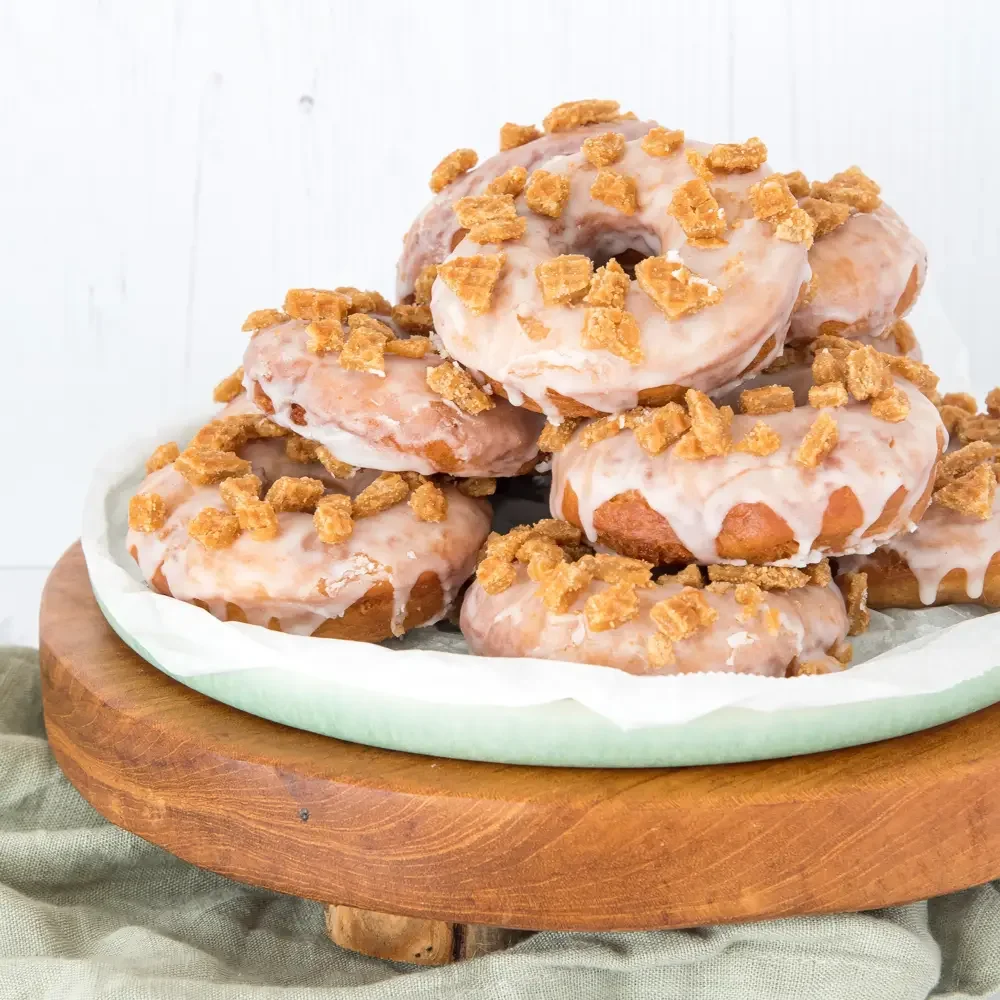
These yeast-raised doughnuts are folded with stroopwafel pieces, fried until golden and finished with a thick icing and more biscuit. They make a generous batch for sharing and bring caramel and cinnamon flavours to a classic doughnut shape.
Ingredients
- 10 gdried yeast
- 60 mllukewarm water
- 250 mllukewarm milk
- 3 tbspcaster sugar
- 100 gunsalted butter, melted
- 575 gplain flour
- 1 tbspcinnamon
- 3medium eggs
- 225 gstroopwafel pieces
- as neededsunflower oil, for deep-frying
- 350 gicing sugar
- 60 mlmilk
- to tastestroopwafel pieces, for topping
Instructions
- 1
Activate the yeast
Mix the yeast, water, lukewarm milk and caster sugar in a bowl. Leave for 10 minutes, until the yeast dissolves and begins to bubble.
- 2
Make the dough
Put the yeast mixture, melted butter, flour, cinnamon and eggs in a bowl and knead to make a sticky dough. Add the 225 g stroopwafel pieces and mix briefly until evenly distributed.
- 3
Leave to rise
Cover your work surface generously with flour and turn the dough out onto it. Knead briefly, transfer to a bowl, cover and leave in a warm place for 45 minutes, or until roughly doubled in volume.
- 4
Cut the doughnuts
Flour the work surface again and roll the dough to about 1 cm thick. Use an 8 cm cutter and a smaller cutter of about 3.5 cm to cut out doughnut shapes. Continue until the dough is used up, placing the doughnuts on a baking tray lined with baking paper.
- 5
Rest and heat
Cover the tray and leave the doughnuts to rest for about 30 minutes. Meanwhile, heat a pan of sunflower oil to 180 °C.
- 6
Fry until golden
Fry the doughnuts for about 2 minutes in total, turning them halfway through, until cooked through and golden brown.
- 7
Mix the icing
Once all the doughnuts have cooled, mix the icing sugar with the milk. The icing should be thick; add icing sugar or milk as needed to adjust its consistency.
- 8
Ice and finish
Dip the doughnuts in the icing and set them on a sheet of baking paper. Sprinkle with the extra stroopwafel pieces.
What are stroopwafel doughnuts?
Stroopwafels are Dutch wafer biscuits joined with a caramel syrup filling, traditionally enjoyed with a hot drink. This recipe brings their caramel and spice notes into a yeast-raised doughnut, then adds more pieces over the icing.
The dough is enriched with butter and eggs, while cinnamon complements the stroopwafel. Frying gives the outside its golden finish and leaves the centre soft.
Nutrition and macros by portion
The nutrition label shows one serving as written: 230 calories, 4g protein, 34g carbs, 9g fat.
| Portion | Adjustment | kcal | Protein | Carbs | Fat |
|---|---|---|---|---|---|
| Lighter | Smaller doughnuts, lighter icing | 161 kcal | 3g | 24g | 6g |
| This serving | As written | 230 kcal | 4g | 34g | 9g |
| Hungry | Two doughnuts | 345 kcal | 6g | 51g | 14g |
The flour, sugar and stroopwafel provide most of the carbohydrates, while butter and absorbed frying oil contribute much of the fat. Eggs and milk add some protein, though these are still a sweet treat rather than a protein-rich meal; pair a doughnut with plain yoghurt or fruit if serving it as part of a more balanced plate.
The ingredients that matter
Yeast: lukewarm liquid helps it dissolve and become active. The first 10-minute rest gives you a chance to see bubbles before mixing the dough.
Stroopwafel: the pieces are mixed through the dough and used again as a topping. Keep the pieces fairly small so they spread throughout the batch.
Working with sticky dough
Flour the work surface generously before turning out the dough, then knead it only briefly as directed. A sticky dough is expected, so avoid adding a lot of extra flour, which can make the doughnuts dense.
Roll the dough to about 1 cm thick and cut each ring with both the 8 cm and 3.5 cm cutters. Gather and re-roll the scraps as needed to use up the dough.
Proofing and frying cues
First rise: leave the covered dough in a warm place for 45 minutes, until it has roughly doubled. The second rest is about 30 minutes after shaping.
Oil temperature: heat the oil to 180 °C before frying. The stated frying time is about 2 minutes in total, with a turn halfway; look for a golden-brown surface and doughnuts cooked through.
Getting the icing right
A thick icing is important here so it coats the doughnuts rather than running straight off. Mix the icing sugar and milk, then adjust the consistency with a little more of either ingredient if necessary.
Wait until the doughnuts have cooled before dipping them. Add the extra stroopwafel pieces while the icing is still wet so they cling to the top.
Serving and timing
This recipe makes 30 doughnuts, so it suits a gathering or a batch to share. The listed method includes two rises, frying and cooling, but gives no total preparation time.
Serve them on their own with coffee or tea, or alongside fresh fruit for a contrast to the sweet icing. Fry in batches rather than crowding the pan.
Recipe notes & tips
- Check that the yeast mixture bubbles after its 10-minute rest before continuing.
- Use enough flour on the work surface to handle the sticky dough without kneading in lots of extra flour.
- Keep the oil at 180 °C and fry a few doughnuts at a time so the pan is not crowded.
- Turn each doughnut halfway through the roughly 2-minute frying time.
- Let the doughnuts cool fully before dipping them in the icing.
- Adjust the icing gradually, as a little milk can make it much thinner.
Variations
- Extra cinnamon: add a little more cinnamon to the dough for a stronger warm spice note.
- Smaller batch: halve all the ingredients for fewer doughnuts.
- Vanilla icing: stir a little vanilla into the icing mixture.
- More topping: scatter extra stroopwafel pieces over the wet icing.
- Different shape: cut the dough into rounds without holes if you do not have a small cutter.
Common mistakes to avoid
- Inactive yeast: check for bubbles after 10 minutes before mixing the dough.
- Too much extra flour: flour the surface for handling but avoid working large amounts into the sticky dough.
- Uneven doughnuts: roll to an even 1 cm thickness so the pieces cook at a similar rate.
- Oil too cool: bring it to 180 °C before frying to help the doughnuts cook and colour as intended.
- Crowded pan: fry in batches so the doughnuts have room to turn.
- Runny icing: add icing sugar gradually until it is thick enough to coat the doughnuts.
How to store
Keep cooled doughnuts in an airtight container at room temperature and eat within 1–2 days for the best texture. If needed, warm briefly in a low oven; the icing may soften.
Frequently asked questions
Can I make the dough ahead?
The recipe specifies two rises but does not give an overnight method. For best results, follow the stated 45-minute and 30-minute rests.
How do I know when the yeast is ready?
After 10 minutes, the mixture should show bubbles as the yeast dissolves and activates. If it remains completely inactive, check that your yeast is in date and the liquid was lukewarm rather than hot.
What if I do not have doughnut cutters?
Use an 8 cm cutter for the outer circle and a smaller cutter of about 3.5 cm for the hole. A small round cutter or a suitably sized glass can work for the centre.
How long should I fry each doughnut?
The recipe gives about 2 minutes in total, turning halfway through. Use the golden-brown colour and cooked-through centre as cues.
Can I make the icing thinner?
Yes. Add milk a little at a time until it reaches the consistency you want, keeping in mind that the recipe calls for a thick icing.
Can I bake these instead of frying them?
This method is written for deep-frying at 180 °C and does not provide baking instructions. Baking would change the texture and cooking time.
Cook it from the original
This recipe comes from laurasbakery.nl. Their page has the author’s own photos, notes and tips — the best place to cook it from.
Open the recipe on laurasbakery.nl