
Spatchcock Chicken
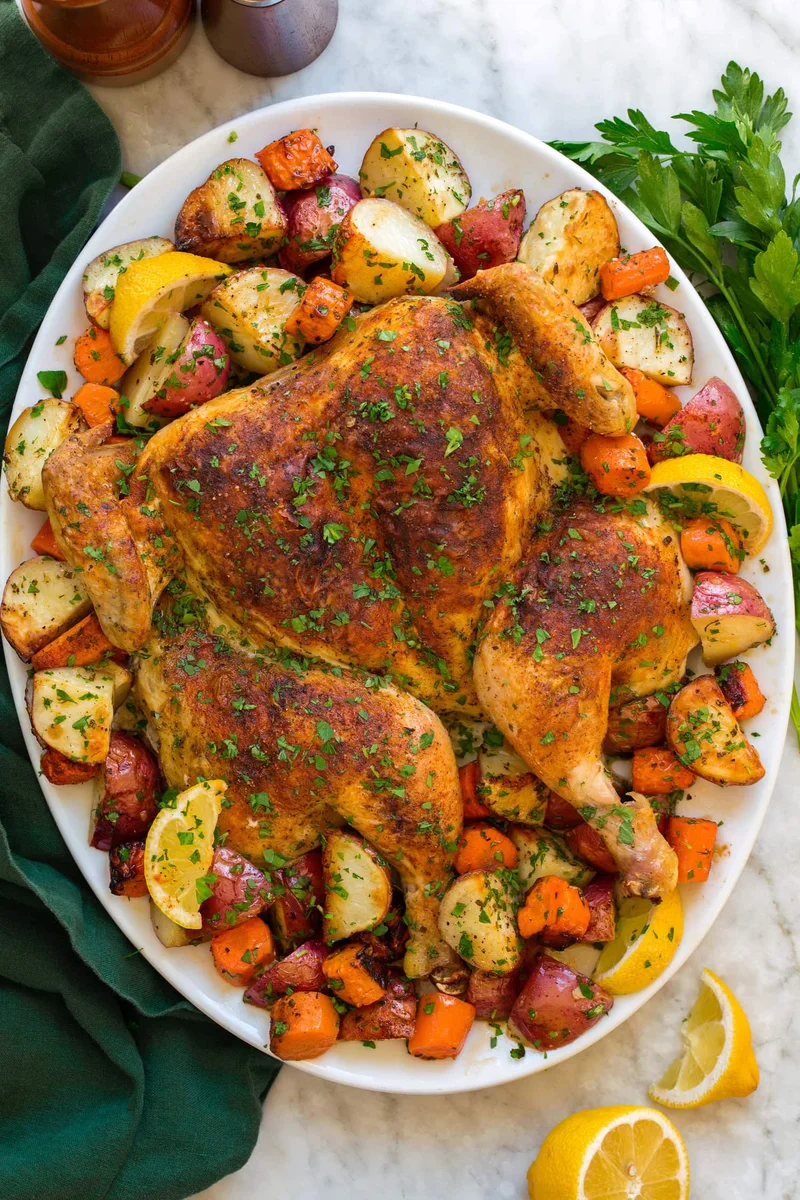
Spatchcock chicken is flattened so it roasts evenly alongside potatoes and carrots on one tray. Garlic, fresh herbs and lemon zest tucked under the skin flavour the meat while helping the skin turn golden.
Ingredients
- 1.81–2.04 kg (4–4.5 lb)whole chicken
- 42 g (3 tbsp), softenedbutter
- 7.5 ml (1½ tsp)minced garlic
- 7.5 ml (1½ tsp), choppedfresh thyme
- 7.5 ml (1½ tsp), choppedfresh rosemary
- 10 ml (2 tsp), plus lemon wedges for servinglemon zest
- to tastesalt and black pepper
- 5 ml (1 tsp)paprika
- 794 g (1¾ lb), cut into 4 cm (1½-inch) chunksred potatoes
- 454 g (1 lb), peeled and cut into 2.5 cm (1-inch) chunkscarrots
- 10 ml (2 tsp), mincedgarlic
- 15 ml (1 tbsp), choppedfresh rosemary
- 10 ml (2 tsp), choppedfresh thyme
- 15 ml (1 tbsp)olive oil
- 45 ml (3 tbsp), choppedfresh parsley
Instructions
- 1
Heat the oven
Heat the oven to 220°C (425°F). Coat an 46 × 33 cm (18 × 13-inch) baking tray with non-stick cooking spray or line it with baking parchment.
- 2
Remove the backbone
Set the chicken breast-side down on a chopping board. With sturdy kitchen shears, cut along both sides of the backbone from end to end and remove it. Refrigerate the backbone for stock if you like.
- 3
Season the inside
If you want to make flattening easier, make a small cut along the upper centre of the breastbone before turning the chicken over. Trim away any obvious excess fat, then season the inside with salt and pepper.
- 4
Flatten the chicken
Turn the chicken breast-side up. Press firmly with the heel of your hand between the breasts to crack the breastbone and flatten the bird; place your other hand on top if you need more pressure.
- 5
Mix herb butter
Stir the butter with 7.5 ml (1½ tsp) each of the garlic, thyme and rosemary, plus the lemon zest. Season to taste with salt and pepper; the source recipe uses about ¾ tsp salt and ¼ tsp pepper.
- 6
Loosen the skin
Use the back of a spatula or your fingers to ease the skin away from the meat, starting at the neck and working towards the other end without pushing all the way through. Make pockets over the thighs too, then pat the outside of the chicken dry with kitchen paper.
- 7
Spread the butter
Work the herb butter under the skin over the breasts and thighs. Adding a spoonful at a time and smoothing it from the top of the skin can help distribute it.
- 8
Arrange the chicken
Put the chicken breast-side up on the prepared tray. Turn the wing tips and tuck them underneath. Sprinkle the chicken evenly with paprika, salt and pepper to taste.
- 9
Season the vegetables
In a large bowl, toss the potatoes and carrots with the remaining garlic, rosemary and thyme, and the olive oil. Season with salt and pepper to taste.
- 10
Fill the tray
Arrange the vegetables around the chicken, using the space beneath the neck area and wing tips if needed.
- 11
Roast until cooked
Roast for about 50–60 minutes, until the thickest part of the breasts registers 71–74°C (160–165°F) on an instant-read thermometer and the thighs reach at least 74°C (165°F). The thighs can be hotter, but avoid taking the breasts beyond that range. If the vegetables start browning early, turn them at about 30 minutes.
- 12
Rest and serve
Loosely cover the chicken with foil and leave it to rest for 10 minutes before carving. Scatter the parsley over the chicken and vegetables, and serve with lemon wedges for squeezing.
What is spatchcock chicken?
Spatchcocking means removing a chicken’s backbone and flattening the bird before cooking. It is a practical roasting technique rather than a particular seasoning, and is often used for whole birds cooked over direct heat or in the oven.
Here, the chicken shares a tray with potatoes and carrots, while a lemon-and-herb butter goes beneath the skin. Flattening helps the bird cook in a relatively even layer, and the vegetables pick up flavour as they roast.
Nutrition and macros by portion
The nutrition label shows one serving as written: 690 calories, 53g protein, 43g carbs, 32g fat.
| Portion | Adjustment | kcal | Protein | Carbs | Fat |
|---|---|---|---|---|---|
| Lighter | More carrots, less butter | 483 kcal | 37g | 30g | 22g |
| This serving | As written | 690 kcal | 53g | 43g | 32g |
| Hungry | Larger chicken portion | 1035 kcal | 80g | 65g | 48g |
The potatoes provide most of the carbohydrates, while the chicken supplies most of the protein. Butter, olive oil and the chicken skin contribute much of the fat; add a green salad or extra non-starchy vegetables to balance the plate.
Why flatten the chicken?
Backbone: Cut close along each side with sturdy kitchen shears so the bird opens cleanly. Keep the backbone chilled if you plan to use it for stock.
Breastbone: A firm press between the breasts helps the chicken lie flat. A flatter shape makes it easier to arrange the bird and vegetables together on the tray.
Getting the herb butter under the skin
Butter: Soften it enough to stir easily with the garlic, thyme, rosemary and lemon zest. Work gently when loosening the skin, and leave it attached at the far end so the butter stays in place.
Distribution: Add the mixture a spoonful at a time, then smooth it over the meat from above the skin. This helps spread the flavour across the breast and thigh areas.
Roasting the vegetables
Cut size: Keep the potatoes and carrots in similarly sized chunks so they roast at a similar pace. The method uses chunks of about 4 cm for the potatoes and 2.5 cm for the carrots.
Tray space: Arrange the vegetables around the chicken rather than piling them up. If they begin to brown before the chicken is ready, turn them at around the 30-minute mark.
How to check doneness
Thermometer: Check the thickest part of the breasts and the thighs with an instant-read thermometer, avoiding bone. The recipe calls for 71–74°C (160–165°F) in the breasts and at least 74°C (165°F) in the thighs.
Rest: Let the chicken stand under foil for 10 minutes before carving. This gives you time to finish preparing the serving platter without cutting into the bird straight from the oven.
Serving the tray
Parsley and lemon: Scatter the chopped parsley over the chicken and vegetables just before serving. Pass lemon wedges around so everyone can squeeze some over their portion.
On the side: The potatoes and carrots make this a substantial one-tray meal. A crisp green salad or simply dressed leafy greens add a fresh contrast.
Recipe notes & tips
- Use sturdy kitchen shears to cut through the backbone more easily.
- Dry the chicken skin well before roasting to encourage browning.
- Keep the skin attached at the far end when making pockets for the butter.
- Check the breast and thigh temperatures separately, as they can cook at different rates.
- Turn the vegetables partway through if their exposed edges are browning too quickly.
- Save the backbone in the fridge if you want to make stock soon.
Variations
- Add onion: Roast chunky wedges around the chicken with the potatoes and carrots.
- Change the herbs: Swap in chopped fresh sage for some of the thyme or rosemary.
- Add extra lemon: Serve with more wedges for a brighter finish at the table.
- Use other root vegetables: Replace some of the carrots with similarly sized parsnip chunks.
- Add a little heat: Mix a pinch of chilli flakes into the herb butter.
Common mistakes to avoid
- Leaving the chicken domed: Press firmly between the breasts so the bird lies flatter on the tray.
- Cutting through the skin pocket: Stop short of the far end so the herb butter does not escape.
- Crowding the vegetables: Spread them around the chicken in a single layer where possible.
- Relying on colour alone: Check the thickest breast and thigh with an instant-read thermometer.
- Carving straight away: Rest the chicken under foil for 10 minutes before slicing.
How to store
Refrigerate leftover chicken and vegetables in a covered container within 2 hours, and eat within 3 days. Reheat until piping hot throughout; an oven helps the vegetables regain some of their roasted texture.
Frequently asked questions
Can I spatchcock the chicken ahead of time?
Yes. You can remove the backbone and flatten the chicken ahead, then keep it covered in the fridge. Apply the herb butter and season it before roasting.
Do I have to cut the breastbone?
No. The small cut is optional and is only suggested to make flattening easier. Press firmly between the breasts to crack the bone and flatten the bird.
Can I use dried herbs instead of fresh?
Fresh herbs are specified here, but dried herbs can be used if needed. Use less than the listed fresh amount, as dried herbs are more concentrated.
What if the vegetables are ready before the chicken?
Take the vegetables off the tray and keep them warm while the chicken finishes roasting. Check the chicken with a thermometer rather than relying on the vegetables as a doneness cue.
Can I make this without a baking tray that size?
Use a sturdy roasting tray that can hold the flattened chicken and vegetables without crowding. If everything will not fit in one layer, roast the vegetables on a separate tray.
Cook it from the original
This recipe comes from cookingclassy.com. Their page has the author’s own photos, notes and tips — the best place to cook it from.
Open the recipe on cookingclassy.com