
Imarti
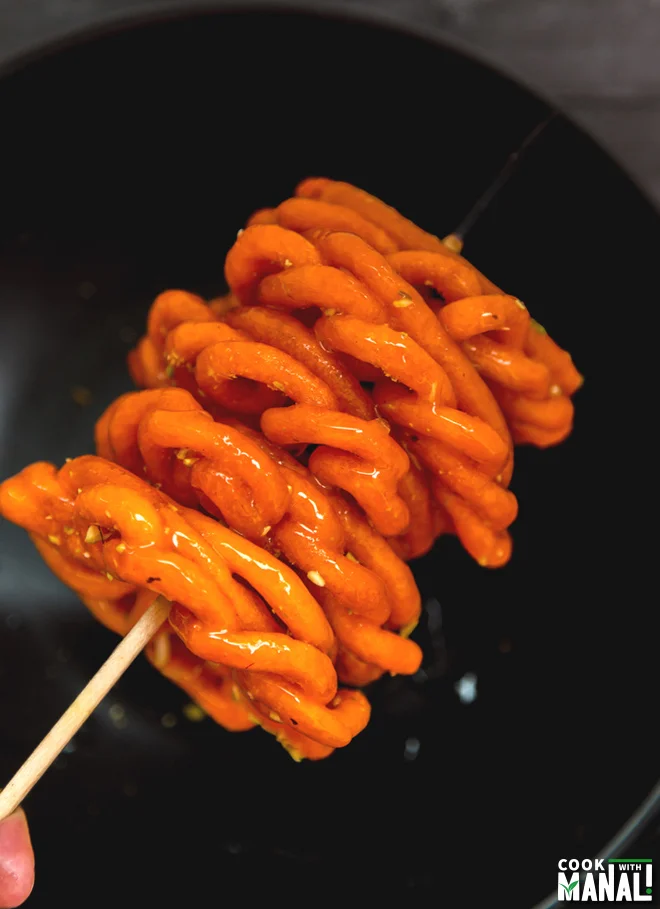
Imarti is a crisp, flower-shaped Indian sweet made from urad dal batter, fried in ghee and dipped in fragrant sugar syrup. Its delicate pattern and rose, cardamom and saffron notes make it a special treat to serve fresh.
Ingredients
- 100 g (1/2 cup)dhuli urad dal (split black gram without skin), soaked overnight
- 8 g (1 tablespoon)rice flour or cornflour
- To tasteorange food colouring
- As neededghee (clarified butter), for frying
- 200 g (1 cup)granulated white sugar
- 80 ml (1/3 cup) + 5 ml (1 teaspoon)water
- 2.5 ml (1/2 teaspoon)rose water
- 3–4green cardamom pods, seeds crushed
- 3–4 strandssaffron
- 2.5 ml (1/2 teaspoon)lemon juice
- To tastepistachios, crushed, to garnish
Instructions
- 1
Soak the dal
Soak the urad dal in plenty of water overnight, or for at least 6 hours.
- 2
Blend the dal
Drain the soaked dal and blend it to a fine paste, adding a little water at a time.
- 3
Colour the batter
Transfer the paste to a bowl and mix in the food colouring and rice flour.
- 4
Rest the batter
Mix continuously with your hands or a spoon for 3–4 minutes, then leave the batter to rest for 15–20 minutes.
- 5
Start the syrup
While the batter rests, put the sugar in a pan over medium heat and add enough water to cover it. Stir continuously until the sugar dissolves.
- 6
Check the thread
After 4–5 minutes, check for one-string consistency: place a drop between your thumb and index finger, then gently separate them. The syrup should form a single thread.
- 7
Flavour the syrup
Add the rose water, crushed cardamom seeds, saffron and lemon juice, then switch off the heat. Set the syrup aside for dipping.
- 8
Heat the ghee
Pour ghee into a kadai and warm it over medium-low heat.
- 9
Fill the piping bag
As the ghee heats, transfer the batter to a piping bag or squeeze bottle. A Wilton tip #10 can be used, or use a zip-lock bag with a small corner cut off.
- 10
Pipe the imarti
When the ghee is mildly hot, pipe in the batter. Keep the heat at medium-low and avoid getting the ghee too hot, as the batter will be difficult to pipe.
- 11
Shape the pattern
Pipe one round, then form small circles next to one another over that first round to create the imarti shape.
- 12
Fry until crisp
Once the batter is piped, raise the heat to medium and fry the imarti until crisp on both sides.
- 13
Drain the ghee
Lift out the fried imarti and shake off any excess ghee.
- 14
Dip the first side
Dip the imarti in the warm sugar syrup for a few seconds.
- 15
Dip the other side
Turn it over so the other side also gets coated in syrup.
- 16
Set the imarti
Remove it from the syrup and place it on a baking sheet lined with parchment paper or a silicone mat.
- 17
Add the garnish
Immediately sprinkle with crushed pistachios.
What is imarti?
Imarti is a South Asian sweet made by piping a lentil batter into a patterned shape, deep-frying it and soaking it briefly in sugar syrup. It is closely associated with Indian sweet-making traditions and is often served for celebrations or as a special dessert.
This version uses split, skinless urad dal for its batter and perfumes the syrup with rose, cardamom and saffron. Frying gives the shaped sweet a crisp exterior, while a short dip adds sweetness without losing its distinctive form.
Nutrition and macros by portion
The nutrition label shows one serving as written: 145 calories, 3g protein, 33g carbs, 0g fat.
| Portion | Adjustment | kcal | Protein | Carbs | Fat |
|---|---|---|---|---|---|
| Lighter | Smaller imarti portions | 102 kcal | 2g | 23g | 0g |
| This serving | As written | 145 kcal | 3g | 33g | 0g |
| Hungry | Serve two imartis | 218 kcal | 5g | 50g | 0g |
The supplied per-serving figures list carbohydrates as the main macronutrient, largely from the lentils and sugar syrup; the urad dal also contributes protein. Ghee provides the frying fat, though the supplied nutrition lists fat as 0 g. Serve one imarti alongside unsweetened tea or a less-sweet dish for a more balanced spread.
The batter matters
Urad dal: blend the soaked lentils gradually, adding only a little water at a time. The aim is a fine, thick paste that can hold its shape when piped.
Rice flour: this is mixed into the batter to support its texture. The recipe also allows cornflour as an alternative.
Get the syrup ready
One-string stage: after 4–5 minutes of cooking, test a cooled drop between your fingers and look for a single thread as they move apart. Take care when handling hot syrup.
Warm syrup: add the rose water, cardamom, saffron and lemon juice once the syrup reaches this stage, then switch off the heat. It should still be warm when the fried imarti is dipped.
Pipe with control
Equipment: a piping bag or squeeze bottle gives control over the batter. A small cut in a zip-lock bag works too, as long as the opening is small enough to make the pattern.
Ghee temperature: begin at medium-low and pipe when the ghee is only mildly hot. If it is too hot, the batter may be difficult to pipe; raise the heat to medium after shaping.
Look for crispness
Frying: cook until the imarti is crisp on both sides, turning as needed. The recipe gives no fixed frying time, so use the texture and colour as your guide.
Draining: lift each piece out and shake off excess ghee before it goes into the syrup. This helps avoid carrying extra frying fat into the coating.
Dip briefly and garnish
Syrup soak: dip for a few seconds, then turn the imarti to coat its other side. A brief soak allows the syrup to cling while the patterned shape stays intact.
Pistachios: add the crushed nuts as soon as the imarti comes out of the syrup so they adhere to the surface.
Serve it simply
Imarti is best enjoyed fresh, when its outside is crisp and its syrup coating is fragrant. Serve it on its own as a sweet, or alongside unsweetened tea to contrast with the syrup.
Because the recipe involves several stages, prepare the batter and syrup before frying. The batter’s resting time can overlap with syrup-making, as described in the method.
Recipe notes & tips
- Soak the urad dal for at least 6 hours so it blends smoothly.
- Add water to the blender gradually to keep the batter thick enough to pipe.
- Rest the batter for 15–20 minutes after mixing it for 3–4 minutes.
- Keep the ghee at medium-low while piping, then raise it to medium for frying.
- Have the syrup warm and ready before the imartis come out of the ghee.
- Shake off excess ghee before dipping each piece in syrup.
Variations
- Use cornflour: replace the rice flour with cornflour as the recipe allows.
- Adjust the colour: add orange food colouring to suit the shade you prefer.
- Change the garnish: use more or less crushed pistachio to finish each piece.
- Emphasise the rose: adjust the rose water to taste while keeping the syrup balanced.
- Lean into cardamom: crush the seeds freshly before adding them to the syrup.
Common mistakes to avoid
- Thin batter: adding too much water makes piping difficult; blend in small additions.
- Very hot ghee: the batter can be hard to pipe; start at medium-low heat.
- Skipping the rest: the method allows 15–20 minutes for the mixed batter to rest.
- Guessing the syrup stage: check for a single thread after 4–5 minutes of cooking.
- Cold syrup: keep it warm for dipping so it coats the freshly fried imarti.
- Long syrup soak: dip for only a few seconds per side to preserve the shape.
How to store
Imarti is best eaten fresh for a crisp texture. If needed, refrigerate leftovers in an airtight container for up to 2 days; warm briefly in a low oven, noting that the syrup may soften the crispness.
Frequently asked questions
How long should I soak the urad dal?
Soak it overnight, or for a minimum of 6 hours, in plenty of water.
Can I use cornflour instead of rice flour?
Yes. The recipe specifies 1 tablespoon of rice flour or cornflour.
How do I know when the syrup is ready?
After about 4–5 minutes, a drop should form a single thread when tested between your thumb and index finger. Take care not to handle the hot syrup directly.
Why is my batter hard to pipe?
The ghee may be too hot, or the batter may be too thin. Keep the heat at medium-low while piping and add blending water gradually.
How long should I dip the imarti?
Dip it for a few seconds, then turn it over to coat the second side.
Can I make imarti ahead?
It is best served fresh for the crispest texture. The dal does need an overnight soak, so plan that stage ahead.
Cook it from the original
This recipe comes from cookwithmanali.com. Their page has the author’s own photos, notes and tips — the best place to cook it from.
Open the recipe on cookwithmanali.com