
No Knead Olive Bread
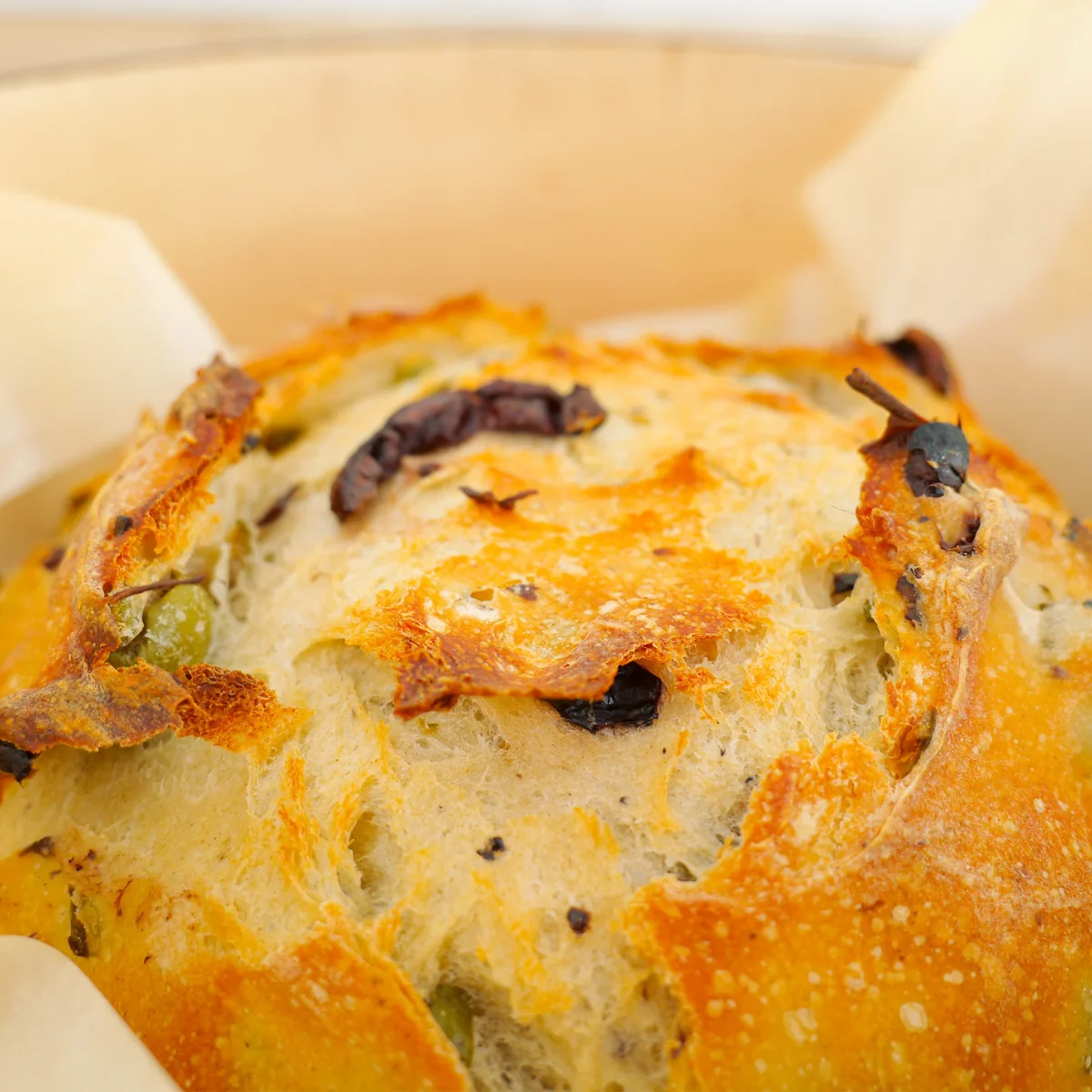
This no-knead olive bread has a crisp, golden crust and a soft, airy centre dotted with Kalamata and green olives. Long, hands-off rising does the work, making it a satisfying loaf to serve with soup or alongside leftover meats.
Ingredients
- 50 gpitted Kalamata olives
- 100 gpitted green olives
- 400 g00 flour
- 7 gdry yeast
- 1 tbspsalt
- 300 mlwater
Instructions
- 1
Prepare the olives
Break the olives into small pieces with your hands, or chop them with a knife.
- 2
Mix the dry ingredients
In a large bowl, combine the flour, salt and yeast, using your hands or a wooden spoon or spatula.
- 3
Add water and olives
Pour in half the water and mix until combined. Add the olives, then pour in the rest of the water and mix thoroughly until no dry flour remains.
- 4
Rest at room temperature
Cover the bowl with plastic wrap and leave the dough at room temperature for 6 hours.
- 5
Chill overnight
After 6 hours, move the bowl to the fridge and leave the dough to rest overnight.
- 6
Turn out the dough
The next day, use wet hands to remove the dough from the bowl and transfer it to a work surface or wooden chopping board.
- 7
Fold and shape
Wet your hands again and fold the dough several times. Shape it into a large ball and place it on a sheet of baking paper.
- 8
Proof the dough
Line a large bowl with a tea towel or cloth, then place the dough, still on the baking paper, inside. Cover the bowl and leave the dough to rest for 2 hours.
- 9
Heat the oven
After the dough has rested for 1 hour, preheat the fan-forced oven to 230°C (446°F). Put the empty Dutch oven inside and heat it for at least 1 hour.
- 10
Score the loaf
Once the dough has rested for 2 hours, carefully lift it from the bowl while keeping it on the baking paper. Use a knife to cut a cross into the top.
- 11
Bake covered
Transfer the dough and baking paper to the preheated Dutch oven. Cover with the lid and bake at 230°C (446°F) for 30 minutes.
- 12
Brown the crust
After 30 minutes, take the Dutch oven out of the oven and remove the lid. Return the bread to the oven and bake uncovered for another 15–20 minutes, until the crust is golden brown.
What is no-knead olive bread?
This is a rustic loaf made by mixing the dough rather than kneading it, then giving it a long rise before baking in a covered Dutch oven. The method draws on the simple, slow-fermented approach used in many home-style breads.
Here, Kalamata and green olives bring salty, savoury pockets to a crusty loaf with a soft, airy interior. The covered pot traps steam early in baking, helping the loaf rise before its crust turns golden.
Nutrition and macros by portion
The nutrition label shows one serving as written: 410 calories, 12g protein, 75g carbs, 6g fat.
| Portion | Adjustment | kcal | Protein | Carbs | Fat |
|---|---|---|---|---|---|
| Lighter | Smaller bread portion | 287 kcal | 8g | 53g | 4g |
| This serving | As written | 410 kcal | 12g | 75g | 6g |
| Hungry | Larger bread portion | 615 kcal | 18g | 113g | 9g |
Most of the carbohydrates and some of the protein come from the 00 flour, while the olives contribute some fat and flavour. The added salt and briny olives are the main sources of sodium. Pair a slice with soup and vegetables or salad for a more balanced plate.
Why use two kinds of olives?
Kalamata olives: their rich, briny flavour gives the crumb a pronounced savoury note.
Green olives: these add another layer of tang and make the olive pieces easy to spot throughout the loaf. Break or chop both types into small pieces so they distribute through the dough.
How the dough comes together
Mixing: combine the flour, salt and yeast before adding water in two stages. Add the olives between pours, then mix until no dry flour is left.
Hydration: the dough is meant to be soft and sticky, so wet hands are useful when folding and shaping it. Avoid adding extra flour just to make it easier to handle.
Making the most of the long rise
First rest: leave the covered dough at room temperature for 6 hours, then refrigerate it overnight. The long schedule is mostly hands-off, but make sure you have enough time for both rises before baking.
Final proof: after shaping, give the dough 2 hours in a cloth-lined bowl. Keep it on its baking paper so it can be moved more easily into the hot pot.
Scoring and baking in a Dutch oven
Hot pot: preheat the empty Dutch oven at 230°C for at least 1 hour, beginning after the dough's first hour of its final rest. Handle it carefully when transferring the loaf, as the pot and lid will be very hot.
Crust cues: bake covered for 30 minutes, then uncover and bake for another 15–20 minutes. The loaf is ready when the crust is golden brown.
Serving the bread
This loaf works well alongside soup, where its crisp crust is useful for dipping, or served with leftover meats. Let the bread cool before slicing so the soft interior has time to settle.
For a simple meal, serve a slice with soup and add vegetables or a salad to round out the plate.
Recipe notes & tips
- Break or chop the olives into small pieces so they are easier to distribute through the dough.
- Mix until no dry flour remains before covering the bowl.
- Use wet hands for folding and shaping the sticky dough.
- Keep the dough on its baking paper when moving it into the hot Dutch oven.
- Start heating the Dutch oven after the dough's first hour of its final rest so it is hot when needed.
- Use the golden-brown crust as the cue to finish the uncovered bake.
Variations
- Herb addition: mix chopped rosemary into the dough with the olives.
- Olive choice: use more Kalamata or green olives while keeping the combined amount the same.
- Seeded crust: sprinkle seeds over the loaf before baking for added crunch.
- Garlic note: mix finely chopped garlic into the dough with the olives.
- Cheese addition: fold a little crumbled cheese into the dough with the olives.
Common mistakes to avoid
- Adding too much flour: the dough should remain soft and sticky, so mix until combined rather than trying to make it dry.
- Skipping the long rest: allow 6 hours at room temperature and an overnight chill as directed.
- Handling with dry hands: wet them before removing, folding or shaping the dough to reduce sticking.
- Heating the Dutch oven for too little time: preheat the empty pot for at least 1 hour at 230°C.
- Uncovering too soon: keep the lid on for the first 30 minutes, then finish uncovered.
- Slicing too early: let the loaf cool before cutting so the crumb can settle.
How to store
Once cool, store the bread in a bread bag or wrapped in a clean tea towel at room temperature for up to 2 days. Reheat slices in a toaster or warm the loaf briefly in the oven to refresh the crust.
Frequently asked questions
Can I use plain flour instead of 00 flour?
The recipe specifies 00 flour. Plain flour can be used as a substitute, though the crumb may differ slightly.
Can I use only one type of olive?
Yes. Keep the total olive amount at 150 g and use either Kalamata or green olives.
Why is the dough sticky?
This is a wet dough, and it is handled with wet hands rather than kneaded. Avoid adding extra flour simply to make it easier to shape.
Can I skip the overnight refrigeration?
The method calls for an overnight rest in the fridge after the 6-hour room-temperature rise. Skipping it would change the schedule and the dough's development.
Do I need a Dutch oven?
The recipe relies on a preheated, covered Dutch oven for the first 30 minutes of baking. No alternative baking method is given here.
How do I know when the bread is done?
After 30 minutes covered, bake it uncovered for 15–20 minutes, until the crust is golden brown.
Cook it from the original
This recipe comes from vincenzosplate.com. Their page has the author’s own photos, notes and tips — the best place to cook it from.
Open the recipe on vincenzosplate.com