
Capoon broth
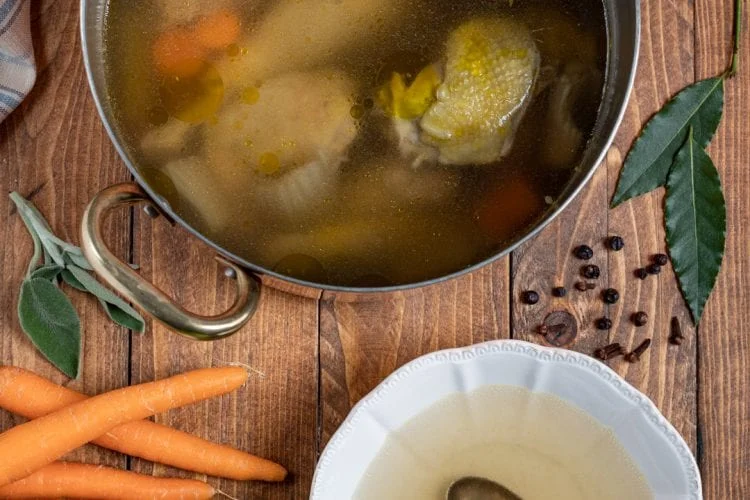
Capon broth is a slowly simmered Italian broth made with capon, vegetables and aromatic herbs. Its long, gentle cooking draws flavour from the bird and makes a warming base for soups, pasta or a simple bowl of broth.
Ingredients
- 1.5 kgcapon, cut into pieces and eviscerated
- 200 gcelery
- 250 gonions
- 200 gcarrots
- 1 sprigrosemary
- 2 leavessage
- 2 leavesbay
- 2 berriesjuniper
- 4cloves
- to tastepepper
- to tastesalt
- 5 lwater
Instructions
- 1
Add the capon
Place the capon pieces in a large, tall, narrow pot so they remain submerged as the broth cooks.
- 2
Prepare vegetables
Peel or trim the vegetables as needed, cut them into large pieces without worrying about even shapes, and add them to the pot.
- 3
Simmer the broth
Add coarse salt, the 5 litres of water and the herbs and spices. Bring to the boil, then turn the heat down to its lowest setting and simmer for 2–3 hours. Skim off any foam that rises to the surface.
- 4
Cool and chill
When the cooking time is up, turn off the heat and let the broth cool. To remove excess fat, strain it into a container and refrigerate; once chilled, the solidified fat can be lifted off with a spoon, either wholly or in part.
- 5
Use the capon
Drain the cooked capon well. The recipe suggests crisping it in a pan with oil and assorted herbs.
What is capon broth?
Capon broth is a traditional Italian-style poultry broth, made by gently cooking capon with vegetables and aromatics. Capon is a castrated male chicken, often used for festive meals in Italy.
This version keeps the ingredients simple and gives the bird time to flavour the liquid. The capon is also kept submerged in a tall, narrow pot, which helps it cook evenly rather than sit exposed above the broth.
Nutrition and macros by portion
The nutrition label shows one serving as written: 350 calories, 34g protein, 3g carbs, 22g fat.
| Portion | Adjustment | kcal | Protein | Carbs | Fat |
|---|---|---|---|---|---|
| Lighter | Remove chilled surface fat | 245 kcal | 24g | 2g | 15g |
| This serving | As written | 350 kcal | 34g | 3g | 22g |
| Hungry | Add more capon | 525 kcal | 51g | 5g | 33g |
The capon provides most of the protein and fat, while the vegetables contribute a small amount of carbohydrate; the broth’s final nutrition also depends on how much meat and fat is eaten. For a balanced meal, serve a moderate portion of capon and broth with vegetables or a modest serving of pasta.
Choosing the pot
Pot shape: a tall, fairly narrow pot helps the capon stay beneath the water. Choose one large enough to hold the bird, vegetables and all 5 litres of water without filling it to the brim.
Submersion: check that the pieces are covered when you add the water. Keeping them immersed helps them cook in the liquid instead of drying out at the surface.
Build a gentle simmer
Heat control: bring the pot to the boil, then reduce the heat to its lowest setting for the long cooking period. A quiet simmer extracts flavour without vigorously agitating the ingredients.
Foam: skim off any foam that appears as the broth cooks. Keep a slotted spoon or skimmer nearby so you can remove it as needed.
Vegetables and aromatics
Large pieces: cut the celery, onions and carrots into rough chunks. They are there to flavour the broth, so neat or uniform cuts are unnecessary.
Herbs and spices: rosemary, sage, bay, juniper and cloves give the liquid its aromatic character. Use pepper and salt to taste; you can adjust the seasoning after straining.
Cooling and removing fat
Cool first: let the broth cool after cooking, then strain it into a container and refrigerate it. For safe handling, avoid leaving it at room temperature for an extended period.
Chilled fat: as the broth cools, fat firms up on the surface and can be spooned away. Remove all of it for a leaner, cleaner-tasting broth, or leave some for a richer result.
Serving the broth and capon
Broth: serve it as a warming first course, or use it as a base for soup or pasta. Taste and adjust the seasoning before serving.
Capon: drain the cooked meat well, then crisp it in a pan with oil and herbs as suggested in the recipe. It makes a useful accompaniment rather than leaving the cooked bird unused.
Recipe notes & tips
- Use a tall, narrow pot so the capon stays submerged beneath the water.
- Keep the heat low after the broth first comes to the boil.
- Skim away foam when it gathers on the surface.
- Cut the vegetables into large, rough pieces rather than finely chopping them.
- Season to taste after cooking, especially if you plan to use the broth in another dish.
- Chill the strained broth before spooning off the solidified fat.
Variations
- Serve with pasta: cook small pasta separately and add it to the hot broth just before serving.
- Add more vegetables: include extra celery, onion or carrot for a vegetable-forward broth.
- Keep more fat: leave some of the chilled fat on the broth for a fuller mouthfeel.
- Crisp the meat: brown drained capon in a pan with oil and herbs for a savoury accompaniment.
Common mistakes to avoid
- Boiling vigorously: the broth can turn cloudy; lower the heat to maintain a gentle simmer.
- Leaving the capon exposed: pieces may dry at the surface; use a tall, narrow pot and keep them submerged.
- Skipping the skimming: foam stays in the liquid; remove it with a skimmer as it rises.
- Cutting vegetables too small: they can be harder to strain out; use large, rough chunks.
- Removing fat while warm: it is difficult to separate cleanly; chill the strained broth first.
How to store
Strain and refrigerate the broth in a covered container, and use it within 3–4 days. Reheat until steaming hot; the cooked capon can be stored separately in the fridge and reheated in a pan or with the broth.
Frequently asked questions
How long should capon broth simmer?
The recipe gives a simmering time of 2–3 hours after the pot comes to the boil. Keep the heat low and skim off any foam that appears.
Should the capon be covered with water?
Yes. The method uses a tall, narrow pot to help keep the capon pieces submerged in the broth.
Do I need to remove the fat?
No; it is optional. Refrigerate the strained broth so the fat solidifies, then spoon off as much or as little as you prefer.
Can I use the cooked capon?
Yes. Drain it well and crisp it in a pan with oil and herbs, as suggested in the recipe.
What can I serve with capon broth?
Serve it on its own or with pasta, or use it as a base for soup. The cooked capon can be served alongside it.
Cook it from the original
This recipe comes from soniaperonaci.it. Their page has the author’s own photos, notes and tips — the best place to cook it from.
Open the recipe on soniaperonaci.it