
Sonso de yuca
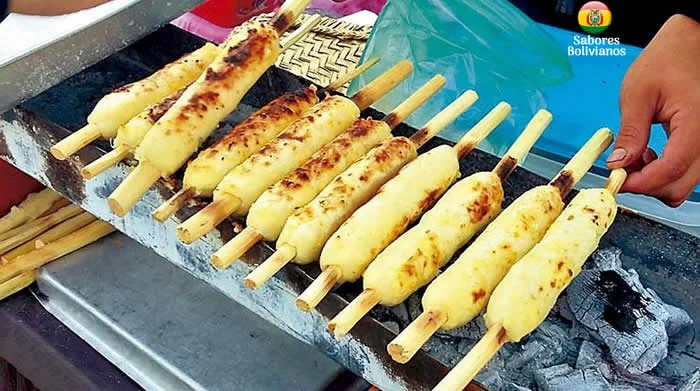
Sonso de yuca is a traditional Bolivian snack made from cooked cassava shaped around wooden skewers with grated cheese. It is a hands-on recipe for a simple, savoury bite browned on a grill.
Ingredients
- As neededCassava (yuca)
- As neededWater
- A little, plus to tasteSalt
- As neededCheese
- As neededOil
- Optional, as neededMilk
- Optional, as neededEgg
Instructions
- 1
Cook the cassava
Cook the cassava in water with a little salt. While it cooks, grate the cheese and set it aside.
- 2
Remove the fibres
When the cassava is cooked, remove the central stems and roots.
- 3
Mash and combine
Mash the cassava and mix it with the grated cheese, adding oil as you work to stop the mixture sticking to your hands.
- 4
Season the mixture
Add a pinch of salt to taste and continue mixing. Milk and egg can be added if you wish; they are optional.
- 5
Shape the rounds
Take portions of the mash or dough and shape them into rounds roughly the size of a fist.
- 6
Fit onto skewers
Thread each cassava ball onto a wooden stick and shape it into a baton, leaving one end of the stick uncovered.
- 7
Brown on the grill
Place the skewers on the grill and heat them until the outside of the cassava mixture begins to brown.
What is sonso de yuca?
Sonso de yuca is a traditional Bolivian snack made with cassava and cheese. In this version, the mixture is shaped around wooden skewers and browned on a grill.
The recipe’s appeal is its contrast: a soft cassava-and-cheese centre with a lightly browned outside. The method keeps the ingredients simple and lets the cheese season the mash.
Nutrition and macros by portion
The nutrition label shows one serving as written: 215 calories, 0g protein, 0g carbs, 0g fat.
| Portion | Adjustment | kcal | Protein | Carbs | Fat |
|---|---|---|---|---|---|
| Lighter | Smaller cassava portions | 151 kcal | 0g | 0g | 0g |
| This serving | As written | 215 kcal | 0g | 0g | 0g |
| Hungry | Larger cassava portions | 323 kcal | 0g | 0g | 0g |
Cassava is the main source of carbohydrate in each portion, while cheese contributes fat and protein. The recipe does not give ingredient quantities, and the supplied nutrition values list zero for protein, carbohydrate and fat, so they cannot describe those ingredients reliably; serve with vegetables or salad for a more balanced plate.
Choosing the ingredients
Cassava: cook it until soft enough to mash, then remove the tough central stems and roots before shaping.
Cheese: grate it so it can be mixed evenly through the cassava. The recipe does not specify a cheese variety or quantity.
Optional additions: milk and egg are suggested as extras, not essentials. Add them only if you want to adjust the mixture.
Getting the mixture workable
Mash the cooked cassava thoroughly before combining it with the cheese. Add oil as you mix to help keep the mixture from clinging to your hands.
Season with salt gradually and taste as you go. The cheese may already contribute saltiness, so avoid adding more than you need.
Shaping around the sticks
Fist-sized portions are the guide in the method, rather than a precise measurement. Shape each portion evenly around its stick so it forms a baton.
Leave one end of each wooden stick uncovered for handling. If the mash is sticking to your hands, use a little oil as described in the method.
Watching the grill
The recipe calls for the grill to heat and the outside of the cassava to begin browning; it does not give a temperature or a precise grilling time. Keep an eye on the surface and turn the skewers as needed for even browning.
The mixture is already cooked before it goes onto the grill, so this stage is about heating it through and colouring the outside.
Serving sonso
Serve the skewers warm, while the outside is freshly browned. They make a handy snack or a simple starter.
For a fuller plate, pair them with a fresh salad or vegetables. Keep the accompaniments light if you want the cassava and cheese to remain the focus.
Recipe notes & tips
- Grate the cheese while the cassava cooks so it is ready to mix in.
- Remove the central stems and roots after cooking, before mashing.
- Add the oil as you work to make the mixture easier to handle.
- Keep the wooden stick uncovered at one end for a secure grip.
- Watch the grill closely and aim for an evenly browned outside.
Variations
- Add milk: mix in a little if you want to adjust the texture.
- Add egg: include it as an optional addition while mixing.
- Change the cheese: try another grated cheese that melts well.
- Adjust the salt: season gradually, taking the cheese's saltiness into account.
Common mistakes to avoid
- Leaving the fibres in: remove the central stems and roots before mashing.
- Skipping the oil: add it during mixing to reduce sticking to your hands.
- Adding too much salt: season gradually and taste the mixture.
- Covering the whole stick: leave one end uncovered for handling.
- Over-browning: watch the grill and take the skewers off once the outside is browned to your liking.
How to store
The recipe does not specify storage guidance. Refrigerate leftovers in a covered container and reheat on a grill or in a pan until hot, aiming to restore some browning to the outside.
Frequently asked questions
Can I make sonso de yuca without milk or egg?
Yes. The recipe describes both as optional, so you can make the cassava-and-cheese mixture without them.
How do I know when the cassava is cooked?
It should be soft enough to mash. The recipe does not give a cooking time.
Why add oil while mixing?
The method uses oil to help stop the cassava mixture sticking to your hands as you combine and shape it.
Do I need to remove the cassava's centre?
Yes. Once cooked, remove the central stems and roots before mashing the cassava.
Can I cook the skewers without a grill?
The method specifies a grill. A grill pan may be used as an alternative, though browning may differ.
How large should each piece be?
Shape each portion into a round roughly the size of a fist, then form it into a baton around a wooden stick.
Cook it from the original
This recipe comes from saboresbolivianos.com. Their page has the author’s own photos, notes and tips — the best place to cook it from.
Open the recipe on saboresbolivianos.com