
Lao Ginger Noodle Soup | Khao Poon Jeow King
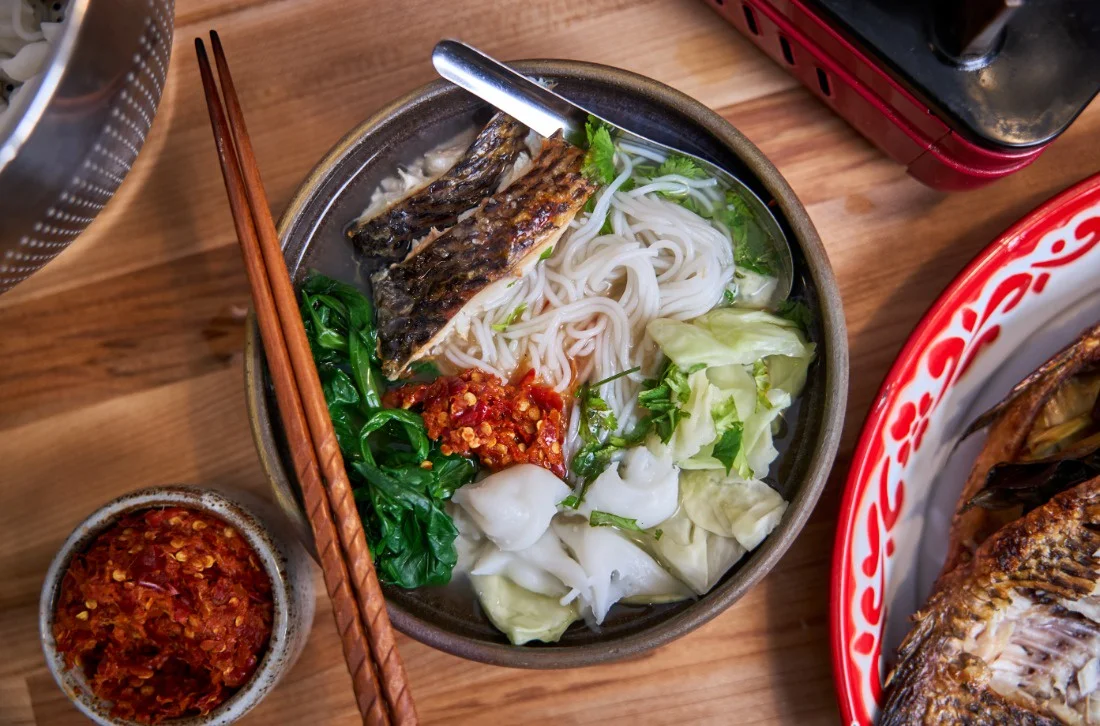
Khao poon jeow king is a popular Lao noodle dish that highlights bold, fresh flavors. It features freshly made vermicelli noodles tossed with a spicy young ginger dip, then seasoned with padaek and fish sauce. The noodles are served with grilled tilapia and blanched vegetables, creating a balance of heat, saltiness, and freshness in every bite. What makes this dish special is the soft, just-made vermicelli noodles that soak up all the flavor. It is a quick and customizable meal that you can adjust to your spice preference and toppings.
Ingredients
- 3 cups (360g) jasmine rice flour, cooked
- 1 cup (120g) mung bean flour
- 1/2 tsp salt
- 900 g water, divided
- 1 cup (100 g) young ginger, chopped
- 1 cup (22 g) dried peppers
- 1 teaspoon salt
- 1/2 teaspoon MSG
- 1 whole tilapia, gutted and scaled
- Pinch of salt
- Pinch of MSG
- 1 stalk lemongrass, trimmed and lightly smashed
- 4 kaffir lime leaves
- Cooking spray or oil
- Fresh Vermicelli noodles
- blanched cabbage
- Blanched pea sprouts
- Jeow king
- Padaek
- Fish sauce
- Baked or Grilled fish
- Cilantro
- Hot Khao poon water
Instructions
- 1
In a large mixing bowl, add the jasmine flour and mung bean flour and mix well. Place half of this mixture (240g) in another mixing bowl.
- 2
In one of the mixing bowls with half of the flour mixture, add salt and 400g water and whisk.
- 3
Place the wet mixture in a large pot and turn it on medium heat and cook for 3 to 4 minutes until it becomes a dough.
- 4
In a kitchen aid bowl, add the other half of the flour mixture and add the cooked dough. Using the paddle attachment, mix on low speed until it becomes a crumbling mixture.
- 5
With 500g of water, slowly add the water until it starts to clump up and become looking like soft serve. Once it becomes a soft serve texture, use the whisk attachment to finish the mixing. You may not need all 500g of water so watch it carefully.
- 6
With one layer of cheesecloth placed in a large bowl, add the soft serve flour mixture in and twist and squeeze out the mixture through the cheesecloth. Use a silicone spoon to remove the mixture that sticks to your hand.
- 7
Get a large stock pot of water to a boil and then turn it down to low. Add enough of the soft serve into a noodle press or potato ricer. Using a spoon, gently mix the water so it swirls. As the water is swirling, quickly squeeze out the soft serve until it is all out.
- 8
Turn the heat back up to high and cook for about 1 minute and 30 seconds until the noodles float.
- 9
Gently with a sieve, get all the noodles and then place it in a cold water bath for a few seconds. Using your hands, get the strands and place them in a strainer to dry.
- 10
After all the noodles are done cooking, save the water that the noodles are cooked in for assembly later.
- 11
Add the chopped young ginger and dried peppers to a mortar.
- 12
Pound and smash until you form a rough, textured paste.
- 13
Add the salt and MSG.
- 14
Mix and pound again briefly to combine evenly.
- 15
Preheat oven to 400°F.
- 16
Pat the tilapia completely dry with paper towels.
- 17
Using a sharp knife, make 3 to 4 diagonal slashes on each side of the fish, cutting down to the bone.
- 18
Season both sides of the fish evenly with salt and MSG, including inside the cavity.
- 19
Stuff the cavity with the smashed lemongrass and kaffir lime leaves.
- 20
Lightly spray or rub the outside of the fish with oil to help it crisp.
- 21
Place on a baking tray and roast at 400°F for 40 minutes, or until cooked through.
- 22
Increase the heat to 500°F and broil for 2 to 4 minutes to crisp the skin. Watch closely so it does not burn.
- 23
Place a generous portion of fresh vermicelli noodles in a large serving bowl.
- 24
Top with the blanched cabbage and pea sprouts.
- 25
Add jeow king to taste, depending on your spice preference.
- 26
Season with a small spoonful of padaek and a splash of fish sauce.
- 27
Add pieces of baked or grilled fish on top.
- 28
Garnish with fresh cilantro.
- 29
Pour hot khao poon broth over everything and serve immediately.
Cook it from the original
This recipe comes from saengskitchen.com. Their page has the author’s own photos, notes and tips — the best place to cook it from.
Open the recipe on saengskitchen.com