
Portuguese Roasted Suckling Pig
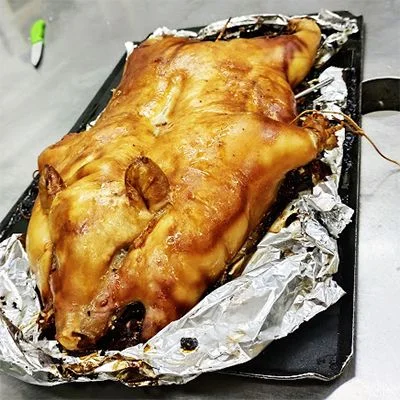
Portuguese-style suckling pig is seasoned in its cavity, roasted until the skin turns golden, then chopped into portions. It makes a dramatic centrepiece for a family meal or celebration.
Ingredients
- about 2 kgsuckling pig
- 30 gonion
- 30 gcarrot
- 30 gcelery
- 10 gminced garlic
- 10 gshallot
- to tastefresh thyme
- 2 tspground black pepper
- 2 tspmixed herbs
- 1 tbspsalt
- 2 tspchicken powder
- 1 tbspolive oil
- 2 tbspcognac
- to tastewhite vinegar
Instructions
- 1
Salt the skin
Rub the salt evenly over the suckling pig's skin.
- 2
Open the backbone
Cut through the backbone from inside the cavity.
- 3
Prepare the seasoning
Dice the onion, carrot, celery and shallot finely, then mix them with the garlic and seasonings.
- 4
Season the cavity
Spread the mixture evenly inside the cavity and leave the pig to marinate for 3 hours.
- 5
Roast the first side
Tie the legs and arms with string. Bake at 165°C for 25 minutes.
- 6
Turn and rest
Turn the pig over and bake at 180°C for 15 minutes. Remove it from the oven and leave it to rest for 10 minutes.
- 7
Dry the skin
Brush the skin evenly with white vinegar and let it dry.
- 8
Finish and chop
Return the pig to the oven at 180°C for 15 minutes, until golden, then chop it into pieces.
What is Portuguese roasted suckling pig?
Roast suckling pig is a celebratory dish found in Portuguese cooking, where a young pig is roasted whole or in large portions. Its appeal is the contrast between crisp skin and tender meat.
This version seasons the cavity with chopped vegetables, herbs and cognac, then uses a final vinegar brush before the last roast. That finishing stage is intended to help the skin dry and colour.
Nutrition and macros by portion
The nutrition label shows one serving as written: 25 calories, 0g protein, 2g carbs, 2g fat.
| Portion | Adjustment | kcal | Protein | Carbs | Fat |
|---|---|---|---|---|---|
| Lighter | Smaller pork portion | 18 kcal | 0g | 2g | 1g |
| This serving | As written | 25 kcal | 0g | 2g | 2g |
| Hungry | Larger pork portion | 38 kcal | 1g | 4g | 3g |
The suckling pig provides most of the protein and fat, while the small amount of vegetables contributes some carbohydrate. Serve it with plenty of vegetables and a modest portion of potatoes or another starchy side to make a balanced plate.
The seasoning inside
Vegetables: finely diced onion, carrot, celery and shallot make a bed of flavour inside the cavity. Keeping the pieces small helps them sit evenly with the herbs and spices.
Seasonings: thyme, mixed herbs, black pepper, salt, chicken powder, olive oil and cognac are combined with the vegetables. Spread the mixture across the cavity rather than piling it in one spot.
Preparing the pig
Backbone: opening it from inside the cavity helps the pig lie flatter for roasting. Take care when cutting, and use a stable surface and a suitable sharp knife.
Tying: secure the legs and arms with cooking string as directed. This keeps the shape compact while it roasts.
Getting the skin golden
Drying: after the first roasting and rest, brush the skin with white vinegar and let it dry before returning the pig to the oven. The recipe does not specify how long to leave it, so proceed once the surface no longer looks wet.
Colour: watch closely during the final 15 minutes at 180°C. The recipe's cue is golden skin; oven performance and the size and shape of the pig can affect how quickly it browns.
Timing and doneness
The listed 60-minute total does not include the 3-hour marinade, and the method itself includes 55 minutes of oven time plus a 10-minute rest. Allow extra time for marinating and drying the skin.
A whole pig's cooking needs vary with its shape and oven. Use a food thermometer to check the thickest parts of the meat, avoiding bone, and follow current food-safety guidance rather than relying on the stated time alone.
Serving the roast
Serve the chopped pieces while the skin is crisp, with the vegetables and any other accompaniments arranged separately. Potatoes, a sharp salad or simply cooked greens make practical sides alongside the rich roast.
For easier sharing, divide the pig into pieces before bringing it to the table. Keep a separate board and utensils for raw pork and cooked food.
Recipe notes & tips
- Pat the skin dry before salting so the seasoning sits evenly.
- Dice the vegetables finely so the cavity filling spreads out without large lumps.
- Marinate the pig for the full 3 hours stated in the method.
- Let the skin dry after brushing it with vinegar before the final roast.
- Check doneness with a thermometer in the thickest parts, away from bone.
- Use clean utensils and a separate board when handling cooked pork.
Variations
- Citrus note: add orange zest to the cavity seasoning for a fresh aromatic accent.
- Herb change: replace the mixed herbs with a blend of rosemary and oregano.
- Garlic emphasis: increase the garlic only if you are adapting the seasoning to your taste.
- Side pairing: serve with roast potatoes and greens for a substantial meal.
Common mistakes to avoid
- Skipping the marinade: give the pig the stated 3 hours so the cavity seasoning has time to infuse.
- Large vegetable pieces: dice them finely so they can be spread evenly inside the cavity.
- Wet skin at the finish: let the vinegar-brushed skin dry before the final roast.
- Relying only on the clock: check the thickest meat with a thermometer because size and oven conditions vary.
- Cutting too soon: allow the stated 10-minute rest before chopping the pig.
How to store
Refrigerate leftovers promptly in a covered container and use within 3–4 days. Reheat until piping hot throughout; the skin may lose some of its crispness.
Frequently asked questions
Does the 60-minute total include marinating?
No. The method calls for a 3-hour marinade, in addition to 55 minutes of oven time and a 10-minute rest. Plan for longer than the listed 60 minutes.
How can I tell when the pig is cooked?
The method describes golden skin but does not give an internal temperature. Check the thickest parts with a food thermometer, away from bone, and follow current food-safety guidance.
Can I prepare it ahead?
You can dice the vegetables and mix the seasonings ahead. Keep them refrigerated, and allow the pig to marinate for the stated 3 hours before roasting.
Why brush the skin with vinegar?
The method uses vinegar before the last roast and drying stage. It does not specify an amount, so brush on a light, even coating.
What should I serve with it?
Roast potatoes, simply cooked greens or a crisp salad all work well. Their textures and flavours complement the rich pork.
Cook it from the original
This recipe comes from cook1cook.com. Their page has the author’s own photos, notes and tips — the best place to cook it from.
Open the recipe on cook1cook.com