
Country bread with sesame and natural sourdough
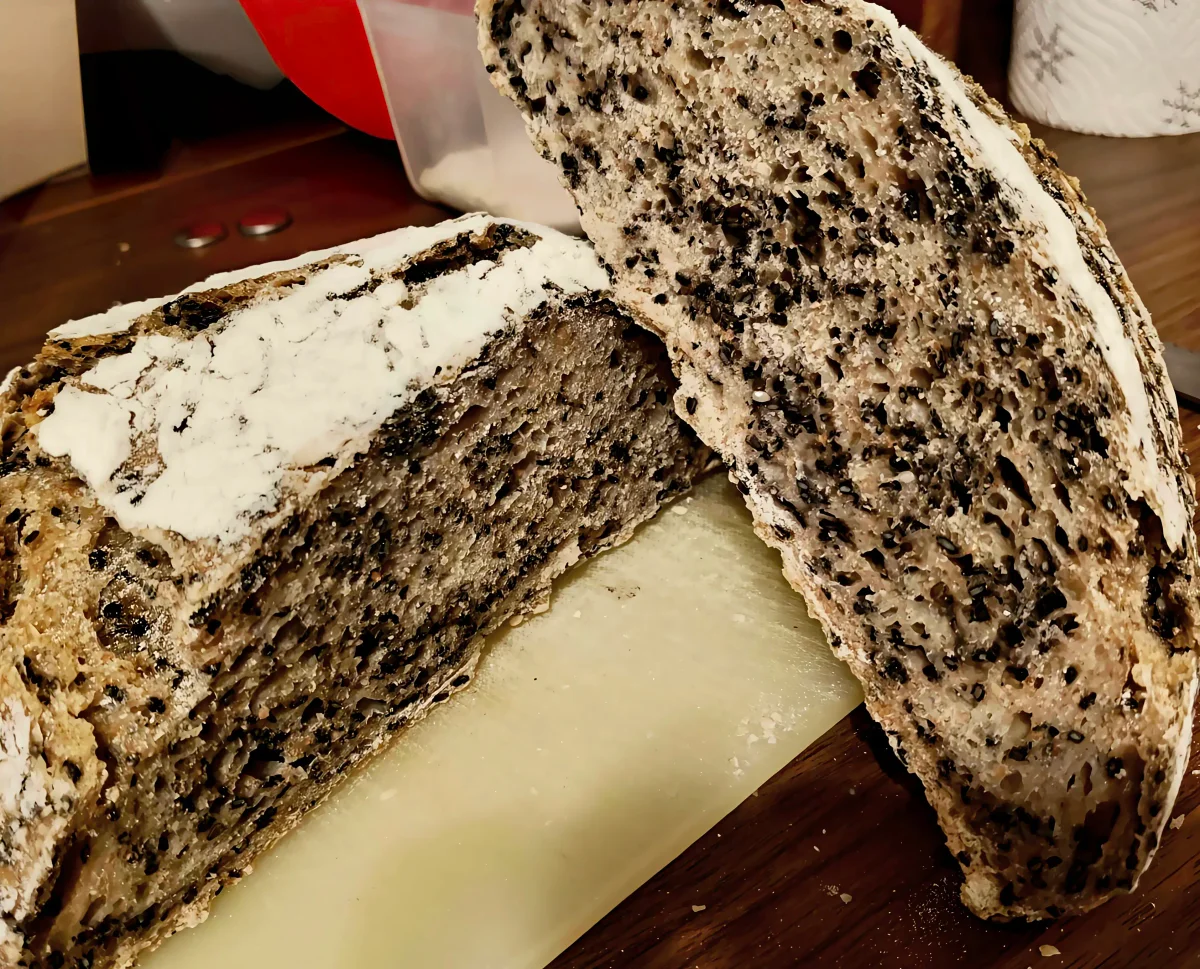
A naturally leavened country loaf with a blend of white and wholemeal flour, finished with toasted black sesame seeds. Its long fermentation and overnight chill make it a good choice when you can plan ahead for a deeply flavoured loaf.
Ingredients
- 55 gwater
- 55 gwholemeal flour
- 15 gsourdough starter
- 400 gstrong white bread flour
- 100 gwholemeal flour
- 350 gwater
- 10 gsalt
- About 70 g (½ cup)black sesame seeds
Instructions
- 1
Prepare the levain
The evening before baking, mix 55 g water, 55 g wholemeal flour and 15 g sourdough starter. Leave at room temperature for at least 12 hours.
- 2
Mix the dough
In the morning, combine the levain with 350 g water. Add both flours and mix, then leave the dough at room temperature for about 40 minutes to autolyse.
- 3
Develop the dough
Add the salt and, if needed, up to 50 ml extra water, then knead. Leave the dough at room temperature for about 5 hours, completing 5 sets of stretches at 30-minute intervals. After the first set, add the sesame seeds, lightly toasted beforehand.
- 4
Shape and chill
Shape the loaf and place it in the fridge overnight.
- 5
Bake the loaf
Bake the following morning at 210°C for about 15 minutes, then reduce the temperature to 170°C and bake for another 20 minutes.
What is country sourdough bread?
Country bread is a rustic-style loaf made here with white and wholemeal flour and a natural sourdough leaven. Sourdough baking has a long tradition, and this version uses an overnight levain and a further overnight chill to fit the dough’s slow fermentation into a home baking schedule.
The combination of flours gives the loaf a balanced base, while black sesame brings a toasted, nutty note. The dough is handled in several stretch-and-fold sets rather than being shaped all at once.
Nutrition and macros by portion
The nutrition label shows one serving as written: 596 calories, 21g protein, 103g carbs, 11g fat.
| Portion | Adjustment | kcal | Protein | Carbs | Fat |
|---|---|---|---|---|---|
| Lighter | Smaller bread serving | 417 kcal | 15g | 72g | 8g |
| This serving | As written | 596 kcal | 21g | 103g | 11g |
| Hungry | Larger bread serving | 894 kcal | 32g | 155g | 17g |
Most of the carbohydrates come from the white and wholemeal flours, while sesame seeds contribute much of the fat and some protein. For a more balanced plate, serve a slice with a protein-rich filling and vegetables such as tomato.
The levain and flour
Levain: Mix the starter, water and wholemeal flour the evening before baking and allow at least 12 hours at room temperature. It gives the dough its natural leavening and contributes to its flavour.
Flour blend: The larger share of white bread flour is paired with wholemeal flour. Measure the flour and water carefully, as the dough’s feel depends on their balance.
Autolysis and hydration
Autolysis: Let the levain, water and flours rest for about 40 minutes before adding salt. This gives the flour time to absorb water before the dough is worked.
Extra water: Add up to 50 ml only if the dough needs it. The recipe leaves this optional, so use the dough’s consistency as your guide rather than automatically adding the full amount.
Stretching and sesame
Stretch-and-folds: Work through 5 sets at 30-minute intervals during the roughly 5-hour room-temperature rise. Handle the dough gently and keep to the stated intervals.
Sesame: Lightly toast the black sesame seeds before adding them after the first set. Let the seeds cool before mixing them through the dough.
Shaping and overnight timing
Shaping: Shape the dough after its room-temperature rise, then refrigerate it overnight. The recipe does not give a specific proofing container, so use one that can hold the loaf without squashing it.
Schedule: The levain needs at least 12 hours, followed by about 40 minutes of autolysis, roughly 5 hours of rising and an overnight chill. The total time is therefore best planned around the dough’s stages rather than a single clock time.
Baking and serving
Two temperatures: Start at 210°C for about 15 minutes, then reduce to 170°C for another 20 minutes. Keep the loaf in the oven as the temperature changes.
Serving: Allow the loaf to cool before slicing so the crumb can set. It works well with cheese, tomato or chicken, as in the sandwich idea described with the recipe.
Recipe notes & tips
- Prepare the levain the evening before so it has at least 12 hours to stand.
- Toast the sesame seeds lightly and let them cool before adding them to the dough.
- Set a timer for the 30-minute intervals between stretch-and-fold sets.
- Add the optional extra water gradually, stopping if the dough already feels sufficiently hydrated.
- Keep the shaped loaf covered while it rests overnight in the fridge.
Variations
- White sesame: Use white sesame seeds in place of black sesame for a milder look and flavour.
- Seed blend: Replace some of the black sesame with another seed while keeping the total amount similar.
- More wholemeal: Swap some white bread flour for wholemeal flour, expecting a denser loaf.
- Sandwich loaf: Use cooled slices with chicken, cheddar and tomato for a substantial sandwich.
- Plain loaf: Leave out the sesame for a simpler country-style sourdough.
Common mistakes to avoid
- Skipping the levain rest: The recipe calls for at least 12 hours at room temperature; prepare it the evening before.
- Adding all the extra water at once: The extra 50 ml is optional, so add it gradually only if needed.
- Adding sesame too early: Mix the toasted seeds in after the first stretch-and-fold set, as specified.
- Rushing the rise: Allow about 5 hours at room temperature and complete the five sets at 30-minute intervals.
- Shortening the fridge rest: Chill the shaped loaf overnight before baking it the following morning.
How to store
Once completely cool, store the loaf in a bread bag or wrapped in a clean tea towel at room temperature and use within about 2–3 days. Reheat slices briefly in a toaster or warm oven; freezing slices is also a practical option for longer storage.
Frequently asked questions
Can I use an unfed starter?
The recipe does not specify whether the starter should be fed beforehand. Use an active starter that can leaven the levain, and allow the levain at least 12 hours at room temperature.
Do I have to add the extra water?
No. The recipe says to add up to 50 ml if needed, so judge the dough as you knead and add it gradually.
Can I leave out the sesame seeds?
Yes. The loaf will still use the same flour, levain and fermentation method, but it will lack the sesame’s toasted flavour.
Can I skip the overnight refrigeration?
The method includes an overnight chill after shaping. Skipping it changes the recipe’s timing and may affect the loaf, so plan to bake it the following morning.
How can I tell when the loaf is baked?
Follow the stated schedule: about 15 minutes at 210°C, then another 20 minutes at 170°C. The recipe does not provide a separate internal-temperature or visual doneness cue.
Why is the dough folded several times?
The method uses five stretch-and-fold sets, spaced 30 minutes apart, during the room-temperature rise. These repeated folds develop the dough gradually as it ferments.
Cook it from the original
This recipe comes from coolinarika.com. Their page has the author’s own photos, notes and tips — the best place to cook it from.
Open the recipe on coolinarika.com