
Baguette
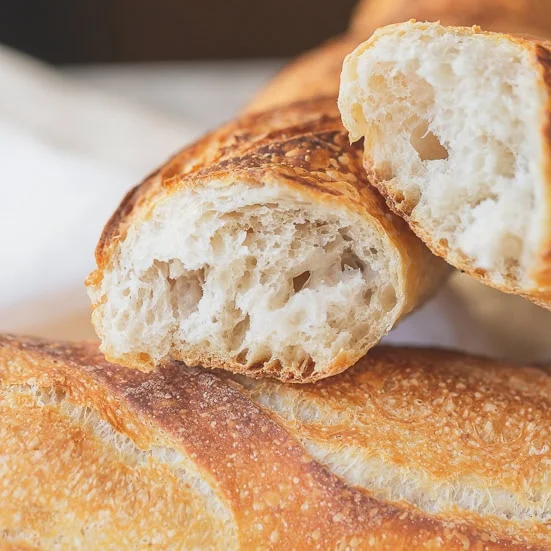
These two baguettes use a slow-fermented poolish for flavour, followed by a series of folds that help build structure. Bake them on a preheated surface with steam for a deeply coloured crust.
Ingredients
- 89 g (3/4 cup)bread flour
- 89 g (6 tablespoons + 1 teaspoon), slightly warmwater
- 1 g (1/4 teaspoon)instant yeast
- 240 g (2 cups)bread flour
- 31 g (1/4 cup)plain flour
- 163 g (1/2 cup + 3 tablespoons), slightly warmwater
- 1 g (1/4 teaspoon)instant yeast
- 6 g (1 1/4 teaspoons)kosher salt
Instructions
- 1
Make the poolish
The night before baking, combine the first 89 g of bread flour, 89 g of slightly warm water and 1 g of instant yeast in a large bowl or lidded container. Cover and leave at room temperature for at least 8 hours, preferably 10–12 hours.
- 2
Mix the dough
Add the remaining 240 g bread flour, 31 g plain flour, 163 g slightly warm water, 1 g instant yeast and 6 g kosher salt to the poolish. Stir and squeeze by hand until the mixture comes together, then cover and leave for 30 minutes.
- 3
Stretch and fold
With a lightly dampened hand, pull one side of the dough out and up, then fold it over the top. Turn the bowl 90 degrees and repeat until you have stretched and folded all four sides. Cover and rest for 30 minutes. Repeat this stretch-and-fold round twice more, resting the covered dough for 30 minutes after each round.
- 4
Heat the oven
During the final rest, put one rack at the bottom of the oven and another in the middle. Place a cast-iron skillet or heatproof pan on the lower rack and a baking stone, baking steel or upside-down sheet pan on the middle rack. Heat the oven to 260°C (500°F) for 1 hour. Lightly flour a baker’s couche or linen towel, and line a pizza peel or unrimmed baking sheet with baking parchment.
- 5
Pre-shape the dough
Cut the dough into two pieces with a dough scraper or knife; do not tear it. On a very lightly floured surface, press one piece into a rectangle and gently stretch the short ends. Fold each short end into the centre so they just meet, then press to seal. Fold the long sides into the centre and press to seal a seam along the dough. Repeat with the second piece, cover both pieces with cling film and rest for 10 minutes.
- 6
Shape the baguettes
Place one piece seam-side up and press it into a thin rectangle. Starting at the top left, fold about 1.3 cm (1/2 inch) of dough down and pinch to seal; work across the dough, continuing to fold and seal into a tight log. Turn it seam-side down and roll it with both hands into a long, thin baguette. Transfer it to the prepared towel or couche and raise the fabric along both sides to support the shape. Repeat with the second piece.
- 7
Proof the dough
Cover the shaped baguettes with cling film and leave them to rise for 45–60 minutes, until doubled in size.
- 8
Score the loaves
Set a small cutting board beside one baguette. Lift the towel gently to turn the loaf onto the board, transfer it to the parchment-lined peel or baking sheet, then turn it back so the seam is underneath. Repeat with the second loaf. Use a very sharp knife to cut 4–5 slashes across the top of each baguette.
- 9
Bake with steam
Put 2 cups (about 470 ml) of ice cubes in a small bowl. Quickly open the oven and slide the parchment and baguettes onto the preheated baking surface. Pour the ice into the hot skillet on the lower rack and shut the oven door immediately. Lower the temperature to 246°C (475°F) and bake for about 25–40 minutes, checking from 25 minutes; the crust should be very dark.
- 10
Cool completely
Leave the baguettes to cool completely before slicing.
What is a baguette?
A baguette is a long French loaf with a crisp crust and a light, chewy centre. This version uses a poolish—a loose mixture of flour, water and a little yeast left to ferment overnight—to develop flavour before the main dough is mixed.
The recipe pairs bread flour with a smaller amount of plain flour, then uses repeated folds to strengthen the dough. A hot baking surface and steam help the loaves expand and form a dark crust.
Nutrition and macros by portion
The nutrition label shows one serving as written: 654 calories, 22g protein, 132g carbs, 3g fat.
| Portion | Adjustment | kcal | Protein | Carbs | Fat |
|---|---|---|---|---|---|
| Lighter | Serve a smaller slice | 458 kcal | 15g | 92g | 2g |
| This serving | As written | 654 kcal | 22g | 132g | 3g |
| Hungry | Add another slice | 981 kcal | 33g | 198g | 5g |
Most of the carbohydrates come from the bread flour and plain flour, while the flour also supplies nearly all the protein. The recipe contains very little added fat; pair a portion with a protein-rich filling and vegetables for a more balanced plate.
Why use a poolish?
Overnight rest: Mixing the first portion of flour, water and yeast the night before gives the poolish 8–12 hours to stand at room temperature. It should be ready before you add the rest of the ingredients.
Final dough: The remaining flour, water, yeast and salt go straight into the poolish. Mixing by hand until the dough comes together keeps the method simple.
Build strength with folds
Damp hand: Lightly wet your hand before pulling the dough so it is less likely to stick. Stretch each side upwards and fold it over the centre, turning the bowl a quarter-turn as you work around it.
Resting rhythm: Give the dough 30 minutes after mixing, then complete three rounds of folds with a 30-minute rest after each round. Keep it covered during the rests.
Shape without tearing
Pre-shape: Divide the dough with a scraper or knife rather than pulling it apart. Fold the ends towards the centre and press the seams closed before the 10-minute rest.
Tight log: For each baguette, fold and pinch the dough into a narrow log, then roll it longer with both hands. The raised folds of the couche or towel support the loaves as they rise.
Set up for a crisp crust
Hot equipment: Heat the oven, baking stone or steel, and lower skillet for a full hour at 260°C (500°F). The preheated surface receives the loaves, while the pan is ready for the ice.
Steam: Add the ice to the hot lower pan and close the oven straight away. Work quickly when transferring the loaves, then reduce the oven to 246°C (475°F) for baking.
Check the rise and bake
Proofing cue: The shaped loaves need 45–60 minutes, or until doubled in size. The exact time can vary, so use the size of the dough as the guide.
Crust cue: Start checking at 25 minutes and bake for about 25–40 minutes in total. The recipe calls for a very dark crust, so let colour guide the final minutes.
Serving and cooling
Cool first: Let the baguettes cool completely before slicing so the crumb can settle and the flavour is at its best.
Serve alongside soup, salad or a meal that needs bread for dipping. They are also useful sliced for sandwiches or toast.
Recipe notes & tips
- Use a lidded container for the poolish if you have one.
- Keep the dough covered during resting and proofing so it does not dry out.
- Use a lightly dampened hand for the folds to reduce sticking.
- Flour the couche or towel lightly so the shaped dough can be moved more easily.
- Have the ice ready before opening the oven so you can add it quickly.
- Wait until the baguettes are completely cool before slicing.
Variations
- Add seeds: Sprinkle seeds over the loaves before baking if you enjoy a seeded crust.
- Use a different flour blend: Keep the stated quantities but replace some of the bread flour with another flour, knowing the dough may behave differently.
- Make smaller loaves: Divide the dough into more pieces for shorter baguettes and check them earlier in the bake.
- Serve as crostini: Slice the cooled baguette and toast the pieces for serving with toppings.
- Make sandwiches: Fill slices with cheese, vegetables or another preferred sandwich filling.
Common mistakes to avoid
- Tearing the dough: Cut it into two pieces with a scraper or knife to avoid pulling it apart.
- Skipping the rests: Cover and give the dough the specified 30-minute rests between folding rounds.
- Loose shaping: Pinch the folds closed as you form each tight log.
- Insufficient preheating: Heat the oven and baking surface for the full 1 hour before baking.
- Slow steam step: Add the ice quickly and shut the oven door immediately.
- Slicing while warm: Cool the loaves completely before cutting.
How to store
Once completely cool, store the baguettes at room temperature in a paper bag or bread bin and eat within 1–2 days for the best texture. Reheat briefly in a warm oven to refresh the crust; freezing is also an option for longer storage.
Frequently asked questions
Can I make the poolish the same day?
The method calls for making it the night before and leaving it at room temperature for at least 8 hours, preferably 10–12 hours. Allow for that fermentation time when planning.
How many stretch-and-fold rounds are needed?
The recipe calls for three rounds, with a 30-minute rest after each one. The first rest is also 30 minutes after mixing.
How do I know when the baguettes are ready to bake?
After shaping, cover them and leave them for 45–60 minutes, until doubled in size.
Can I bake them without a baking stone?
Yes. The method lists a baking steel or an upside-down sheet pan as alternatives to a baking stone.
Why are ice cubes added to the oven?
They provide steam during the initial part of baking. Add them to the preheated lower pan and close the oven promptly.
How dark should the crust be?
The recipe aims for a very dark crust. Begin checking at 25 minutes and bake for about 25–40 minutes, choosing the colour you prefer.
Cook it from the original
This recipe comes from ohsweetbasil.com. Their page has the author’s own photos, notes and tips — the best place to cook it from.
Open the recipe on ohsweetbasil.com