
Spaghetti Sauce with Meat
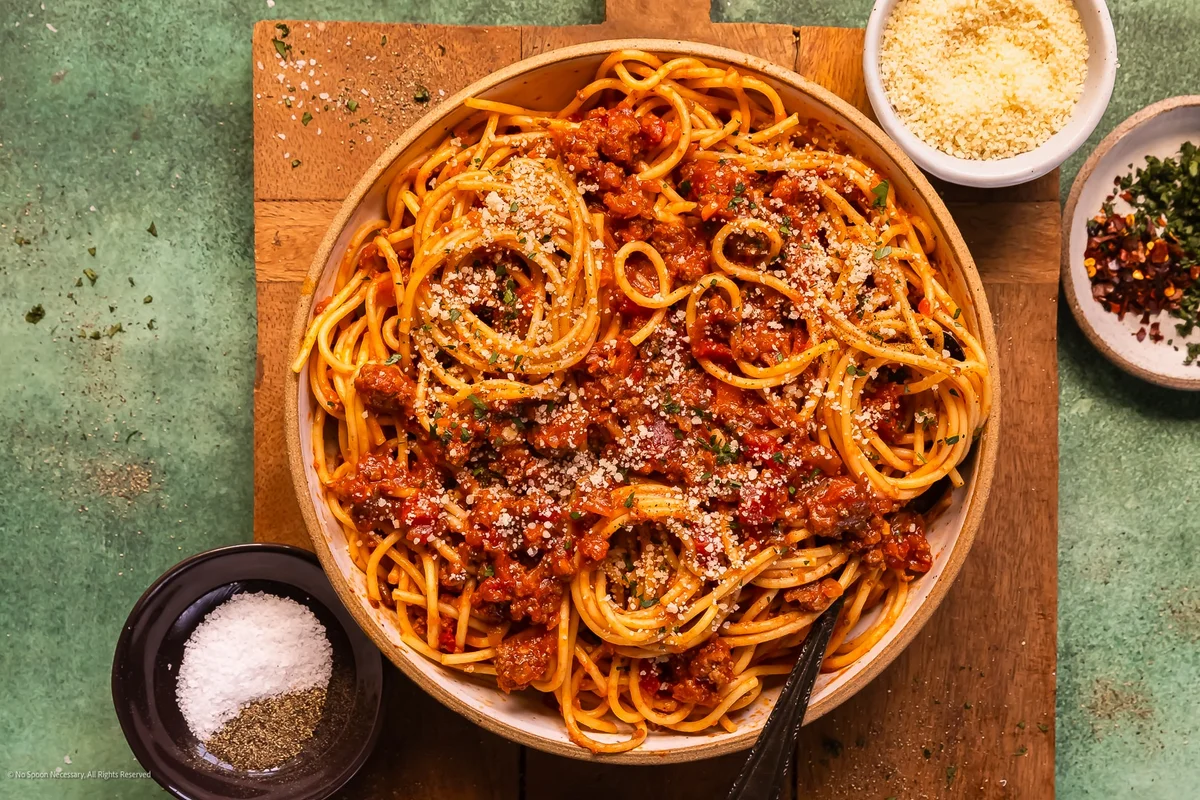
This Italian-style meat sauce combines beef, finely chopped vegetables, mushrooms and tomatoes for a rich, gently simmered pasta topping. It is a useful recipe for turning everyday ingredients into a satisfying meal, with optional pasta and seasonings you can adjust to taste.
Ingredients
- 1 smallyellow onion, peeled, cut into 8 wedges and with the root removed
- 1 smallcarrot, peeled and cut into 6 pieces
- 1 large ribcelery, cut into 6 pieces
- 4–6 clovesgarlic, peeled
- 113 gbutton mushrooms, cleaned, stemmed and halved or quartered as needed
- 1 slicehearty white sandwich bread, roughly torn into 6 pieces
- 30 mlwhole milk
- 454 g85% lean ground beef
- 30 ml eacholive oil and unsalted butter
- 3 heaped tbsptomato paste
- 1¼ tspItalian seasoning
- ⅛ tsp, or more to tastered pepper flakes
- 1 can (794 g)San Marzano crushed tomatoes
- 25 g, or more to taste, plus extra for servingfreshly grated Parmesan
- 15 mlfish sauce, optional but recommended
- 15 mlminced Italian parsley or basil, optional but recommended, plus extra for serving
- To tastekosher salt and ground black pepper
- 454 g, optionalspaghetti, linguine, penne or another long, thin or short tubular pasta
Instructions
- 1
Chop the vegetables
Put the onion, carrot, celery, garlic and Italian seasoning in a food processor. Use short pulses until finely chopped, scraping down the sides as needed. Transfer the mixture to a bowl.
- 2
Chop the mushrooms
Add the mushrooms to the empty processor bowl and pulse until finely chopped. Transfer them to a separate bowl.
- 3
Make the bread paste
Put the torn bread and milk in the processor bowl. Pulse, scraping down the sides as needed, until a paste begins to form.
- 4
Season the beef
Add the ground beef to the bread paste with 1 teaspoon of kosher salt and a scant ½ teaspoon of freshly ground black pepper. Pulse until well combined, then set aside.
- 5
Soften the vegetables
Heat the olive oil and butter in a Dutch oven over medium-high heat. Once the butter has melted and its foam has subsided, add the chopped vegetable mixture. Cook, stirring often, until the onion is nearly soft, about 3 minutes.
- 6
Cook the mushrooms
Add the chopped mushrooms and cook, stirring often, until all the vegetables are soft but not browned, about 2 minutes.
- 7
Caramelise the paste
Stir in the tomato paste, Italian seasoning and red pepper flakes. Cook, stirring constantly, for 1–2 minutes, until the tomato paste is lightly caramelised.
- 8
Brown the beef
Add the beef mixture. Cook for 3–5 minutes, breaking up larger pieces with the back of a wooden spoon and stirring occasionally, until the beef is no longer pink.
- 9
Add the tomatoes
Pour in the crushed tomatoes and their juices. Bring the sauce to the boil over high heat, then immediately reduce the heat to a simmer.
- 10
Simmer the sauce
Simmer gently, stirring occasionally, for about 35 minutes, until the sauce has reduced and thickened.
- 11
Cook the pasta
If serving with pasta, bring a large pan of water to the boil and salt it generously. Cook the pasta according to the packet directions until al dente. Reserve 1 cup of pasta water, then drain the pasta and return it to the hot pan.
- 12
Finish the sauce
Stir the Parmesan, fish sauce and fresh herbs into the sauce. Taste and adjust the seasoning, adding salt and pepper for overall flavour or more of a particular ingredient as desired. Cover and keep warm.
- 13
Combine and serve
Add 3 cups of sauce to the pasta and stir to coat, loosening it with some reserved pasta water if needed. Serve at once with extra grated Parmesan. Roasted garlic bread can be served alongside.
What is spaghetti meat sauce?
Spaghetti meat sauce is a tomato-based pasta sauce enriched with ground meat. This version draws on Italian-style ingredients and a slow simmer, while finely chopped vegetables and mushrooms build flavour throughout the sauce.
Bread softened with milk is mixed into the beef before cooking, helping the meat stay tender. Parmesan, herbs and a little fish sauce go in at the end to round out the flavour.
Nutrition and macros by portion
The nutrition label shows one serving as written: 240 calories, 17g protein, 6g carbs, 16g fat.
| Portion | Adjustment | kcal | Protein | Carbs | Fat |
|---|---|---|---|---|---|
| Lighter | Smaller pasta portion | 168 kcal | 12g | 4g | 11g |
| This serving | As written | 240 kcal | 17g | 6g | 16g |
| Hungry | Larger pasta portion | 360 kcal | 26g | 9g | 24g |
The pasta is the main source of carbohydrates, while olive oil, butter and beef contribute much of the fat. Beef and Parmesan provide protein, with the tomatoes and vegetables adding some carbohydrates as well. For a more balanced plate, serve the pasta with a side of vegetables or salad.
Build a fine vegetable base
Vegetable mix: Pulse the onion, carrot, celery and garlic until finely chopped, but stop before they become a purée. Small, even pieces soften quickly and blend into the finished sauce.
Mushrooms: Chop these separately so you can add them after the first vegetables have begun to soften. Cook both batches until tender, without browning them.
Keep the beef tender
Bread paste: Pulsing the torn bread with milk makes a soft paste that is mixed into the beef. Combine it just until cohesive; there is no need to keep pulsing once the ingredients are incorporated.
In the pot: Break the beef into smaller pieces as it cooks, but avoid crushing it into a fine mince. Continue until no pink remains before adding the tomatoes.
Give the tomato paste a moment
Tomato paste: Stir it constantly with the seasonings for 1–2 minutes, until lightly caramelised. This short step cooks the paste before the liquid tomatoes go in.
Simmer: Once the sauce reaches a boil, lower the heat straight away. A gentle simmer for about 35 minutes lets the sauce reduce and thicken without scorching on the bottom.
Check the sauce texture
Doneness: The sauce is ready when it has reduced and thickened during the simmer. Stir from time to time so it cooks evenly.
Pasta water: Reserve a cup before draining the pasta. Add it a little at a time if the sauce clings too thickly when you combine it with the pasta.
Finish and serve
Final seasoning: Stir in Parmesan, fish sauce and parsley or basil once the sauce has simmered. Taste before adding more salt, since Parmesan and fish sauce both contribute savoury flavour.
Pairing: Toss the pasta with 3 cups of sauce and serve with more Parmesan. Roasted garlic bread makes a fitting side; the remaining sauce can be kept for another meal.
Recipe notes & tips
- Pulse the vegetables in short bursts so they stay finely chopped rather than turning into a wet purée.
- Use a spatula to scrape down the food processor bowl between pulses for an even mixture.
- Stir the tomato paste constantly during its brief cooking time to prevent it catching.
- Keep the sauce at a gentle simmer and stir occasionally as it thickens.
- Reserve pasta water before draining, even if you think the sauce will not need thinning.
- Taste after adding the Parmesan and fish sauce before adjusting the salt.
Variations
- Change the beef: Use another ground meat in place of the beef, adjusting the cooking as needed.
- Choose another pasta: Serve the sauce with linguine, penne or a favourite pasta shape.
- Adjust the heat: Add more red pepper flakes for a spicier sauce.
- Swap the herbs: Use minced basil instead of Italian parsley, or the other way round.
- Leave out the fish sauce: Omit it if preferred and adjust the seasoning after tasting.
- Add extra Parmesan: Stir in more grated Parmesan to taste and finish with extra at the table.
Common mistakes to avoid
- Over-processing the vegetables: Use short pulses and stop when the pieces are finely chopped.
- Browning the vegetable base: Keep stirring and cook only until the vegetables are softened.
- Scorching the tomato paste: Stir constantly for its 1–2 minutes in the pot.
- Leaving large beef clumps: Break them up with the back of a wooden spoon as the meat cooks.
- Boiling the sauce hard: Reduce the heat as soon as it boils and let it simmer gently.
- Draining away the pasta water: Set aside 1 cup before draining so you can loosen the sauce if needed.
How to store
Refrigerate leftover sauce in a covered container for up to 3 days. Reheat gently in a saucepan, stirring until hot throughout; add a splash of water if it has thickened. Keep cooked pasta separate where possible and combine just before serving.
Frequently asked questions
Can I make the sauce without a food processor?
Yes. Finely chop the vegetables and mushrooms by hand, and mash the bread with the milk before mixing it with the beef.
Do I have to use the fish sauce?
No, it is optional. Leave it out and taste the finished sauce before adjusting the salt and other seasonings.
Can I serve this with a different pasta?
Yes. The recipe suggests spaghetti, linguine or penne, and you can use another long, thin or short tubular pasta.
How do I know when the sauce is done?
After about 35 minutes of gentle simmering, it should have reduced and thickened. Stir occasionally during this time.
Why should I save pasta water?
It can help thin the sauce if it is too thick when you toss it with the pasta. Add it gradually until the sauce reaches the consistency you want.
Can I prepare the sauce ahead?
Yes. Store the cooked sauce in the refrigerator in a covered container, then reheat it gently before serving. Cook the pasta fresh if you can.
Cook it from the original
This recipe comes from nospoonnecessary.com. Their page has the author’s own photos, notes and tips — the best place to cook it from.
Open the recipe on nospoonnecessary.com