
Greek Bread recipe (Village bread/ Horiatiko Psomi)
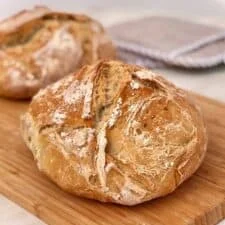
Horiatiko psomi is a Greek village-style bread with a soft, chewy crumb and a crisp, deeply coloured crust. A simple flour-and-yeast dough makes two round loaves, with a long rise doing much of the work.
Ingredients
- 1 kg (35 oz)bread flour
- 630 ml (21 oz)lukewarm water
- 25 g (0.8 oz)fresh yeast
- 1 tspsugar
- 30 ml (2 tbsp)olive oil
- 22.5 ml (1½ tbsp)salt
- As neededfine semolina
Instructions
- 1
Activate the yeast
Put the water, yeast and sugar in a large bowl. Stir with a fork until the yeast dissolves, then leave it for 5–10 minutes to activate. If using dried yeast instead, use one third of the stated quantity.
- 2
Mix the dough
Gradually stir in half the flour. Add the olive oil and salt, then the remaining flour, mixing until it is all absorbed. The dough should feel sticky to the touch.
- 3
Knead and cover
Knead briefly by hand until the dough is elastic, then shape it into a ball. Put it in a lightly oiled large bowl and cover with cling film.
- 4
Leave to rise
Let the dough rise at room temperature for 10–12 hours, or overnight.
- 5
Divide the dough
Deflate the risen dough. Dust a large work surface with semolina and transfer the dough onto it, then use a sharp knife to divide it into two equal pieces.
- 6
Shape the loaves
Knead each piece by hand for about 3 minutes, just until smooth and not too sticky. Sprinkle the dough with 2–3 tablespoons of semolina as you knead.
- 7
Score and cover
Shape the dough into two round loaves and put them in a lidded casserole dish or clay pot. Score the top of each loaf with a sharp knife, then put the lid on.
- 8
Bake until crusty
Preheat the oven to 250°C (480°F). Bake the loaves covered for 20 minutes, then remove the lid and bake for about 15 minutes more, until coloured and crusty.
What is Horiatiko psomi?
Horiatiko psomi means village bread in Greek and refers to a hearty, everyday loaf associated with home baking. This version uses a straightforward flour-and-yeast dough and shapes it into two round loaves.
The long rise gives the dough time to develop while the lidded bake helps the loaves cook before they finish uncovered and form a crisp crust.
Nutrition and macros by portion
The nutrition label shows one serving as written: 283 calories, 9g protein, 53g carbs, 3g fat.
| Portion | Adjustment | kcal | Protein | Carbs | Fat |
|---|---|---|---|---|---|
| Lighter | Smaller bread portion | 198 kcal | 6g | 37g | 2g |
| This serving | As written | 283 kcal | 9g | 53g | 3g |
| Hungry | Larger bread portion | 425 kcal | 14g | 80g | 5g |
Most of the carbohydrates and some of the protein come from the bread flour, while the olive oil supplies most of the fat. Pair a portion with vegetables and a protein-rich accompaniment to balance the plate.
A simple dough with a sticky feel
Flour: bread flour gives the dough enough structure for round loaves. Add it in stages so it is easier to mix evenly.
Water: the dough is meant to feel sticky after mixing, so resist adding extra flour at this point. A little stickiness helps keep the baked crumb tender.
Give the rise time
Yeast: fresh yeast is dissolved in the lukewarm water with sugar, then left for 5–10 minutes. If you use dried yeast, the recipe specifies one third of the fresh yeast quantity.
Timing: the dough rises at room temperature for 10–12 hours or overnight. The recipe gives this long rise even though the stated total time is 85 minutes, so plan ahead.
Shape without overworking
Divide: after deflating the dough, cut it into two equal pieces for two loaves. A sharp knife helps make a clean division.
Knead: work each piece for about 3 minutes, just until it looks smooth and no longer clings too much to your hands. Use the specified semolina as you shape rather than adding a large amount of extra flour.
Use the lid for the first bake
Covered baking: start with the casserole dish or clay pot covered for 20 minutes at 250°C. This gives the loaves time to bake before the crust is exposed to the oven.
Finish: remove the lid and bake for about 15 minutes more. Look for a well-coloured, crisp crust rather than relying only on the clock.
Serve it with a meal
The round loaves are useful alongside soups, stews and Greek-style meals, or simply served with olive oil for dipping. Slice them once they have cooled enough to handle so the crumb is easier to cut.
For a more balanced plate, pair a portion of bread with a protein-rich dish and vegetables rather than serving it as the only substantial part of the meal.
Recipe notes & tips
- Use lukewarm rather than hot water when dissolving the yeast.
- Keep the dough sticky after mixing instead of correcting it with extra flour.
- Dust the work surface with semolina before transferring the dough.
- Knead each loaf for about 3 minutes, stopping when it is smooth.
- Use a sharp knife to score the loaves just before baking.
- Remove the lid for the final 15 minutes so the crust can colour.
Variations
- Dried yeast: use one third of the fresh yeast quantity, as specified in the recipe.
- Clay pot: bake the loaves in a lidded clay pot instead of a casserole dish.
- Smaller loaves: divide the dough into more pieces for smaller rounds, adjusting the baking time to suit their size.
- Semolina finish: dust the shaped loaves lightly with semolina for a more rustic surface.
- Herbed bread: mix dried herbs into the flour for a fragrant variation.
Common mistakes to avoid
- Adding too much flour: the dough should be sticky after mixing, so wait until shaping before dusting with semolina.
- Using hot water: very hot water can interfere with the yeast; use lukewarm water.
- Rushing the rise: allow 10–12 hours or leave the dough overnight as directed.
- Over-kneading the shaped pieces: stop after about 3 minutes, once each piece is smooth.
- Skipping the lid: keep the pot covered for the first 20 minutes of baking.
- Leaving the loaves covered throughout: remove the lid for the final 15 minutes so the crust can become coloured and crisp.
How to store
Once cooled, store the bread in a bread bag or wrapped at room temperature and use within a few days. Rewarm slices briefly in the oven or toast them; freeze extra bread well wrapped for longer storage.
Frequently asked questions
Can I use dried yeast instead of fresh yeast?
Yes. The recipe specifies one third of the fresh yeast quantity when substituting dried yeast.
How long does the dough need to rise?
Leave it at room temperature for 10–12 hours or overnight, as directed.
Should the dough be sticky?
Yes, it should be sticky after the flour has been mixed in. Add semolina during shaping as needed rather than trying to make the initial dough dry.
Can I bake the loaves without a clay pot?
Yes. The method allows for a lidded casserole dish as an alternative to a clay pot.
Why do I bake the loaves covered first?
The recipe starts with 20 minutes of covered baking, then removes the lid for about 15 minutes so the crust can colour and become crisp.
How many loaves does this recipe make?
It makes two round loaves, by dividing the risen dough into two equal pieces.
Cook it from the original
This recipe comes from mygreekdish.com. Their page has the author’s own photos, notes and tips — the best place to cook it from.
Open the recipe on mygreekdish.com