
Mandarin Orange Buns
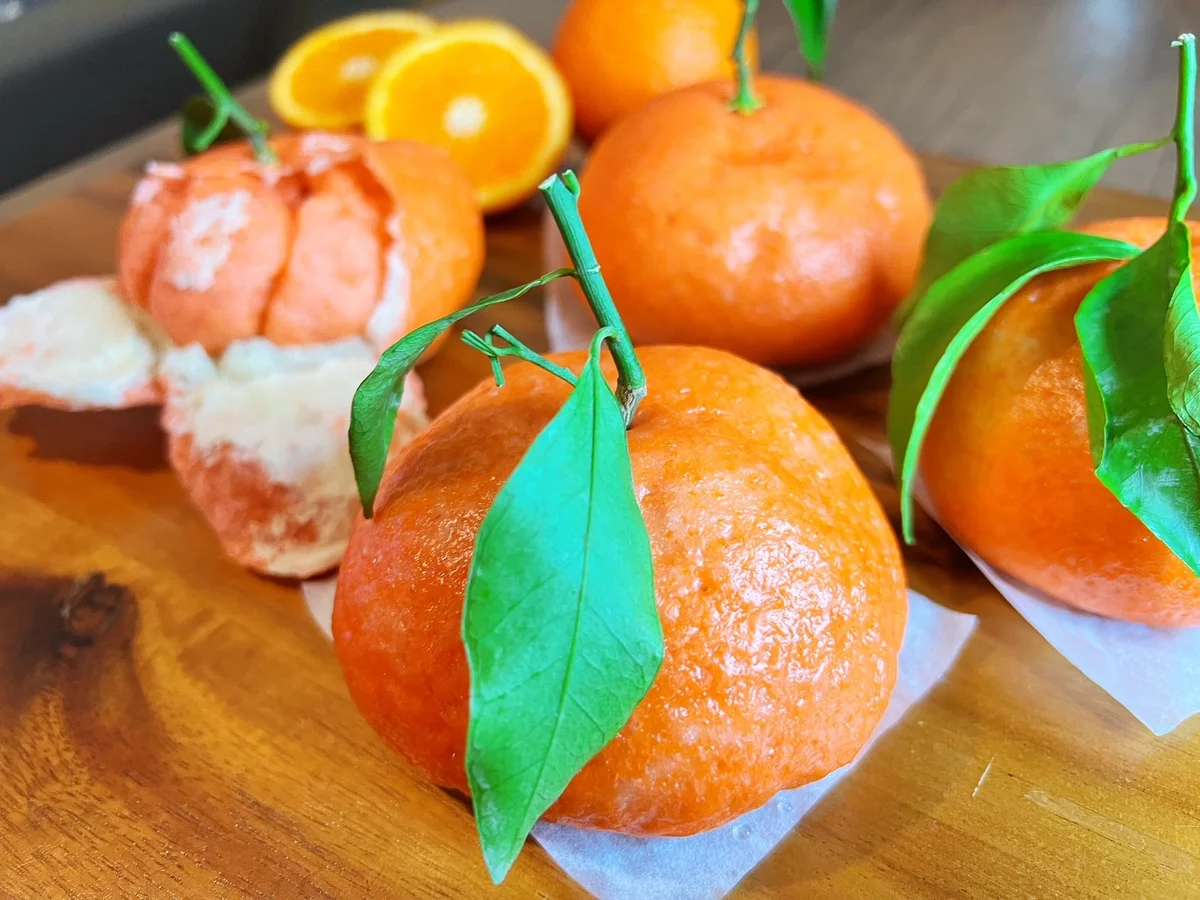
These steamed buns are shaped and textured to resemble mandarins, with a carrot-coloured dough and a peelable outer layer. They make a playful Chinese New Year treat inspired by the good-luck and prosperity associated with mandarins and steamed buns.
Ingredients
- 160 gcarrot (about 1 large carrot)
- 4 dropsred icing colour (optional; see note 1)
- 35 gwarm water (see note 2)
- 30 gsugar
- 2.5 gyeast
- 250 gplain flour
- 55 gwarm water (see note 2)
- 10 gsugar
- 1 gyeast
- 100 gplain flour
Instructions
- 1
Steam the carrot
Peel the carrot and cut it into slices. Pour boiling water into a steamer pot and steam the 160 g of carrot slices over medium-high heat for 20 minutes.
- 2
Cool the carrot
When the carrot is tender, take the pot off the heat and leave the slices to cool slightly.
- 3
Activate the yeast
In a small bowl, dissolve 30 g sugar in 35 g warm water. Sprinkle 2.5 g yeast over the liquid and leave for 10 minutes.
- 4
Purée the carrot
Transfer the carrot to a blender without adding water, as the steamed carrot already contains enough. Blend until smooth; the recipe yields about 150 g purée. Alternatively, use 150 g canned carrot purée.
- 5
Mix the purée
Add the yeast-and-sugar liquid to the carrot purée. If using it, add the red food colouring, then blend on low for 10 seconds.
- 6
Combine orange dough
Put 250 g plain flour in a large bowl. Add the carrot purée and stir with chopsticks or a rubber spatula.
- 7
Knead the dough
Knead by hand or with a stand mixer for about 5 minutes, until the ingredients are evenly combined. The dough does not need to be completely smooth yet.
- 8
Rest the dough
Shape the dough into a ball, cover it with plastic wrap or a bowl, and leave it to rest for 20 minutes.
- 9
Make white dough
While the orange dough rests, dissolve 10 g sugar in 55 g warm water. Sprinkle 1 g yeast over it and leave for 10 minutes. Add the yeast mixture to 100 g plain flour, knead, shape into a ball and leave to rest.
- 10
Divide orange dough
While the white dough rests, knead the orange dough for 5 more minutes, until smooth. Divide the roughly 480 g dough into portions of 320 g and 160 g. Divide the 320 g portion into eight 40 g balls and the 160 g portion into eight 20 g balls. Cover them with plastic wrap.
- 11
Divide white dough
Knead the white dough for 5 more minutes, until smooth. Divide the roughly 160 g dough into eight 20 g balls, roll them, and cover with plastic wrap.
- 12
Shape orange centres
If desired, make three vertical cuts across the centre of each 40 g orange ball, dividing it into six sections. Shape each ball back into a round form to give it an orange-like appearance.
- 13
Roll the wraps
Roll each 20 g ball with a rolling pin into a circle about 3 inches in diameter. Repeat for all 16 small balls, eight orange and eight white.
- 14
Texture orange wraps
Use a comb to make hundreds of small indentations on each orange wrap. Turn each one over so its smooth side faces up.
- 15
Join the wraps
Brush a thin layer of water over the smooth side of each orange wrap. Place a white wrap on top and press gently to join them.
- 16
Oil the white layer
Brush a thin layer of cooking oil over each white wrap so the orange-peel layer can be removed more easily after steaming.
- 17
Fill and pleat
Place a 40 g orange ball in the centre of a joined wrap. Lift a corner with your thumb and index finger, then fold and pleat anticlockwise around the filling. Pinch the dough closed at the end.
- 18
Proof the buns
Cut parchment paper into 4-inch squares and set each bun on a square. Put them in the steamer used for the carrot, which will provide a warm, humid place to proof. Insert a toothpick in the centre of each bun, cover the steamer with its lid and leave for 30 minutes.
- 19
Steam the buns
After the 30-minute proof, steam the buns over medium heat for 20 minutes.
- 20
Cool the peel
After 20 minutes, open the lid immediately to expose the buns to cool air. This helps the peel shrink slightly and makes the buns look more like mandarins.
- 21
Add the stems
Remove the toothpicks and replace them with real orange stems and leaves.
- 22
Freeze leftovers
Put leftover buns in a food-storage bag and freeze them. The recipe says they keep well for up to 6 months.
What are mandarin orange buns?
These are steamed buns shaped to look like mandarins, bringing together two foods associated with Chinese New Year. Mandarins are linked with good luck and wealth, while buns are a familiar festive food.
This version uses carrot purée to colour the dough and layers orange and white dough to create a peel that can be lifted away. Indented surfaces and a shaped centre add to the fruit-like effect.
Nutrition and macros by portion
The nutrition label shows one serving as written: 187 calories, 0g protein, 0g carbs, 0g fat.
| Portion | Adjustment | kcal | Protein | Carbs | Fat |
|---|---|---|---|---|---|
| Lighter | Smaller bun portion | 131 kcal | 0g | 0g | 0g |
| This serving | As written | 187 kcal | 0g | 0g | 0g |
| Hungry | Add another bun | 281 kcal | 0g | 0g | 0g |
Most of the carbohydrates in these buns come from the plain flour and sugar, while the carrot contributes some carbohydrate as well. The recipe contains no substantial protein source or added fat in its listed ingredients, though the method also calls for a little cooking oil. Serve a bun with a protein-rich savoury dish and vegetables to make a more balanced plate.
Building the orange colour
Carrot purée: steam the slices until tender, then blend them without extra water. The recipe aims for about 150 g purée from 160 g carrot.
Food colouring: the red icing colour is optional. Add it with the yeast mixture if you want a deeper orange shade.
Two doughs, two jobs
Orange dough: this forms both the filling-shaped centre and the outer textured layer. The first knead brings the ingredients together; a second knead after resting makes the surface smooth.
White dough: this sits beneath the orange wrap and helps create the peelable layer. Keep the small dough balls covered while you shape the other pieces so they do not dry out.
Making the peel
Texture: the comb marks are made on the orange wraps before they are turned smooth-side up. This leaves the outside textured while giving the layers a smooth surface to join.
Joining: a little water sticks the orange and white circles together, while a thin coating of oil on the white layer helps the peel separate after steaming. Seal the pleats firmly around each orange centre.
Proofing and steaming
Proof: the buns rest for 30 minutes in the covered steamer after shaping. The recently used steamer is intended to provide a warm, humid environment.
Steam: cook over medium heat for 20 minutes. The method calls for opening the lid immediately afterwards so the cooler air makes the outer layers shrink slightly.
Serving and presentation
Let the buns cool enough to handle, then remove the toothpicks and add orange stems and leaves as directed. They can be served as a festive snack or alongside tea.
For a more convincing display, arrange them among real mandarins. The recipe’s peelable outer layer is part of the presentation, so handle the buns gently when serving.
Recipe notes & tips
- Keep the small dough balls covered while rolling and assembling the wraps.
- Do not add water when blending the steamed carrot; the recipe relies on its moisture.
- Use a light hand when pressing the white wrap onto the orange one so the layers remain distinct.
- Pinch the pleats closed carefully to keep the filling enclosed during steaming.
- Open the steamer lid immediately after the 20-minute steaming time, as directed, to encourage the peel to shrink.
Variations
- Skip the colouring: leave out the optional red icing colour for a more natural carrot shade.
- Use canned purée: substitute 150 g canned carrot purée for the steamed and blended carrot.
- Change the shape: omit the three cuts in each orange centre for a simpler round filling.
- Serve plain: leave off the optional real stems and leaves for an easier-to-handle bun.
- Make a smaller display: divide the dough into smaller buns, keeping the orange and white layers in proportion.
Common mistakes to avoid
- Adding water to the carrot: the steamed carrot has enough moisture for blending, so purée it without extra water.
- Skipping the second knead: knead each dough again for 5 minutes after resting to smooth the surface.
- Leaving dough uncovered: cover the balls while you work so their surfaces do not dry out.
- Forgetting the oil: brush the white layer lightly so the orange peel can separate after steaming.
- Opening the lid late: open it immediately after the 20-minute steam to help the outer layers shrink.
How to store
Put leftover buns in a food-storage bag and keep them in the freezer; the recipe says they will keep for up to 6 months. The supplied method does not specify a reheating time, so reheat until hot throughout using your usual steaming method.
Frequently asked questions
Can I use canned carrot purée?
Yes. The recipe suggests using 150 g canned carrot purée instead of steaming and blending the carrot.
Is the red icing colour essential?
No, it is optional. The carrot provides colour on its own, while the added colouring can deepen the shade.
Why are there two doughs?
The orange dough makes the fruit-coloured layers and centre, while the white dough forms the inner layer beneath the peel.
How long do the buns proof?
Leave them covered in the steamer for 30 minutes before cooking.
How long do I steam the buns?
Steam them over medium heat for 20 minutes, then open the lid immediately as directed.
Can I freeze the finished buns?
Yes. Store leftovers in a food-storage bag in the freezer; the recipe says they keep for up to 6 months.
Cook it from the original
This recipe comes from msshiandmrhe.com. Their page has the author’s own photos, notes and tips — the best place to cook it from.
Open the recipe on msshiandmrhe.com