
Medialunas
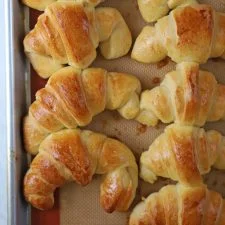
Argentine medialunas are small, crescent-shaped sweet rolls with a soft, enriched dough and a glossy syrup finish. This home-style version is a good choice when you want a batch of tender pastries to share with coffee.
Ingredients
- 500 gplain flour
- 100 gbutter
- 10 g dried yeast or 25 g fresh yeastyeast
- 200 mlmilk
- 100 gsugar
- 1egg
- 1 teaspoonvanilla extract
- A pinchsalt
- Zest of 1lemon or orange
- 1egg, beaten, for brushing
- 240 ml (1 cup)water, for the syrup
- 200 g (1 cup)sugar, for the syrup
Instructions
- 1
Activate the yeast
Put 120 ml (½ cup) of lukewarm milk in a bowl and stir in the yeast, ½ teaspoon of the sugar and 1 tablespoon of the flour. Leave for 10 minutes.
- 2
Mix the enrichments
In a separate bowl, beat the butter with the sugar, egg, vanilla, salt and lemon zest.
- 3
Combine the dough
Stir in the activated yeast mixture, then gradually add the flour and the remaining milk.
- 4
Knead until smooth
Knead the mixture until the dough is smooth and firm.
- 5
Rest the dough
Leave the dough to rest for 30 minutes.
- 6
Roll it out
Roll the dough out with a rolling pin to a thickness of about ½ cm.
- 7
Cut the triangles
Shape the dough into a rectangle, cut it into two strips, then cut the strips into triangles.
- 8
Shape the crescents
Take each triangle by its wider end and roll it up to form a crescent.
- 9
Arrange on a tray
Place the medialunas on a baking tray lined with baking paper or greased with butter.
- 10
Brush with egg
Brush the top of each medialuna with beaten egg.
- 11
Prove until doubled
Leave the shaped dough to rest until it has doubled in size.
- 12
Heat the oven
Preheat the oven to 180°C (350°F).
- 13
Bake until golden
Bake the medialunas for about 15 minutes, or until golden.
- 14
Cook the syrup
Combine 240 ml (1 cup) of water and 200 g (1 cup) of sugar in a pan. Cook for about 10 minutes, until thickened.
- 15
Brush with syrup
Brush each medialuna with the syrup.
What are medialunas?
Medialunas are crescent-shaped pastries associated with Argentina, where they are a familiar choice for breakfast or an afternoon coffee. Their name means “half-moons”, describing their curved shape.
This version uses an enriched yeast dough with butter, egg and citrus zest, then finishes the baked rolls with syrup. The result is softer and sweeter than a plain bread roll, with a lightly glossy surface.
Nutrition and macros by portion
The nutrition label shows one serving as written: 200 calories, 5g protein, 34g carbs, 7g fat.
| Portion | Adjustment | kcal | Protein | Carbs | Fat |
|---|---|---|---|---|---|
| Lighter | Use less syrup | 140 kcal | 3g | 24g | 5g |
| This serving | As written | 200 kcal | 5g | 34g | 7g |
| Hungry | Serve two medialunas | 300 kcal | 7g | 51g | 10g |
Most of the carbohydrates come from the flour and sugar, including the syrup; butter and egg contribute much of the fat, while flour, milk and egg supply some protein. Pair a medialuna with plain yoghurt or fruit for a more balanced breakfast or snack.
A soft, enriched dough
Butter and egg: these make the dough richer and more tender than a basic flour-and-water dough. Beat them with the sugar and flavourings before adding the yeast mixture.
Citrus zest: lemon or orange adds a fragrant note to the sweet dough. Zest only the coloured outer skin to avoid a bitter taste.
Give the yeast a head start
Warm milk: use lukewarm milk for the yeast mixture, not hot milk. The recipe uses 120 ml (½ cup) at this stage, with the rest added later.
Foam and time: leave the yeast mixture for 10 minutes as directed. This gives the yeast time to begin working before it is mixed into the dough.
Shape even crescents
Triangle size: cut the rectangle into strips and then triangles, aiming for pieces of similar size so they bake at roughly the same rate.
Rolling: start at the wide end of each triangle and roll towards the point. Keep the point tucked underneath on the tray so the shape is less likely to unwind.
Watch the proving and bake
Second rise: after shaping, allow the medialunas to double in size before baking. The method does not give a fixed time for this stage, so judge by the dough rather than the clock.
Doneness: bake at 180°C for about 15 minutes, looking for a golden surface. Check towards the end of the bake, as small pastries can colour quickly.
Finish with syrup
Syrup: simmer the water and sugar for about 10 minutes, until the mixture thickens. Brush it over the pastries after baking for a sweet, shiny finish.
Serving: enjoy the medialunas fresh, with coffee, tea or a glass of milk. Their sweetness also works well alongside plain yoghurt or fresh fruit.
Recipe notes & tips
- Measure the milk for the yeast mixture from the 200 ml total, then add the remainder with the flour.
- Keep the dough thickness close to ½ cm so the triangles roll up evenly.
- Leave a little space between the shaped pastries on the tray.
- Let the medialunas double in size before baking rather than relying on a set proving time.
- Brush on the syrup while the pastries are still warm so it coats their surfaces easily.
Variations
- Orange zest: use orange instead of lemon for a sweeter citrus aroma.
- Vanilla finish: add a little extra vanilla to the syrup for a warmer flavour.
- Less syrup: brush on a thin layer for a less sweet, less glossy finish.
- Fresh yeast: use 25 g fresh yeast in place of the 10 g dried yeast.
- Smaller pastries: cut smaller triangles and begin checking them earlier in the bake.
Common mistakes to avoid
- Hot milk: very hot milk can impair the yeast; use lukewarm milk for activation.
- Uneven triangles: pieces of different sizes bake inconsistently; cut them as evenly as you can.
- Loose rolls: the crescents may open in the oven; tuck each triangle’s point underneath on the tray.
- Skipping the second rise: baking before the dough doubles can leave the rolls dense; allow them to rise fully.
- Overcooking the syrup: cooking it too long can make it overly thick; stop after about 10 minutes once it has thickened.
- Baking by time alone: colour varies between ovens; check for golden tops around the 15-minute mark.
How to store
Store cooled medialunas in an airtight container at room temperature for up to 2 days. Warm them briefly in a low oven before serving; the syrup coating may become less glossy over time.
Frequently asked questions
Can I use fresh yeast instead of dried yeast?
Yes. The recipe gives 25 g fresh yeast as an alternative to 10 g dried yeast.
How warm should the milk be?
Use lukewarm milk for activating the yeast. It should not feel hot.
How long should the shaped medialunas rise?
The method does not specify a duration. Leave them until they have doubled in size.
Can I use orange zest instead of lemon?
Yes. The recipe allows either lemon or orange zest.
When should I brush on the syrup?
Brush the syrup over the medialunas after baking, as the final step.
Can I prepare the dough ahead?
The recipe does not give an overnight method. For the stated method, follow the two rests and bake after the shaped dough has doubled.
Cook it from the original
This recipe comes from midiariodecocina.com. Their page has the author’s own photos, notes and tips — the best place to cook it from.
Open the recipe on midiariodecocina.com