
Veggie Primavera
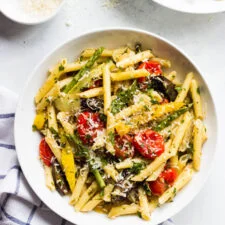
Veggie primavera pairs roasted seasonal vegetables with small-shaped pasta in a buttery tomato, herb and stock sauce. Roasting the vegetables gives them a little colour while the quick pan sauce brings everything together for a satisfying weeknight meal.
Ingredients
- 567 g (about 6 cups)fresh vegetables, cut into strips
- 45 ml (3 tbsp)olive oil
- 10 ml (2 tsp)Italian seasoning
- To tastekosher salt and pepper
- 227 g (8 oz)dry small-shaped pasta, such as penne
- 30 ml (2 tbsp)olive oil
- 2 clovesgarlic, minced
- 1 pint (about 473 ml)grape tomatoes
- 237 ml (1 cup)vegetable broth or chicken stock
- 43 g (3 tbsp)butter
- 15 g (¼ cup)fresh Italian parsley, chopped
- 25 g (¼ cup)grated Parmesan cheese
- To tastekosher salt and pepper
Instructions
- 1
Preheat the oven
Heat the oven to 230°C (450°F). Line a large baking tray with parchment paper and set it aside.
- 2
Season the vegetables
In a large bowl, toss the vegetables with 45 ml (3 tbsp) olive oil and the Italian seasoning. Season with salt and pepper to taste, then spread them in a single layer on the prepared tray.
- 3
Roast the vegetables
Roast for 20 minutes, or until tender and lightly golden.
- 4
Cook the pasta
Cook the pasta according to the packet instructions, then drain it.
- 5
Start the sauce
Heat 30 ml (2 tbsp) olive oil in a large sauté pan over a medium heat. Add the garlic and tomatoes and cook for about 2 minutes.
- 6
Reduce the stock
Pour in the stock and simmer uncovered until the liquid has reduced by half, about 13–15 minutes.
- 7
Finish the sauce
Take the pan off the heat and immediately stir in the butter until melted, followed by the parsley. Season with salt and pepper to taste.
- 8
Combine and serve
Add the hot pasta to the sauce and stir to coat. Gently fold in the roasted vegetables and Parmesan, taste and adjust the seasoning, then serve.
What is pasta primavera?
Pasta primavera is a pasta dish served with vegetables; despite its Italian-sounding name, the familiar version is associated with Italian-American cooking. Its appeal is the contrast between pasta and a generous mix of vegetables, brought together with a light, savoury sauce.
Here, the vegetables roast separately while tomatoes simmer with stock, then butter, parsley and Parmesan round out the sauce. That combination adds richness and herbal flavour without hiding the vegetables.
Nutrition and macros by portion
The nutrition label shows one serving as written: 353 calories, 11g protein, 36g carbs, 20g fat.
| Portion | Adjustment | kcal | Protein | Carbs | Fat |
|---|---|---|---|---|---|
| Lighter | Use less butter | 247 kcal | 7g | 25g | 14g |
| This serving | As written | 353 kcal | 11g | 36g | 20g |
| Hungry | Serve a larger portion | 530 kcal | 16g | 54g | 30g |
The pasta provides most of the carbohydrates, while olive oil and butter contribute much of the fat. The vegetables, pasta and Parmesan all add some protein, with Parmesan also bringing a savoury finish. Serve with a green salad or extra non-starchy vegetables to balance the plate.
Choose vegetables that roast well
Vegetable mix: Cut the vegetables into strips and aim for pieces of similar thickness so they cook at roughly the same pace. The recipe leaves the choice open, making it easy to use a mix of fresh vegetables you have on hand.
Seasoning: Italian seasoning, salt, pepper and olive oil provide a simple savoury coating. Toss thoroughly so the vegetables are seasoned before they go onto the tray.
Give the vegetables room
Single layer: Spread the vegetables across a large tray without piling them up. Space helps them roast and develop light golden colour rather than simply softening in a crowded heap.
Doneness: Check at the 20-minute mark. They should be tender with a little browning; the exact time can vary with the type and size of the pieces.
Reduce the tomato sauce
Tomatoes and garlic: Cook them together in the oil for about 2 minutes before adding the stock. This brief start lets the garlic become fragrant while the tomatoes begin to soften.
Reduction: Simmer the stock uncovered until the liquid is reduced by half, about 13–15 minutes. Keep the heat at a steady simmer and use the reduction as your cue rather than relying on the clock alone.
Finish with butter and herbs
Off the heat: Stir in the butter as soon as the pan comes off the hob, so it melts into the hot sauce. Add the parsley at this point for a fresh herbal note.
Final seasoning: Taste the sauce before combining everything, then check again after adding the Parmesan. Both salt and pepper are added to taste, so adjust gradually.
Bring the pasta together
Hot pasta: Drain the pasta when it is cooked according to its packet directions, then add it to the sauce while hot. Stir so the sauce coats the pasta.
Gentle finish: Fold in the roasted vegetables and Parmesan without crushing the vegetables. Serve once everything is combined.
What to serve alongside
This dish can be served on its own as a complete pasta meal. For a fuller table, pair it with a crisp green salad or a simple side of bread.
Because the sauce is buttery and the Parmesan is savoury, fresh, lightly dressed vegetables make a good contrast.
Recipe notes & tips
- Cut the vegetables into similarly sized strips to help them roast evenly.
- Spread the vegetables in a single layer on the tray for better browning.
- Use the pasta packet instructions to judge when the pasta is cooked.
- Keep the stock uncovered as it simmers so it can reduce by half.
- Take the sauce off the heat before stirring in the butter.
- Taste the finished dish before serving and adjust the salt and pepper.
Variations
- Seasonal vegetables: Use a different mix of fresh vegetables, cut into strips.
- Penne: Choose penne or another small-shaped pasta that can be coated easily.
- Vegetarian sauce: Choose vegetable broth rather than chicken stock.
- Herb finish: Add the parsley as directed for a fresh herbal flavour.
- Cheese finish: Use the grated Parmesan listed, stirring it through with the vegetables.
Common mistakes to avoid
- Crowded tray: The vegetables may soften without browning; spread them in a single layer.
- Uneven pieces: Different-sized strips can cook at different rates; cut them to a similar thickness.
- Covered simmer: Keeping the pan covered slows the reduction; simmer the stock uncovered.
- Butter over heat: Adding butter while the pan is still on the hob can change the sauce; remove it from the heat first.
- Rough mixing: Stirring too vigorously can break up the roasted vegetables; fold them in gently.
- Skipping the taste: The seasoning may need adjustment after the cheese goes in; taste before serving.
How to store
Refrigerate leftovers in an airtight container for up to 3 days. Reheat gently in a pan or microwave until piping hot, adding a small splash of water or stock if the pasta seems dry.
Frequently asked questions
Can I use different vegetables?
Yes. The recipe allows for fresh vegetables cut into strips, so choose a mix that roasts well and cut the pieces to a similar thickness.
Can I use vegetable broth instead of chicken stock?
Yes. Either vegetable broth or chicken stock is specified for the sauce.
How do I know when the vegetables are done?
After about 20 minutes, they should be tender and lightly golden. Check the thicker pieces as the size and type of vegetables can affect the timing.
Why does the sauce need to reduce?
Reducing the stock by half concentrates the liquid before the butter and parsley are stirred in. Simmer it uncovered for about 13–15 minutes.
Can I make the pasta ahead?
The recipe is written to combine hot, freshly cooked pasta with the sauce. For the best texture, cook and combine it just before serving.
What pasta shape works best?
The recipe calls for dry small-shaped pasta and gives penne as an example. Use a shape that is easy to stir through the sauce and vegetables.
Cook it from the original
This recipe comes from littlebroken.com. Their page has the author’s own photos, notes and tips — the best place to cook it from.
Open the recipe on littlebroken.com