
Juicy Roast Turkey Recipe
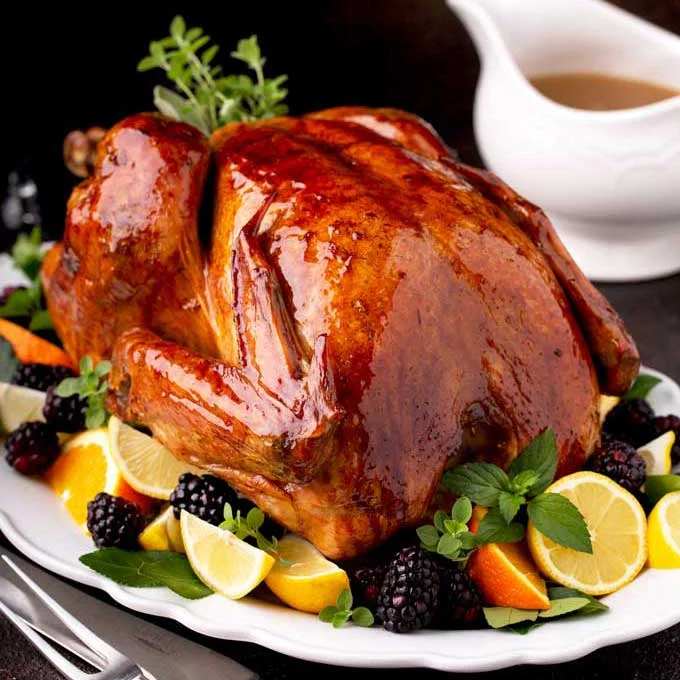
This American-style roast turkey is brined, flavoured with garlic butter and roasted with citrus and herbs, then served with homemade gravy. It takes time, but much of it is hands-off, making it a good centrepiece for a celebratory meal.
Ingredients
- 240 ml (1 cup)salt
- 220 g (1 cup)brown sugar
- 2oranges, quartered
- 2lemons, quartered
- 1apple, quartered
- 5 sprigsthyme
- 3 sprigsrosemary
- 1 tablespoonblack peppercorns
- 2bay leaves
- 7.6 litres (2 gallons)water
- 1 (4.5–5.4 kg; 10–12 pounds)turkey, fresh or completely thawed
- 85 g (6 tablespoons)unsalted butter
- 4 clovesgarlic
- 2 teaspoonssoy sauce
- to tastesalt and pepper
- 1lemon, quartered
- 1 largeonion, quartered
- 2carrots, cut into 2.5 cm (1 inch) chunks, peeled or unpeeled
- 2 ribscelery, cut into 2.5 cm (1 inch) chunks
- 4 sprigsthyme
- 4 sprigsrosemary
- a fewsage leaves, optional
- 240–360 ml (1–1½ cups)turkey or chicken stock
- reservedturkey neck and giblets
- 1 smallonion, chopped
- 1 largecarrot, chopped
- 1 stalkcelery, chopped
- 1 smallbay leaf
- 710 ml (3 cups)water
- 710 ml (3 cups)low-salt chicken stock or broth, canned or homemade
- 120 ml (½ cup)white wine
- 710 ml (3 cups), plus more if neededturkey broth or chicken broth
- 30 g (¼ cup)flour
- 57 g (4 tablespoons)unsalted butter
- to tastefreshly ground black pepper
- reserved, if desiredcooked turkey neck meat and giblets
Instructions
- 1
Mix the brine
In a non-reactive container, dissolve the salt and brown sugar in 7.6 litres of water. Add the remaining brine ingredients and mix until the sugar dissolves.
- 2
Prepare the turkey
Remove the neck and giblets from the cavity. Take the giblets out of their bag and refrigerate them with the neck in a sealed container until needed, or reserve them for broth. Remove any plastic or wire securing the legs, pick off stray pin feathers and, if you wish, briefly rinse the turkey under cold running water.
- 3
Brine the turkey
Submerge the turkey in the brine, cover the container and refrigerate for at least 4 hours or overnight.
- 4
Rinse and dry
Lift the turkey out of the brine and rinse it under cold running water to remove excess salt. Pat it thoroughly dry with paper towels, especially the skin; if time allows, leave it to air-dry for about 30 minutes.
- 5
Heat the oven
Preheat the oven to 163°C (325°F).
- 6
Make herb butter
Melt the butter in a small saucepan over low heat. Add the garlic cloves and soy sauce, stir to combine, then take the pan off the heat.
- 7
Set up the turkey
Place the turkey breast-side up in a large roasting pan; a rack is not required.
- 8
Season and stuff
Season the cavity lightly with salt and pepper. Put some of the onion, carrots, celery, lemon, thyme, rosemary and sage, if using, inside the cavity. Arrange the rest of the aromatics around the turkey, placing larger pieces such as carrots, onion and celery underneath it.
- 9
Butter the turkey
Gently loosen the skin over the breast with your fingers. Spoon some flavoured butter beneath the skin, including around the legs and thighs. Discard the garlic or tuck it under the skin or into the cavity, but do not leave it on the pan where it may burn. Brush or pour the remaining butter over the turkey, then season with salt and ground black pepper.
- 10
Tie the legs
Tie the drumsticks loosely with kitchen string and, if you wish, tuck the wings underneath. Carefully turn the turkey breast-side down.
- 11
Roast breast-side down
Roast the turkey uncovered, breast-side down, for 1 hour. Make the turkey broth while it roasts.
- 12
Make the broth
Put the turkey neck and giblets in a heavy saucepan, holding back the liver until the final 15 minutes. Add the chopped onion, carrot, celery and bay leaf, then pour in the water and chicken stock. Bring to the boil over medium-high heat, reduce the heat to medium-low and simmer for 45 minutes to 1 hour, until reduced to about 4 cups. Add the liver for the final 15 minutes if using it. Strain and reserve the broth.
- 13
Reserve neck meat
If you want meat and giblets in the gravy, pull the meat from the turkey neck and finely chop it with the giblets. Set aside.
- 14
Turn and baste
After the first hour, take the turkey out of the oven and carefully turn it breast-side up. Baste it with about 60–120 ml (¼–½ cup) of turkey or chicken broth or stock, then return it to the oven.
- 15
Finish roasting
Roast uncovered, breast-side up, for about 2–3 hours, until an instant-read thermometer inserted into the thickest part of the thigh, away from the bone, reads 71°C (160°F). Baste with about 120 ml (½ cup) of broth or stock every hour during cooking.
- 16
Rest the turkey
Transfer the turkey to a serving platter or carving board. Loosely cover it with foil and leave it to rest for 15–30 minutes before carving.
- 17
Skim the pan juices
Discard the vegetables and herbs from the roasting pan. Pour the pan juices into a glass measuring jug and skim off the fat.
- 18
Heat the roasting pan
Set the roasting pan over two hob burners on medium heat. Alternatively, use a saucepan, bearing in mind that it will not capture the browned bits in the roasting pan.
- 19
Deglaze and simmer
Return the pan juices to the roasting pan or saucepan. Add the wine and scrape up the browned bits with a wooden spoon. Add 710 ml (3 cups) of reserved turkey broth and bring to the boil, then reduce the heat to low and simmer while you make the roux. Use canned broth if you did not make broth from scratch.
- 20
Make the roux
Melt the butter in a saucepan over medium-high heat. Whisk in the flour and cook for 2–3 minutes, stirring constantly.
- 21
Thicken the gravy
Gradually pour the simmering stock mixture into the roux, whisking briskly to keep it smooth. Reduce the heat to medium-low and simmer, stirring as needed, until thickened. It will thicken further as it stands; add extra broth if needed to loosen it.
- 22
Season the gravy
Stir in the reserved chopped neck meat and giblets if desired. Season with salt and freshly ground black pepper to taste, then pour the gravy into a gravy boat.
- 23
Carve and serve
Serve the turkey whole on a platter, garnished with fresh herbs, sliced citrus or whole cranberries, or carve it before serving. Arrange carved meat on a platter with garnishes and serve with the homemade gravy.
What is roast turkey?
Roast turkey is a traditional American celebratory main course, particularly associated with Thanksgiving. This version uses a seasoned brine, garlic butter and aromatics, then turns the roasting juices into gravy.
The brine seasons the bird ahead of cooking, while butter beneath the skin helps flavour the breast. Roasting breast-side down first and then turning the turkey gives the method a distinct two-stage rhythm.
Nutrition and macros by portion
The nutrition label shows one serving as written: 434 calories, 6g protein, 66g carbs, 12g fat.
| Portion | Adjustment | kcal | Protein | Carbs | Fat |
|---|---|---|---|---|---|
| Lighter | Use less gravy | 304 kcal | 4g | 46g | 8g |
| This serving | As written | 434 kcal | 6g | 66g | 12g |
| Hungry | Serve a larger portion | 651 kcal | 9g | 99g | 18g |
The recipe's listed macros are dominated by the turkey's protein, the butter's fat and the brown sugar in the brine's carbohydrate contribution; some brine ingredients may not all be consumed. Balance the plate with a generous serving of vegetables alongside the turkey and gravy.
Why brine the turkey?
Brine: The salt-and-sugar mixture is the first step, so allow at least 4 hours in the refrigerator, or leave the turkey overnight. Use a non-reactive container large enough to keep the bird submerged.
Rinse and dry: Rinsing after brining removes excess surface salt. Drying the skin well helps it roast rather than steam.
Build flavour with butter and aromatics
Herb butter: Garlic and soy sauce are stirred into melted butter, which is spooned beneath the breast skin and spread over the outside. Work gently to loosen the skin without tearing it.
Cavity and pan: Citrus, onion, carrots, celery and herbs flavour the cavity and roasting pan. Larger vegetable pieces can sit beneath the bird, as directed, while keeping garlic off the bare pan to prevent it burning.
The two-stage roasting method
First stage: Roast the turkey breast-side down for 1 hour at 163°C (325°F). This is also the time to start the broth on the hob.
Second stage: Turn the bird breast-side up, baste it, then roast for about 2–3 hours, basting hourly. Since cooking time varies with the turkey and oven, use the thermometer reading in the thickest part of the thigh as the guide.
How to tell when it is done
Temperature: Insert an instant-read thermometer into the thickest, meatiest part of the thigh without touching bone. The recipe's target is 71°C (160°F).
Resting: Once out of the oven, tent the turkey loosely with foil and rest it for 15–30 minutes before carving. This gives you time to finish the gravy and prepare the serving platter.
Make the most of the broth
Simmer: The neck, giblets, vegetables, water and chicken stock form the base of the homemade broth. Add the liver only for the last 15 minutes, if using, then strain the liquid.
Gravy: Wine loosens the browned bits from the roasting pan, and the roux thickens the combined pan juices and broth. Whisk the hot liquid into the roux gradually to help keep the gravy smooth.
Serving ideas
Carve the turkey at the table or arrange slices on a platter with fresh herbs, citrus or whole cranberries. Serve the gravy alongside so everyone can add as much as they like.
For a complete meal, pair it with vegetables and a potato side. The turkey and gravy are rich and savoury, so a bright or simply prepared vegetable makes a useful contrast.
Recipe notes & tips
- Make sure the turkey is fully thawed before you begin brining it.
- Choose a container that fits the turkey and keeps it submerged in the brine.
- Pat the turkey especially dry after rinsing to help the skin roast well.
- Loosen the breast skin slowly with your fingers to avoid tearing it.
- Use an instant-read thermometer in the thigh and avoid touching the bone.
- Whisk steadily as you add the simmering broth mixture to the roux.
Variations
- Use chicken stock: Substitute it for turkey stock in the roasting pan or broth.
- Skip the wine: Deglaze the pan with extra broth instead.
- Leave out sage: The recipe makes sage optional, so omit it if preferred.
- Add giblets to gravy: Finely chop the cooked neck meat and giblets and stir them in.
- Garnish the platter: Add fresh herbs, sliced citrus or whole cranberries before serving.
Common mistakes to avoid
- Skipping the rinse: Rinse the brined turkey under cold running water to remove excess surface salt.
- Leaving the skin damp: Pat the turkey thoroughly dry before adding the butter.
- Tearing the skin: Loosen it carefully with your fingers before spooning butter underneath.
- Burning the garlic: Tuck the cloves under the skin or into the cavity rather than leaving them on the pan.
- Guessing the doneness: Check the thickest part of the thigh with a thermometer, away from the bone.
- Adding gravy liquid too quickly: Pour it into the roux gradually while whisking vigorously.
How to store
Refrigerate leftover turkey and gravy in covered containers within 2 hours of serving and use within 3–4 days. Reheat until steaming hot; add a little broth to the gravy if it has thickened in the fridge.
Frequently asked questions
How long should I brine the turkey?
Brine it for at least 4 hours or overnight, keeping it covered in the refrigerator. Rinse it under cold running water afterwards.
Can I use a frozen turkey?
The recipe calls for a fresh or completely thawed turkey. Thaw it fully before brining so the brine can surround the bird.
Do I need a roasting rack?
No. The method places the turkey directly in a large roasting pan, with some of the larger aromatics underneath it.
Can I make the broth without giblets?
The recipe uses the reserved neck and giblets for its broth, but the gravy instructions allow canned broth if you have not made the broth from scratch. Follow the method's instruction to add liver only during the last 15 minutes if using it.
Why roast the turkey breast-side down first?
That is the sequence specified in this recipe: roast breast-side down for 1 hour, then turn the bird breast-side up and continue cooking. Turn it carefully, as the pan and turkey will be hot.
Can I make the gravy ahead?
The recipe makes the gravy from the freshly roasted turkey's pan juices. You can prepare the broth while the turkey roasts, then finish the gravy after collecting and skimming the pan juices.
Cook it from the original
This recipe comes from lemonblossoms.com. Their page has the author’s own photos, notes and tips — the best place to cook it from.
Open the recipe on lemonblossoms.com