
Sausage Stuffed Turkey Breast
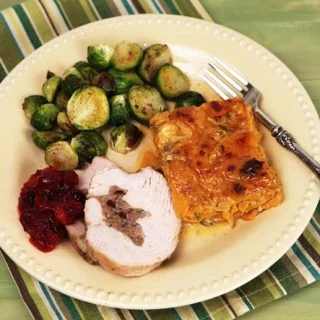
A butterflied turkey breast is rolled around Italian sausage, cranberries and fennel, then roasted and served with a simple wine and chicken-broth gravy. It makes a festive centrepiece without the work of roasting a whole turkey.
Ingredients
- 1.8 kg (4 lb)turkey breast, boned and butterflied
- 30 ml (2 tablespoons)olive oil
- 1 smallonion, peeled and diced
- 2 clovesgarlic, peeled and minced
- 340 g (¾ lb)sweet Italian sausages
- 75 g (½ cup)dried cranberries
- 5 ml (1 teaspoon)crushed fennel seeds
- 240 ml (1 cup)chicken broth
- 240 ml (1 cup)white wine
- 16 g (2 tablespoons)flour
- to tastesalt
- to tasteblack pepper
Instructions
- 1
Soften the onion
Heat the olive oil in a frying pan and cook the diced onion until tender.
- 2
Cook the garlic
Add the garlic and cook for another minute or two, then transfer the onion mixture to a bowl.
- 3
Add the sausage
Remove the sausage meat from its casings, crumble it into the bowl with the onions and combine.
- 4
Season the filling
Mix in the fennel seeds and dried cranberries, then season with salt and pepper.
- 5
Heat the oven
Preheat the oven to 190°C (375°F).
- 6
Flatten the turkey
Open out the butterflied breast and pound it with a meat mallet until it is an even thickness throughout.
- 7
Spread the filling
Spread the sausage mixture over the breast, leaving a 4 cm (1½ inch) border.
- 8
Roll and tie
Roll the breast up tightly and secure it with kitchen twine.
- 9
Add the liquids
Place the breast in a small roasting pan with half of the wine and chicken broth.
- 10
Roast the turkey
Roast for about 1 hour and 20 minutes, basting every 15 minutes with the wine mixture, until the turkey reaches an internal temperature of 66°C (150°F).
- 11
Rest under foil
Remove the breast from the oven, transfer it to a platter and cover it with foil.
- 12
Drain the pan
Remove the pan from the oven and pour off any excess oil.
- 13
Deglaze the pan
Set the roasting pan over a burner, add the remaining wine mixture and scrape up the browned bits from the bottom.
- 14
Mix the flour
Spoon a few portions of the liquid into a small bowl and mix them with the flour until smooth.
- 15
Thicken the sauce
Whisk the flour mixture into the liquid in the pan and stir until the sauce thickens.
- 16
Season and strain
Season the sauce with salt and pepper, then strain it through a sieve.
- 17
Slice the turkey
Remove the twine and cut the turkey into 1 cm (½ inch) slices.
- 18
Serve with sauce
Serve the sliced turkey with a little sauce.
What is sausage-stuffed turkey breast?
This is a rolled turkey roast filled with sausage, dried cranberries and fennel, then served in slices with gravy. Stuffed and rolled roasts are a practical alternative to cooking a whole bird, especially when you want a centrepiece that is easier to carve.
Turkey and sausage make a savoury, rich filling, while cranberries bring a sweet-tart note and fennel adds a gentle anise flavour. The wine and broth in the roasting pan become the base for the sauce.
Nutrition and macros by portion
The nutrition label shows one serving as written: 925 calories, 105g protein, 28g carbs, 42g fat.
| Portion | Adjustment | kcal | Protein | Carbs | Fat |
|---|---|---|---|---|---|
| Lighter | Use less sausage filling | 648 kcal | 74g | 20g | 29g |
| This serving | As written | 925 kcal | 105g | 28g | 42g |
| Hungry | Serve a larger slice | 1388 kcal | 158g | 42g | 63g |
The turkey and sausage supply most of the protein, while the sausage and olive oil contribute much of the fat. Cranberries, flour and the accompanying wine and broth account for some of the carbohydrates. Pair a slice with green vegetables and a moderate serving of potatoes to round out the plate.
Building the filling
Onion and garlic: cooking them until tender mellows their flavour before they go into the filling. Let the mixture cool briefly if it is very hot before combining it with the sausage.
Sausage: remove the casings so the meat can be crumbled and spread evenly. The recipe uses sweet Italian sausage, which seasons the stuffing as it cooks.
Cranberries and fennel: distribute these through the sausage mixture so each slice gets a little of both. Season the filling to taste before spreading it over the turkey.
Rolling the breast
Even thickness: pound the butterflied turkey so it cooks more evenly and is easier to roll. Use a meat mallet with steady, controlled strokes rather than forcing the meat thin in one place.
Border: leave about 4 cm (1½ inches) clear around the edge when spreading the filling. This gives the stuffing room as you roll the breast and helps keep it from spilling out.
Roasting and checking doneness
Basting: spoon the wine and broth mixture over the turkey every 15 minutes, as directed. This also keeps the pan supplied with liquid for the gravy.
Temperature: use a meat thermometer to check the thickest part of the turkey. The source recipe gives 66°C (150°F) as its target; follow current food-safety guidance for poultry and verify the temperature with a reliable thermometer.
Making the gravy
Pan juices: after pouring off excess oil, add the remaining wine mixture and scrape the browned bits from the pan. These bits add savoury flavour to the sauce.
Flour slurry: first mix the flour with a few spoonfuls of liquid until smooth, then whisk it into the pan. This helps the sauce thicken without lumps; strain it before serving for a smoother finish.
Serving and timing
Rest the roast under foil while you prepare the sauce, then remove the twine and slice across the roll. The recipe gives an approximate roasting time of 1 hour and 20 minutes, but the thermometer is the useful doneness check.
Serve with the sauce and simple sides such as roast potatoes, green vegetables or a crisp salad. Their freshness and texture complement the rich sausage filling.
Recipe notes & tips
- Ask a butcher to bone and butterfly the turkey breast if you would rather not prepare it yourself.
- Remove the sausage casings before mixing the filling so it spreads more easily.
- Leave the stated border around the filling to make rolling and tying neater.
- Baste every 15 minutes as the recipe directs, using the liquid in the roasting pan.
- Use a meat thermometer to check the thickest part of the breast.
- Mix the flour with a little pan liquid first to help prevent lumps in the gravy.
Variations
- Add fresh herbs: mix chopped sage or thyme into the sausage filling for an herbal note.
- Use another dried fruit: swap the cranberries for chopped dried apricots for a sweeter filling.
- Change the sausage: use mild or hot Italian sausage to adjust the seasoning and heat.
- Add nuts: fold chopped toasted chestnuts into the filling for extra texture.
- Make it wine-free: replace the wine with additional chicken broth in the roasting liquid.
Common mistakes to avoid
- Uneven turkey: pound the breast to a fairly consistent thickness so it cooks more evenly.
- Overfilling: keep the 4 cm (1½ inch) border clear so the filling is less likely to escape as you roll.
- Loose roll: tie the roast securely with kitchen twine to help it hold its shape.
- Lumpy gravy: blend the flour with a few spoonfuls of liquid before whisking it into the pan.
- Guessing doneness: check the thickest part with a meat thermometer rather than relying only on the roasting time.
How to store
Refrigerate leftover turkey and sauce in covered containers within 2 hours of cooking and use within 3–4 days. Reheat slices with a little sauce until piping hot throughout; the sauce can be warmed separately and stirred smooth.
Frequently asked questions
Can I prepare the turkey roll ahead of time?
You can assemble and tie the roll ahead, then keep it covered in the fridge until ready to roast. Keep raw poultry chilled and cook it promptly.
How do I know when the turkey is done?
Check the thickest part with a reliable meat thermometer and follow current food-safety guidance for poultry. The source recipe specifies 66°C (150°F), but its cooking time is approximate.
Can I use a different sausage?
Yes. Mild or hot Italian sausage will work, though the flavour and seasoning of the filling will change.
What can I use instead of white wine?
Use additional chicken broth in place of the wine. The sauce will have a different flavour but can still be made using the same method.
Why mix the flour with liquid before adding it?
Making a smooth mixture with a few spoonfuls of pan liquid helps the flour blend into the sauce without forming lumps.
What sides go well with this roast?
Try roast potatoes and green vegetables, or serve it with a crisp salad for a lighter contrast to the rich filling.
Cook it from the original
This recipe comes from italianfoodforever.com. Their page has the author’s own photos, notes and tips — the best place to cook it from.
Open the recipe on italianfoodforever.com