
Chicken Cordon Bleu
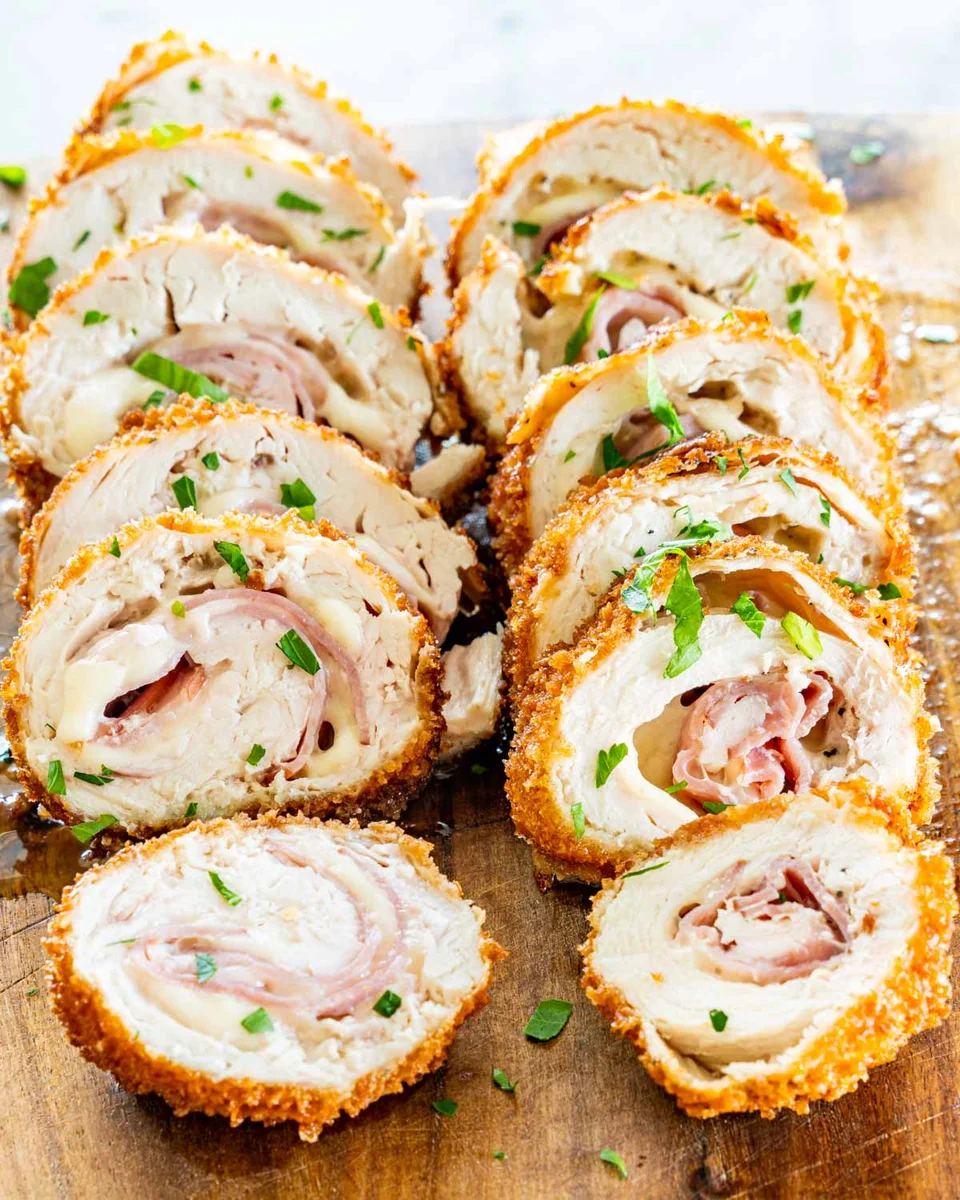
Chicken Cordon Bleu wraps ham and Swiss cheese inside thin chicken breasts, then coats them in breadcrumbs and fries them until crisp. It takes a little preparation, but the savoury filling and creamy mustard-Parmesan sauce make it a satisfying centrepiece.
Ingredients
- 4boneless, skinless chicken breasts
- 4 slicesham
- 4 slicesSwiss cheese
- 60 g (½ cup)plain flour
- 2eggs, beaten
- 100 g (1 cup)breadcrumbs (panko)
- ½ teaspoon (or to taste)salt
- ½ teaspoon (or to taste)pepper
- for fryingvegetable oil
- 2 tablespoonsbutter
- 2 tablespoonsplain flour
- 360 ml (1½ cups)milk
- 3 tablespoonsDijon mustard
- 50 g (½ cup)shredded Parmesan
- ¼ teaspoon (or to taste)salt
Instructions
- 1
Flatten the chicken
Place each chicken breast between two sheets of cling film and pound with a meat mallet or rolling pin until about 6 mm (¼ inch) thick. Repeat with the remaining breasts, then season both sides with salt and pepper.
- 2
Roll and chill
Lay a slice of Swiss cheese and a slice of ham over a chicken breast placed on cling film; use two slices of each if needed to cover it. Roll the chicken widthways around the filling and wrap it tightly in the cling film, tying the ends. Repeat with the remaining breasts and chill in the freezer for 30 minutes to 1 hour.
- 3
Coat the chicken
Put the flour, beaten eggs and breadcrumbs in three separate shallow bowls. Season the flour and eggs with salt and pepper. Unwrap each chicken breast and coat it first in flour, then egg, and finally breadcrumbs.
- 4
Fry until cooked
Pour vegetable oil into a deep frying pan to a depth of about 5 cm (2 inches) and heat it to 163°C (325°F). Add the chicken and fry for 5 minutes, turn, then fry for another 5 minutes or until the centre reaches 74°C (165°F). Rest for 5–10 minutes.
- 5
Make the sauce
Melt the butter in a saucepan over medium heat. Add the flour, whisk thoroughly and cook for 1–2 minutes.
- 6
Finish and serve
Pour in the milk gradually while whisking until the mixture is smooth. Add the Dijon mustard and Parmesan, then bring the sauce to a bubble, whisking continuously, until thickened. Taste and add salt as needed, then serve the chicken with a scoop of sauce.
What is Chicken Cordon Bleu?
Chicken Cordon Bleu is a breaded chicken dish filled with ham and cheese. Its French name means “blue ribbon”, though the familiar stuffed-and-breaded version is often associated with European cookery rather than a single settled origin.
Here, thin chicken is rolled around Swiss cheese and ham, chilled to help it hold its shape, then fried. A creamy Dijon and Parmesan sauce adds a tangy, savoury finish.
Nutrition and macros by portion
The nutrition label shows one serving as written: 623 calories, 51g protein, 40g carbs, 28g fat.
| Portion | Adjustment | kcal | Protein | Carbs | Fat |
|---|---|---|---|---|---|
| Lighter | Serve with extra greens | 436 kcal | 36g | 28g | 20g |
| This serving | As written | 623 kcal | 51g | 40g | 28g |
| Hungry | Add roasted potatoes | 935 kcal | 77g | 60g | 42g |
Chicken provides most of the protein, while the flour, breadcrumbs and milk contribute carbohydrates. The frying oil, butter, cheese and ham contribute much of the fat; serve with green vegetables or salad to balance the plate.
Why chill the rolls?
Tight wrapping helps the chicken hold its spiral around the filling. The freezer rest firms the rolls, making them easier to unwrap and coat without disturbing the seam.
Build an even coating
Flour: a light first layer helps the beaten egg cling to the chicken. Shake off excess so the coating does not become patchy or heavy.
Egg and crumbs: coat all sides in egg before pressing on the breadcrumbs. Panko gives a coarse, crunchy finish; ordinary breadcrumbs also work.
Check the centre
Fry at 163°C (325°F), turning the chicken after 5 minutes and cooking for another 5 minutes. The crust should be golden, but colour alone cannot confirm that the centre is cooked.
Check the thickest part with a food thermometer; it should reach 74°C (165°F). Rest the chicken for 5–10 minutes before serving so the filling settles and the juices redistribute.
Keep the sauce smooth
Cook the butter and flour together for 1–2 minutes, whisking so the flour is evenly incorporated. Add the milk gradually while whisking to reduce the chance of lumps.
Once the mustard and Parmesan are added, keep whisking as the sauce bubbles and thickens. If it becomes too thick before serving, whisk in a little more milk.
Plan the plate
The chicken is rich and filling, so serve it with a crisp green salad or steamed green vegetables. Boiled or roasted potatoes also make a good match if you want a more substantial meal.
Recipe notes & tips
- Pound the chicken to an even thickness so it rolls and cooks more evenly.
- Use cling film to keep the rolls tight, and tie the ends securely before chilling.
- Set up the flour, egg and breadcrumbs in order to make coating the chicken easier.
- Check the oil temperature before frying and let it return to temperature between batches if needed.
- Use a thermometer to check the centre of the thickest chicken roll.
- Rest the fried chicken for 5–10 minutes before slicing or serving.
Variations
- Use Gruyère: swap it for the Swiss cheese for a more pronounced, nutty flavour.
- Try another ham: use a thinly sliced cooked ham that fits neatly inside the chicken.
- Change the crumbs: use fine breadcrumbs instead of panko for a more even coating.
- Add herbs: stir chopped parsley or chives into the sauce just before serving.
- Adjust the mustard: add a little less Dijon for a milder sauce.
Common mistakes to avoid
- Uneven chicken: pound the breasts to an even thickness so thin areas do not overcook.
- Loose filling: roll tightly around the ham and cheese, then chill the wrapped chicken before coating.
- Patchy crumb: coat each roll in flour, egg and breadcrumbs in that order, covering the ends as well.
- Oil too hot: monitor the temperature and keep it near 163°C (325°F) so the crust does not brown too quickly.
- Guessing doneness: check that the thickest part reaches 74°C (165°F) rather than relying on the crust colour.
- Lumpy sauce: add the milk gradually and whisk continuously as it goes in.
How to store
Refrigerate leftover chicken and sauce in separate airtight containers for up to 3–4 days. Reheat the chicken in an oven until hot throughout to help the coating crisp again, and warm the sauce gently while stirring; add a splash of milk if needed.
Frequently asked questions
Can I prepare the chicken rolls ahead?
Yes. Roll and wrap them, then chill in the freezer for 30 minutes to 1 hour as directed. Keep them chilled until you are ready to unwrap and coat them.
Can I use ordinary breadcrumbs instead of panko?
Yes. Panko gives a coarser, crisp coating, while ordinary breadcrumbs make a finer crust.
How do I know when the chicken is cooked?
Check the thickest part of a roll with a food thermometer. It should reach 74°C (165°F).
Why is the cheese leaking out?
The roll may not be tight enough, or the chicken may have a gap at the seam. Wrap it snugly around the filling and chill it before coating.
Can I make the sauce ahead?
You can make it ahead and refrigerate it separately, then reheat it gently while whisking. Add a little milk if it has thickened too much.
Cook it from the original
This recipe comes from jocooks.com. Their page has the author’s own photos, notes and tips — the best place to cook it from.
Open the recipe on jocooks.com