
Salmon tartare
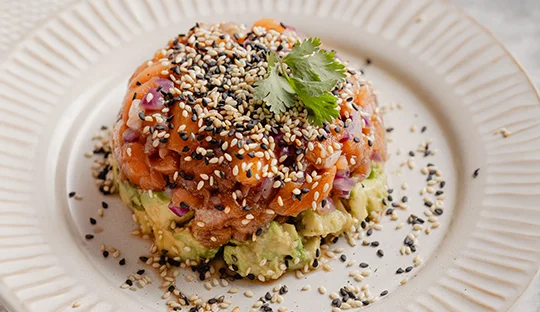
This salmon tartare layers soy-and-agave-marinated salmon with seasoned avocado, then finishes with sesame and coriander. It comes together in 10 minutes and makes a fresh starter or light lunch.
Ingredients
- 150 gsalmon, diced
- 30 ml (2 tbsp), or more to tasteGourmet soy sauce
- 30 ml (2 tbsp)agave syrup or maple syrup
- ¼red onion, finely chopped
- ½avocado, diced
- 15 ml (1 tbsp)Gourmet sesame mix
- to tasteGourmet sea salt
- a few leavescoriander
Instructions
- 1
Mix the salmon
Dice the salmon and finely chop the red onion. Mix them with the soy sauce and agave syrup, then set aside.
- 2
Prepare the avocado
Dice the avocado, or mash it if you prefer, and season with salt to taste. Set aside.
- 3
Layer the bowl
Line a small bowl with cling film. Add the salmon mixture, followed by the avocado, pressing each layer firmly to compact it.
- 4
Turn out and serve
Invert the bowl onto a plate and lift it away. Cover with the sesame mix, garnish with coriander leaves and serve immediately.
What is salmon tartare?
Tartare is a preparation of finely chopped or diced ingredients served without cooking; the name is often associated with French cuisine and steak tartare. This version uses raw salmon, with avocado as a soft, creamy counterpoint.
Soy sauce and agave give the fish a savoury-sweet dressing, while sesame and coriander bring a fragrant finish. Layering the ingredients makes it look composed without adding much preparation.
Nutrition and macros by portion
The nutrition label shows one serving as written: 287 calories, 16g protein, 15g carbs, 18g fat.
| Portion | Adjustment | kcal | Protein | Carbs | Fat |
|---|---|---|---|---|---|
| Lighter | Use less agave | 201 kcal | 11g | 11g | 13g |
| This serving | As written | 287 kcal | 16g | 15g | 18g |
| Hungry | Serve with extra toast | 431 kcal | 24g | 23g | 27g |
The salmon provides most of the protein and some of the fat, while avocado and sesame add further fat. The agave or maple syrup supplies most of the carbohydrates, with a smaller contribution from the vegetables. Pair a portion with salad or other vegetables for a more substantial plate.
Choosing the salmon
Freshness first: use salmon sold as suitable for raw consumption, and keep it chilled until you are ready to prepare the dish. Cut it into evenly sized, small cubes so the dressing coats each piece.
Keep the knife and board clean, and prepare the tartare shortly before serving. If you are unsure whether your fish is suitable to eat raw, cook it instead.
Balancing the dressing
Soy sauce: it brings saltiness and savoury depth, so taste the mixture before adding any more salt. The recipe allows extra soy sauce to taste.
Agave: its sweetness softens the salty dressing. Maple syrup is offered as an alternative; add either gradually if you prefer a less sweet result.
Layering for a neat shape
The cling film makes it easier to turn the tartare out of the small bowl. Press the salmon and avocado down firmly enough to hold together, but avoid crushing the diced fish.
A smaller bowl gives the layers more support. Turn it onto the serving plate carefully, then lift the bowl and peel away the film.
Getting the texture right
Diced avocado gives a distinct, soft layer; mashing it makes the stack smoother and easier to compact. Either way, season the avocado separately so its flavour is not lost beneath the salmon.
The finished tartare should hold its shape briefly while remaining tender. Add the sesame and coriander at the end so they stay visible and fresh.
Serving suggestions
Serve straight after assembling, as the recipe directs. Toasted bread or crisp crackers make useful accompaniments, while a simple green salad can turn it into a light meal.
Keep any extra soy sauce on the side rather than pouring it over the finished stack, which can make the base watery.
Recipe notes & tips
- Chill the salmon until just before cutting and mixing.
- Cut the salmon and onion finely for an even mixture.
- Taste the salmon mixture before adding extra soy sauce or salt.
- Use a small bowl to help the layers hold their shape.
- Serve as soon as it has been turned out and garnished.
Variations
- Use lime: add a little lime juice to the salmon mixture for a sharper flavour.
- Add chilli: finely chop a little fresh chilli and mix it through the salmon.
- Swap the herbs: use finely chopped chives instead of coriander.
- Add cucumber: fold a small amount of finely diced cucumber into the avocado layer.
- Change the seeds: use toasted sesame seeds if you do not have a sesame mix.
Common mistakes to avoid
- Using unsuitable fish: choose salmon intended for raw consumption, or cook the fish if you cannot confirm its suitability.
- Cutting uneven pieces: dice the salmon consistently so the dressing coats it evenly.
- Adding too much salt: taste first, as the soy sauce is already salty.
- Pressing too hard: compact the layers enough to hold, without crushing the salmon.
- Making it too early: assemble close to serving so the avocado stays fresh and the stack holds its shape.
How to store
This tartare is best served immediately and is not well suited to storing once assembled. Keep the ingredients refrigerated before preparation, and discard any leftovers that have been left at room temperature.
Frequently asked questions
Can I make salmon tartare ahead of time?
It is best assembled just before serving. You can prepare the ingredients in advance, keep them covered and chilled, and layer them at the last minute.
Can I use frozen salmon?
Use it only if the packaging or supplier confirms that it is suitable for eating raw, and thaw it safely in the fridge. Otherwise, cook the salmon before using it.
Should I dice or mash the avocado?
Either works: diced avocado gives a more defined layer, while mashed avocado creates a smoother one that compacts easily.
What can I use instead of agave?
The recipe suggests maple syrup as an alternative. Use the same amount, then adjust to taste.
How do I stop the tartare falling apart?
Use a small bowl lined with cling film and press each layer firmly as you add it. Turn it out carefully onto a flat plate.
What should I serve with it?
Try toasted bread or crisp crackers, or serve it with a simple green salad for a light meal.
Cook it from the original
This recipe comes from gourmet.cl. Their page has the author’s own photos, notes and tips — the best place to cook it from.
Open the recipe on gourmet.cl