
Bak kwa – Chinese meat jerky
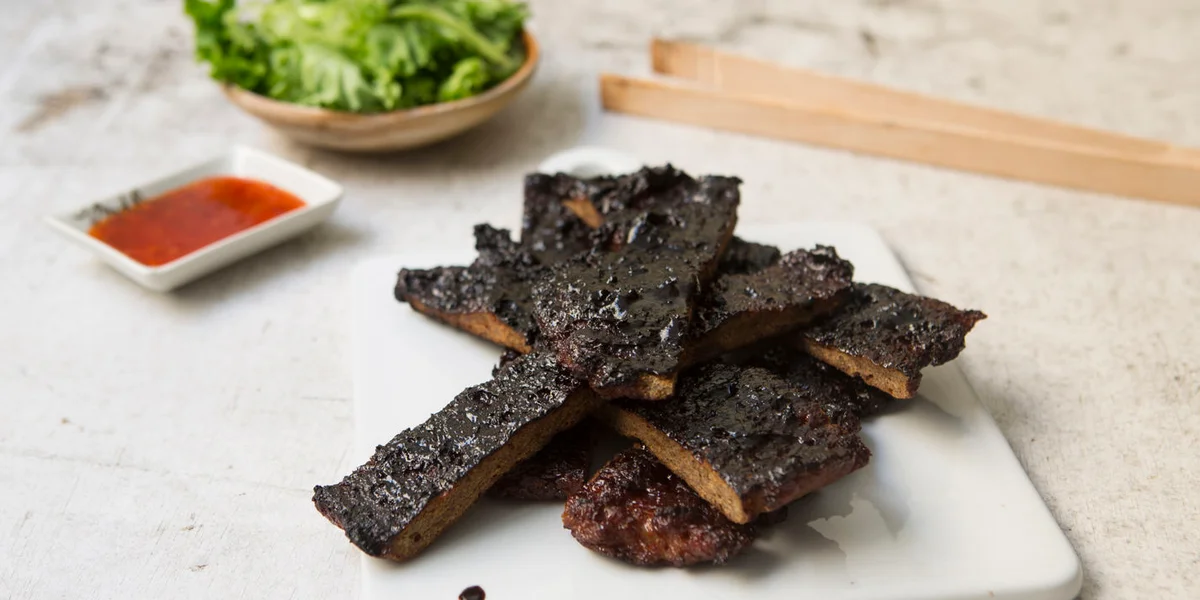
Bak kwa is a sticky, sweet-savoury Chinese pork jerky often enjoyed during Chinese New Year. This version combines minced pork belly with honey, sugar and spices, then dries and grills it for a smoky, lightly charred finish.
Ingredients
- 650 gminced pork belly
- 100 ghoney
- 150 glight brown sugar
- 45 ml (3 tbsp)rice wine
- 45 ml (3 tbsp)fish sauce
- 5 ml (1 tsp)sesame oil
- 5 ml (1 tsp)light soy sauce
- 5 ml (1 tsp)soy sauce
- 5 ml (1 tsp)five-spice powder
- 1 dashred food colouring (optional)
Instructions
- 1
Mix and knead
Put all the ingredients in a large mixing bowl and combine by hand until the mixture is firm and dough-like. Then punch, whip and repeatedly lift and slap it back into the bowl until it becomes a sticky, gluey paste; this can take 5–15 minutes.
- 2
Spread and chill
Grease a baking sheet or large, flat baking tin. Spread the meat paste over it in a thin layer, about 3 mm thick, using the back of a spoon to even it out. Leave it uncovered in the fridge overnight to dry slightly and marinate.
- 3
Dry the meat
The next day, dry the meat paste. In a hot, sunny location, the original method suggests leaving it in the sun; otherwise, turn the sheet of paste out onto a wire rack and put it in an oven preheated to 100°C for 20 minutes, with the door slightly ajar.
- 4
Cut into shapes
Once the meat is relatively dry, take it out of the oven and cut it into strips, squares, circles or oblongs. At this stage, the bak kwa can be frozen for up to three months.
- 5
Grill until charred
If using a barbecue, grill the pieces over hot coals until they have a smoky flavour and char marks. Alternatively, preheat a grill to its highest setting and cook the pieces for 10 minutes, until slightly charred. Serve warm or cold.
What is bak kwa?
Bak kwa is a Chinese-style dried meat snack, commonly associated with Chinese New Year and especially popular in Singapore and Malaysia. It is usually made from seasoned, sweetened meat that is dried before being grilled.
This version uses minced pork belly, whose fat helps keep the finished pieces rich and tender. Honey, brown sugar, fish sauce and five-spice build the characteristic sticky, salty-sweet flavour.
Nutrition and macros by portion
The nutrition label shows one serving as written: 1068 calories, 15g protein, 58g carbs, 86g fat.
| Portion | Adjustment | kcal | Protein | Carbs | Fat |
|---|---|---|---|---|---|
| Lighter | Smaller pieces, more vegetables | 748 kcal | 11g | 41g | 60g |
| This serving | As written | 1068 kcal | 15g | 58g | 86g |
| Hungry | Larger portion | 1602 kcal | 23g | 87g | 129g |
The pork belly provides most of the fat and protein, while the honey and brown sugar supply most of the carbohydrates. Fish sauce and soy sauces contribute much of the sodium. Pair a piece with vegetables and plain rice, and adjust the portion to suit the rest of the meal.
Why use pork belly?
Pork belly: its high fat content gives the jerky a rich texture and helps prevent it from becoming too dry during grilling. Minced meat also makes it easier to spread into a thin, even layer.
Seasonings: fish sauce and soy sauces supply savoury depth, while rice wine and sesame oil add aromatic notes. Five-spice brings a warm, distinctive fragrance.
Mixing for a cohesive paste
Mixing: start by combining everything until the meat looks like a firm dough. Then keep working it by hand, lifting and slapping it back into the bowl until it turns sticky and gluey.
Texture: the recipe allows 5–15 minutes for this stage, depending on how vigorously you work. A cohesive paste is easier to spread and helps the pieces hold together.
Spreading and drying
Even layer: aim for about 3 mm thickness across the tray, smoothing the paste with the back of a spoon. Thin, even spreading helps the sheet dry at a more consistent rate.
Overnight rest: the uncovered time in the fridge lets the surface dry slightly while the seasoning marinates. The following 20 minutes in a 100°C oven is another drying stage, not the final grilling.
Grilling and doneness
Grill: the recipe uses hot coals for a smoky flavour, or the highest grill setting for 10 minutes as an alternative. Keep a close eye on the pieces, since their sugar-rich coating can darken quickly.
Finish: look for slight charring, as specified in the method, rather than relying only on colour to judge whether minced pork is cooked. For food safety, check that the thickest pieces reach 71°C in the centre.
Serving ideas
Serve the pieces warm or cold as a snack, or add them to a meal with plain rice and vegetables. Their sweet, savoury seasoning makes them especially suited to simple accompaniments.
The method gives no exact finished yield or piece size, so cut the sheet into portions that suit how you plan to serve it. If making it ahead, freeze the dried sheet before grilling, as the recipe suggests.
Recipe notes & tips
- Use a large bowl so you have room to lift and slap the meat paste while mixing.
- Spread the paste as evenly as possible so thinner spots do not dry much faster than thicker ones.
- Use the back of a spoon to smooth the paste into an approximately 3 mm layer.
- Keep a close watch during grilling because the honey and sugar can char quickly.
- For food safety, dry the meat in the oven rather than leaving raw minced pork in the sun.
- Check the centre of the thickest pieces with a food thermometer before serving.
Variations
- Skip the colouring: leave out the optional red food colouring for a more natural appearance.
- Use barbecue coals: grill over hot coals for the smoky finish described in the recipe.
- Choose the grill: use the highest grill setting for 10 minutes when a barbecue is not available.
- Cut snack pieces: shape the dried sheet into small squares for easy serving.
- Freeze ahead: freeze the dried, ungrilled pieces for up to three months, as suggested by the method.
Common mistakes to avoid
- Stopping the mixing early: keep working the meat until it becomes a sticky, cohesive paste.
- Uneven spreading: smooth the layer to about 3 mm so it dries more evenly.
- Leaving raw meat in the sun: use the oven-drying method instead to avoid unsafe handling.
- Grilling unattended: watch closely because the sugary surface can char quickly.
- Judging doneness by colour alone: check that the centre of the thickest pieces reaches 71°C.
How to store
The recipe suggests freezing the dried, ungrilled bak kwa for up to three months. Refrigerate cooked leftovers promptly in a sealed container and use within 3–4 days; reheat until steaming hot, or serve cold as the method allows.
Frequently asked questions
Can I make bak kwa without a barbecue?
Yes. Preheat a grill to its highest setting and cook the pieces for 10 minutes, until slightly charred. Keep an eye on them as they cook.
How thin should I spread the meat?
The method specifies a layer about 3 mm thick. Try to keep it even across the tray.
Can I dry the meat paste outside?
The source method mentions drying it in the sun, but leaving raw minced pork exposed outdoors is not a safe option. Use the oven method instead.
How long does the mixing take?
The method gives a range of 5–15 minutes. Work the mixture until it changes from dough-like to a sticky, gluey paste.
Can I freeze bak kwa?
The method says the dried pieces can be frozen for up to three months before grilling. Keep them sealed and thaw safely in the fridge before cooking.
Can I serve it cold?
Yes. The recipe suggests serving the grilled bak kwa warm or cold.
Cook it from the original
This recipe comes from greatbritishchefs.com. Their page has the author’s own photos, notes and tips — the best place to cook it from.
Open the recipe on greatbritishchefs.com