
Poached Salmon With Dill Sour Cream Sauce
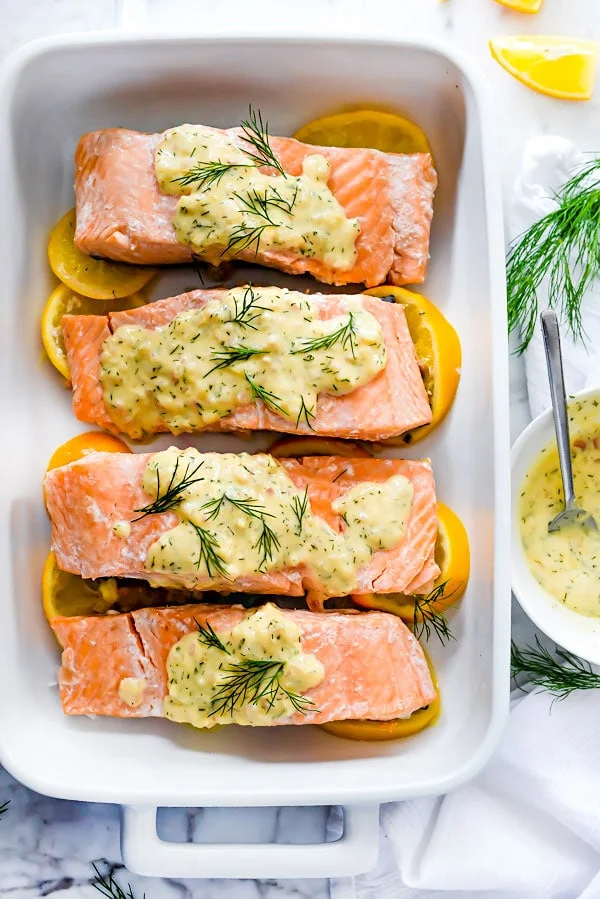
Salmon fillets are gently poached over lemon and dill, then served with a creamy sauce made from the reduced cooking liquid. It is a quick, delicate main course that brings together fresh herbs, mustard and a little white wine.
Ingredients
- 2lemons (one cut into 6 mm slices and the other into wedges)
- 30 ml (2 tablespoons)fresh dill, minced, plus 8–12 dill stems
- 1 largeshallot, minced and divided
- 120 ml (½ cup)white wine
- 120 ml (½ cup)water
- 907 g (2 pounds), about 3.8 cm thicksalmon fillets
- 15 ml (1 tablespoon)Dijon mustard
- 30 ml (2 tablespoons)sour cream
- 30 g (2 tablespoons)butter
- to tastekosher salt and freshly ground black pepper
Instructions
- 1
Layer the pan
Arrange the lemon slices in one layer in a large frying pan. Add half the minced dill, the dill stems and half the minced shallot, about 2 tablespoons. Pour in the wine and water, then place the salmon on top of the lemon slices.
- 2
Poach the salmon
Set the pan over a high heat and bring the liquid to a rolling simmer. Reduce the heat to low, cover and cook for 11–15 minutes, until the centre is still translucent when checked with the tip of a small knife and registers 52°C (125°F).
- 3
Lift out the fish
Take the pan off the heat. Use a spatula to transfer the salmon and lemon slices carefully to a serving dish, and discard the dill stems. Loosely cover the salmon with foil.
- 4
Finish the sauce
Return the pan and poaching liquid to a high heat and simmer until reduced to 30 ml (2 tablespoons), about 5 minutes. Whisk in the remaining shallot and Dijon mustard, then simmer until thickened, about 4 minutes. Whisk in the sour cream and butter, and season with kosher salt and freshly ground black pepper. Add lemon juice to taste and simmer until thickened, about 1 minute. Whisk in the remaining minced dill.
What is poached salmon with dill sauce?
Poached salmon is cooked gently in liquid rather than browned in a pan or roasted. This American-style version uses wine, water, lemon and dill for the poaching liquid, then turns that liquid into a creamy mustard sauce.
The method keeps the fish tender while making good use of the fragrant cooking liquid. Fresh dill added at the end gives the sauce a bright herbal finish.
Nutrition and macros by portion
The nutrition label shows one serving as written: 431 calories, 46g protein, 7g carbs, 22g fat.
| Portion | Adjustment | kcal | Protein | Carbs | Fat |
|---|---|---|---|---|---|
| Lighter | Use less butter | 302 kcal | 32g | 5g | 15g |
| This serving | As written | 431 kcal | 46g | 7g | 22g |
| Hungry | Serve with extra potatoes | 647 kcal | 69g | 11g | 33g |
The salmon supplies most of the protein, while its fat and the butter contribute much of the dish's fat. The lemon and shallot add some carbohydrate, with smaller amounts coming from the wine, mustard and sour cream. Pair a portion with green vegetables and a moderate serving of potatoes or rice for a balanced plate.
The poaching ingredients
Lemon slices: these sit beneath the fish and lend their flavour to the liquid as it simmers.
Wine and water: together they create the shallow poaching bath. The wine contributes flavour, while the water keeps the liquid from becoming too concentrated before the salmon cooks.
Dill and shallot: some flavour the poaching liquid, while the reserved portions go into the sauce for a fresher, more pronounced finish.
Keep the heat gentle
Bring the liquid to a rolling simmer first, then turn the heat down to low before covering the pan. A gentle simmer cooks the salmon more evenly than a vigorous boil.
Use a pan large enough to arrange the lemon slices and fish in a single layer. Keep the lid on during cooking so the heat stays steady.
Check the salmon carefully
Thickness: the recipe is timed for fillets about 3.8 cm thick, with a cooking time of 11–15 minutes. Thinner pieces may need less time, so start checking early.
Doneness: check the centre with the tip of a small knife and use a thermometer to look for 52°C (125°F), as specified in the method. The centre should still be translucent when checked.
Build the sauce from the liquid
Reduction: simmer the poaching liquid until only 30 ml (2 tablespoons) remain, then add the remaining shallot and mustard. This concentrates the liquid before the creamy ingredients go in.
Finish: whisk in the sour cream and butter, then add lemon juice to taste and the remaining dill. Keep the sauce at a simmer while it thickens; avoid letting it boil hard after adding the sour cream.
Serving ideas
Serve the salmon with the sauce spooned over or alongside it, and use the lemon wedges at the table for extra brightness.
Boiled or steamed potatoes, rice or crusty bread can catch the sauce. Add green vegetables, such as peas or asparagus, for a fresh contrast.
Recipe notes & tips
- Choose a frying pan that fits the salmon in a single layer.
- Keep the salmon covered while it poaches for more even cooking.
- Check the thickest part of a fillet rather than relying only on the cooking time.
- Reduce the liquid before adding the sour cream and butter so the sauce has a concentrated base.
- Add lemon juice a little at a time and taste as you go.
- Whisk the sauce well after adding the butter and sour cream to bring it together.
Variations
- Use parsley: swap some or all of the dill for minced fresh parsley.
- Add capers: stir a few into the finished sauce for a briny accent.
- Try crème fraîche: use it in place of sour cream for a similarly creamy finish.
- Use fish stock: replace the water with fish stock for a deeper savoury flavour.
- Add extra lemon: serve with more wedges for a sharper citrus note.
Common mistakes to avoid
- Boiling the fish hard: lower the heat after the initial simmer so the salmon cooks gently.
- Overcooking the fillets: begin checking at the early end of the 11–15 minute range, especially if they are thinner.
- Crowding the pan: arrange the lemon and salmon in one layer, using a larger pan if needed.
- Skipping the reduction: simmer the poaching liquid to 30 ml (2 tablespoons) before adding the sauce ingredients.
- Letting the sauce boil vigorously: keep it at a gentle simmer after adding the sour cream and butter.
- Adding all the lemon juice at once: taste as you add it so the sauce stays balanced.
How to store
Refrigerate leftover salmon and sauce in a covered container for up to 2 days. Reheat gently in a covered pan over a low heat, adding a small splash of water if the sauce has thickened; avoid boiling it.
Frequently asked questions
Can I use salmon fillets thinner than 3.8 cm?
Yes, but they will cook more quickly than the timing given. Start checking them early and use the doneness cues in the method.
How do I know when the salmon is ready?
The method calls for a centre temperature of 52°C (125°F) and a centre that is still translucent when checked with a small knife. Check the thickest part of the fillet.
Can I make the sauce without wine?
The recipe uses white wine as part of the poaching liquid. You can replace it with water, though the sauce will have a different flavour.
Can I prepare the sauce ahead?
It is best finished just before serving, after reducing the poaching liquid. If you make it ahead, reheat it gently and whisk it until smooth.
What can I serve with this salmon?
Try potatoes, rice or crusty bread, along with green vegetables. The starch is useful for catching the dill sour cream sauce.
Cook it from the original
This recipe comes from foodiecrush.com. Their page has the author’s own photos, notes and tips — the best place to cook it from.
Open the recipe on foodiecrush.com