
Pan de jamón
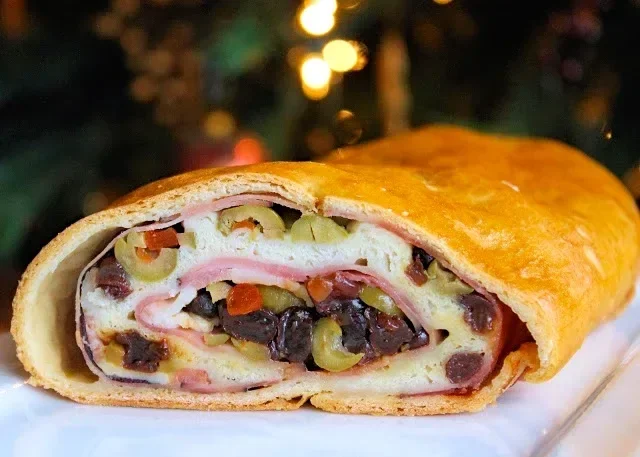
Pan de jamón is a Venezuelan celebration bread rolled around ham, olives, raisins and bacon. This no-knead version makes a generous, sweet-and-savoury loaf with a decorative finish.
Ingredients
- 60 ml (¼ cup)warm water
- 1 tablespoon (about 13 g)sugar
- 1 teaspoonyeast
- 420 gplain flour
- 3eggs (2 for the dough and 1 for glazing)
- 80 ml (⅓ cup) plus 1 tablespoon (15 ml)warm milk
- 4 tablespoons (about 57 g)melted butter
- 1 tablespoon (about 13 g)brown sugar
- 2 slicesbacon
- 454 g (1 lb)thinly sliced ham
- 20whole pimento-stuffed Manzanilla olives
- 120 ml (½ cup)sliced pimento-stuffed Manzanilla olives
- 120 ml (½ cup)raisins
- 120 ml (½ cup)golden raisins
- 1 tablespoon (15 ml)molasses, or papelón syrup
Instructions
- 1
Dissolve the sugar
Stir the white sugar into the warm water until dissolved.
- 2
Bloom the yeast
Add the yeast and leave it to activate for about 15 minutes.
- 3
Mix the dough
Once the yeast has risen, put the yeast mixture, milk, 2 eggs, 2 tablespoons of melted butter, the salt and flour in a mixer bowl fitted with a dough hook.
- 4
Form the dough
Mix until the dough comes together into a smooth, even ball. Add a little more flour if needed.
- 5
Let it rise
Shape the dough into a ball and place it in a large bowl with a little olive oil. Brush the dough with the oil, cover with a damp tea towel or cling film, and leave it to rise for at least 30–45 minutes, or until doubled in size.
- 6
Heat the oven
Preheat the oven to 175°C (350°F).
- 7
Roll the dough
On a floured surface, use a rolling pin to make a rectangle about 40 × 50 cm and 5 mm thick.
- 8
Place the olives
Along the edge that will sit in the centre of the loaf, arrange a row of whole stuffed olives. Fold the dough over them and press with your fingers to hold them in place.
- 9
Brush and sweeten
Brush the dough with melted butter and scatter the brown sugar over it.
- 10
Layer the ham
Arrange a generous layer of ham over the olives, overlapping the slices and leaving half of each slice beyond the dough edge so the filling shows in the centre when sliced.
- 11
Cover the dough
Cover the remaining dough with the rest of the ham, leaving about 7.5 cm (3 inches) of dough uncovered. Fold or ruffle the ham rather than laying it flat.
- 12
Add the bacon
Distribute the bacon over the dough.
- 13
Scatter the fruit
Scatter the sliced olives and both kinds of raisins over the filling.
- 14
Roll the loaf
Carefully roll up the dough, keeping the roll fairly loose rather than tight.
- 15
Decorate the top
Cut the uncovered strip of dough from the centre into 2, then 4, then 8 strips. Wrap these strips over the loaf as decoration.
- 16
Prick the dough
Prick the loaf all the way through 6 times with a fork.
- 17
Prepare the tray
Line a baking tray with baking parchment or a silicone baking mat.
- 18
Proof the loaf
Transfer the loaf to the tray, cover it with a clean tea towel and leave it to rise for 30 minutes.
- 19
Glaze the loaf
Beat the remaining egg with the molasses, then brush the mixture over the loaf.
- 20
Bake the bread
Bake for 30 minutes, rotating the tray every 10 minutes.
- 21
Check the colour
The loaf is ready when it is evenly browned.
- 22
Brush with butter
Remove the loaf from the oven and brush it with a little melted butter.
- 23
Cool before slicing
Leave the loaf to cool completely before slicing.
What is pan de jamón?
Pan de jamón is a Venezuelan stuffed bread, commonly associated with festive meals. Its soft dough is rolled around ham, olives and raisins, bringing savoury, salty and sweet flavours together.
This version keeps the dough preparation simple by mixing it rather than kneading it by hand. A row of whole olives at the centre and strips of dough wrapped over the top give the loaf a distinctive look when sliced.
Nutrition and macros by portion
The nutrition label shows one serving as written: 4070 calories, 178g protein, 462g carbs, 170g fat.
| Portion | Adjustment | kcal | Protein | Carbs | Fat |
|---|---|---|---|---|---|
| Lighter | Less ham and butter | 2849 kcal | 125g | 323g | 119g |
| This serving | As written | 4070 kcal | 178g | 462g | 170g |
| Hungry | Larger slice | 6105 kcal | 267g | 693g | 255g |
The dough and raisins provide much of the carbohydrate, while the butter, bacon and ham contribute much of the fat; the ham and eggs are the main protein sources. Pair a slice with fresh salad or vegetables for a more balanced plate.
The dough and its rise
Yeast mixture: give the yeast about 15 minutes in the sweetened warm water before mixing the dough. The recipe then relies on two rises: one until the dough doubles, and a second 30-minute rise after shaping.
Soft dough: mix until the dough forms a smooth ball, adding a little more flour only if necessary. The recipe also calls for oiling the bowl and brushing the dough before covering it.
Building the filling
Ham: overlap the slices and let half of the first layer extend beyond the dough edge; this helps make a well-filled centre. Fold or ruffle the remaining ham, and leave about 7.5 cm of dough bare at the end for decoration.
Olives and fruit: the whole olives form a line in the middle, while sliced olives and both kinds of raisins are scattered over the ham. Keep the roll loose as you wrap the dough around the filling.
Shaping the decorative top
Centre row: wrap dough around the whole olives and press it into place before adding the other filling. This creates a defined olive line through the middle of the loaf.
Dough strips: divide the uncovered edge into 2, then 4, then 8 strips and wrap them over the loaf. Prick the shaped bread six times with a fork as directed.
Baking and doneness
Oven: bake at 175°C for 30 minutes, rotating the tray every 10 minutes. The recipe’s visual cue is an evenly browned loaf.
Finish: brush the hot loaf with a little melted butter, then wait until it has cooled completely before slicing. Cutting it while warm can make the filled slices harder to handle.
How to serve it
Slice the cooled loaf so each piece shows the ham, olive and raisin filling. It works well on a festive table or as a substantial snack.
For a meal, serve a slice with a crisp green salad or fresh vegetables to bring a lighter, fresh contrast to the rich bread.
Recipe notes & tips
- Let the yeast mixture stand for the full 15 minutes before mixing the dough.
- Use only enough extra flour to bring the dough together into a smooth ball.
- Overlap the ham slices and leave the specified uncovered strip at the end for the decorative top.
- Keep the roll loose so the filling is not tightly compressed.
- Rotate the baking tray every 10 minutes for more even browning.
- Cool the loaf fully before cutting to help the slices hold their shape.
Variations
- Use papelón syrup: swap it for the molasses in the egg glaze, as the recipe suggests.
- Use one kind of raisin: combine the total raisins as either regular or golden raisins.
- Vary the olives: use the same amount of another pimento-stuffed green olive.
- Change the bacon: omit it for a simpler ham, olive and raisin filling.
- Make smaller loaves: divide the dough and filling, then shape each loaf separately.
Common mistakes to avoid
- Skipping the first rise: give the dough at least 30–45 minutes, or wait until it has doubled.
- Rolling too tightly: leave the loaf fairly loose so the filling is not compressed.
- Covering the whole edge: leave about 7.5 cm of dough bare for the decorative strips.
- Forgetting the tray rotation: turn it every 10 minutes during the 30-minute bake.
- Slicing while warm: let the loaf cool completely before cutting.
How to store
Once completely cool, wrap the loaf or place it in an airtight container and refrigerate for up to 3 days. Reheat slices in a low oven until warmed through.
Frequently asked questions
Can I make the dough without a stand mixer?
The method uses a mixer with a dough hook. It says to mix until a smooth, uniform ball forms, but does not give a separate hand-mixing method.
How long should the dough rise?
For the first rise, allow at least 30–45 minutes and wait until it has doubled in size. After shaping, cover the loaf and let it rise for 30 minutes.
How do I know when the loaf is baked?
The recipe’s cue is an evenly browned surface. It bakes for 30 minutes at 175°C, with the tray rotated every 10 minutes.
Why are some olives whole and some sliced?
The whole olives are arranged in a row at the centre of the loaf. The sliced olives are scattered over the rest of the filling.
Can I use papelón syrup instead of molasses?
Yes. The recipe names papelón syrup as an alternative for the molasses in the egg glaze.
Should I slice the bread while it is warm?
No. Leave it to cool completely before slicing, as the recipe directs.
Cook it from the original
This recipe comes from enrilemoine.com. Their page has the author’s own photos, notes and tips — the best place to cook it from.
Open the recipe on enrilemoine.com